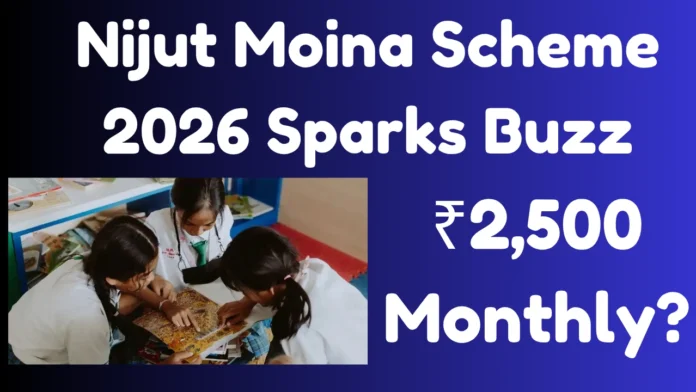
The Nijut Moina Scheme 2026 officially called Mukhya Mantrir Nijut Moina Aasoni has re-entered public conversation after Assam Chief Minister Dr. Himanta Biswa Sarma rolled out an expanded version of the initiative on 28 February 2026, announcing that 2.5 lakh females had already benefited under earlier phases and that the programme would now extend to a significantly larger cohort.
The scheme provides direct benefit transfer (DBT) monthly stipends ranging from ₹1,000 for Higher Secondary students to ₹2,500 for postgraduate students, with no income ceiling making it one of the few state-level girls’ education stipend programmes in India accessible to students from all economic backgrounds. The state government targets over 3.5–4 lakh girl students in the current 2025–26 academic year, more than double the 1.6 lakh beneficiaries covered in the first phase.
What Nijut Moina Scheme 2026 Actually Offers
The scheme delivers financial assistance on a per-month basis for 10 months of the academic year, meaning the annual credit per student corresponds directly to the monthly stipend multiplied by ten. The amounts vary by level of study and are structured as follows:
| Level of Study | Monthly Stipend | Annual Total (10 months) |
| Class 11 (Higher Secondary Year 1) | ₹1,000 | ₹10,000 |
| Class 12 (Higher Secondary Year 2) | ₹1,000 | ₹10,000 |
| Undergraduate (3-year or 4-year degree) | ₹1,250 | ₹12,500 |
| Postgraduate (MA, M.Com, M.Sc) | ₹2,500 | ₹25,000 |
| B.Ed (Bachelor of Education) | ₹2,500 | ₹25,000 |
The government transfers all amounts directly to the student’s Aadhaar-linked bank account through DBT, eliminating intermediaries and ensuring that the money reaches the beneficiary without deduction.



Who Is Eligible: and Who Is Not
The Nijut Moina Scheme 2026 carries deliberately broad eligibility to maximise coverage among Assam’s girl student population. The primary conditions are straightforward and do not include an income ceiling, distinguishing this scheme from most central government scholarships.
Eligible criteria include:
- Girl students enrolled in Class 11, graduation first year, postgraduation first year or B.Ed first year in a government or provincialised (government-aided) institution in Assam
- The student must be a permanent resident of Assam, confirmed through domicile documents
- Students from all castes, religions and economic backgrounds qualify — no income bar applies
Who is excluded:
- Students enrolled in private unaided institutions do not qualify; the scheme covers only government and government-aided colleges and schools
- Students who already receive a government salary, pension or similar regular financial support from the state or central government are excluded
- Students enrolled in correspondence or distance education programmes — not publicly confirmed as included; official clarification is awaited
The Core Purpose: Tackling Child Marriage and Dropout Rates
Assam recorded one of India’s highest rates of child marriage for years, with the 2011 Census and subsequent NFHS surveys showing significant numbers of girls married before age 18 in districts such as Dhubri, Barpeta and Morigaon.
The Nijut Moina scheme directly attacks the economic driver of this phenomenon: families that cannot afford to keep daughters in education after Class 10 often arrange early marriages instead. By providing a guaranteed monthly income to the girl student herself not a lump-sum to the family the scheme creates an individual financial incentive for girls to stay enrolled and resist early marriage pressure.
Chief Minister Himanta Biswa Sarma has cited the scheme as a key component of Assam’s stated goal of eliminating child marriage by 2026, a target that aligns the educational stipend with the state’s broader legal enforcement drive against underage marriages.
Nijut Moina 2.0: What Changed From Phase 1
The original Mukhya Mantrir Nijut Moina Aasoni launched in June 2024 covered approximately 1.6 lakh girl students in its inaugural phase. The Nijut Moina 2.0 version, formally launched at Gauhati University in August 2025 and expanded further in February 2026, made three significant changes:
- Coverage expansion: The 2.0 phase targets over 4 lakh girl students, compared to 1.6 lakh in the first cycle
- B.Ed inclusion: Bachelor of Education students now qualify at the ₹2,500 per month rate, bringing teacher training programme enrollees into the scheme for the first time
- Broader institutional reach: Awareness and application form distribution now happens simultaneously across all 35 Assam districts at the time of launch, rather than being Guwahati-centric
The total government expenditure on the scheme stands at approximately ₹260 crore for over 5 lakh girls in the current expanded cycle, with projections of ₹1,500 crore over a five-year period.
How to Apply for Nijut Moina Scheme 2026
Applications for the Nijut Moina scheme submit through the student’s own educational institution rather than a separate government portal in most cases. The process works as follows:
- Collect the application form from your school or college administration, or download it from the Assam Higher Education Department portal at highereducation.assam.gov.in
- Fill in personal details including name, date of birth, Assam domicile information, Aadhaar number and enrolled course details
- Attach supporting documents: Aadhaar card, institution enrollment certificate, bank account passbook (Aadhaar-linked), passport-size photograph and domicile/residential proof
- Submit to the institution’s nodal officer, who compiles and forwards the batch submission to the Directorate of Higher Education, Assam
- DBT credit arrives in the student’s bank account after institutional verification; the first instalment typically releases within 60–90 days of the academic year beginning
Not publicly disclosed is the specific application deadline for the 2026–27 academic cycle; students should check with their institution’s administrative office for the current submission window.

