

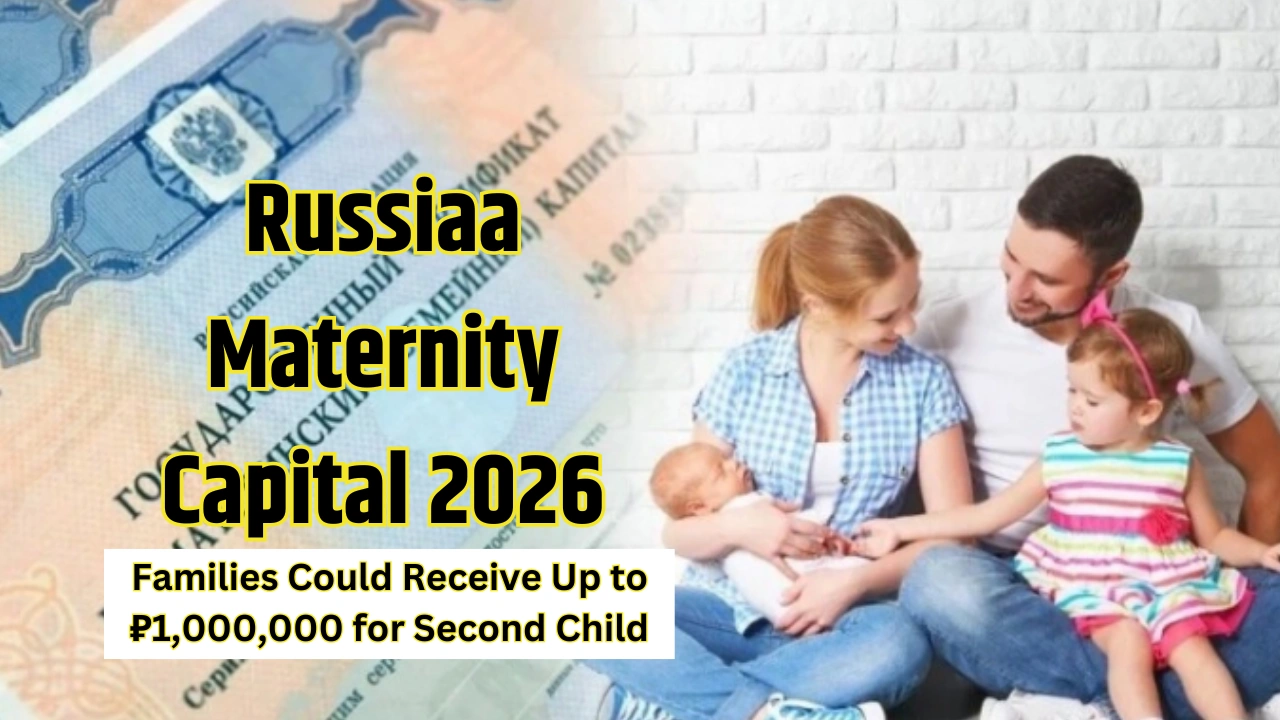
Russia’s federal maternity capital programme has expanded its payment structure for 2026, with eligible families now able to receive a combined total of up to ₽1,000,000 in state support for the birth or adoption of a second child, as the Kremlin intensifies efforts to reverse the country’s declining birth rate.
Russia Maternity Capital 2026: The Key Numbers Families Must Know
Russia Maternity Capital 2026 marks a significant milestone in the country’s family support policy, with payment amounts reaching their highest levels since the programme launched in 2006. The Russian government indexes these payments annually against inflation, ensuring the real value of the benefit keeps pace with rising living costs.
For 2026, families receive ₽676,398 for a first child born or adopted on or after 1 January 2020. The additional payment for a second child pushes the total cumulative support to approximately ₽1,000,000, depending on regional top-ups and supplementary programmes.
How the Payment Structure Works for First and Second Children
The maternity capital programme operates on a tiered structure that rewards families who have a second child after already claiming support for their first. A family that did not claim maternity capital for their first child can receive the full combined amount upon the birth of their second child.
Reports suggest the government structured the payments this way to maximise the incentive for families to have a second child specifically. The lump sum does not transfer as cash directly to the parents but instead credits to a state-issued certificate redeemable for approved purposes.
What Families Can Actually Spend the Money On
The Russian government restricts how families use maternity capital funds to ensure the money benefits children directly. Approved uses include:
- Housing: Purchase, construction, or renovation of residential property, including mortgage repayment
- Education: Payment of tuition fees for any family member at accredited Russian educational institutions
- Mother’s pension: Contribution to the mother’s funded pension account to improve long-term retirement security
- Child rehabilitation: Payment for goods and services that help children with disabilities integrate socially and improve quality of life
- Preschool childcare: Payment for nursery and early childhood education services from the child’s birth
Families can split the certificate amount across multiple approved categories rather than spending it all in one area.
Regional Top-Ups Push Total Support Even Higher
Beyond the federal maternity capital payment, many Russian regions offer their own additional lump sums to families with two or more children. These regional payments vary significantly across the country’s 85 federal subjects.
Reports suggest some regions in Siberia and the Far East offer supplementary payments of up to ₽200,000 on top of the federal amount, as part of government strategies to boost population growth in underdeveloped areas. Families living in these regions can stack federal and regional benefits, pushing total support well above the ₽1,000,000 figure.
Who Qualifies for Russia Maternity Capital in 2026
The programme targets a defined group of Russian citizens. Eligibility criteria include:
- Russian citizenship held by the mother at the time of the child’s birth or adoption
- The child born or adopted on or after 1 January 2007 for second and subsequent children, or on or after 1 January 2020 for first children
- The family has not previously received a federal maternity capital certificate for the same child
- Both biological births and legally completed adoptions qualify under the programme rules
Fathers can claim maternity capital in specific circumstances, including cases where the mother has died, lost parental rights, or committed a crime against her children.
How to Apply Through the Pension Fund of Russia
The Pension Fund of Russia (SFR — Social Fund of Russia following the 2023 merger) manages all maternity capital applications. The application process has become significantly more streamlined in recent years.
Families can now apply through the following channels:
- The Gosuslugi (State Services) online portal at gosuslugi.ru
- Any MFC (Multifunctional Centre) service office in person
- Directly through a branch of the Social Fund of Russia
For births registered through maternity hospitals connected to the digital birth registration system, the Social Fund automatically issues the certificate without requiring a separate application. Not publicly disclosed is the exact percentage of births currently processed through this automatic system.
The Broader Demographic Context Driving the Policy
Russia recorded a birth rate of approximately 9 births per 1,000 people in recent years, one of the lowest figures in the country’s modern history. The government views maternity capital as a central tool in its demographic strategy alongside tax incentives, housing subsidies, and expanded parental leave entitlements.
President Putin has repeatedly referenced the maternity capital programme in public addresses as evidence of the state’s commitment to supporting Russian families. Reports suggest the government plans further indexation of the payment amounts beyond 2026 to maintain the programme’s real-terms value.
FAQs: Russia Maternity Capital 2026
Q: Can foreigners living in Russia claim maternity capital?
No. The programme requires Russian citizenship. Foreign nationals and stateless persons do not qualify for federal maternity capital payments.
Q: Does maternity capital expire if not used?
No. The certificate does not carry an expiry date. Families can hold it indefinitely and redeem it when they choose, provided they use it for an approved purpose.
Q: Can maternity capital be used as a deposit on a mortgage?
Yes. Using maternity capital as a mortgage down payment or to repay an existing home loan is one of the most common uses of the benefit across Russia.
Q: What happens to the certificate if the mother dies before using it?
The father or the children themselves can inherit the right to use the certificate, subject to legal procedures through the Social Fund of Russia.
Q: Is maternity capital taxable income in Russia?
No. Maternity capital payments are exempt from personal income tax under Russian federal law.