

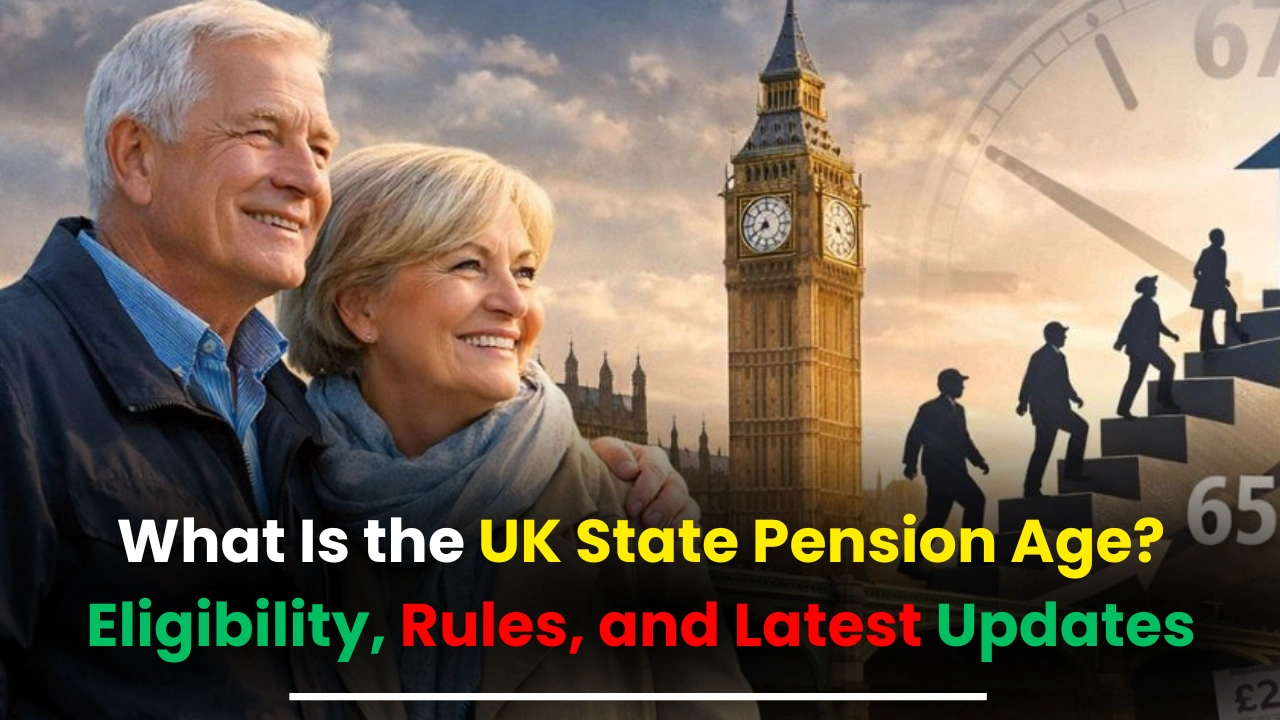
The UK State Pension age of 66 applies to both men and women as of April 2026, meaning anyone born before April 6, 1960 has already reached State Pension age and can claim their entitlement from the Department for Work and Pensions (DWP).
For those born after that date, the goalposts are actively shifting the phased increase to 67 is already in progress and will affect anyone born between April 6, 1960 and April 5, 1977, while a further rise to 68 remains legislated for those born from April 6, 1977 onwards, subject to future parliamentary review. Understanding exactly where your birth date places you in this schedule is one of the most important financial calculations any UK worker can make.
Current State Pension Age: Who Gets It at 66 Right Now
As of April 2026, individuals born on or before April 5, 1960 have already reached their State Pension age of 66 and can claim the New State Pension or the basic State Pension depending on their National Insurance record.
Men born before April 6, 1951 and women born before April 6, 1953 receive the basic (old) State Pension a different, older scheme rather than the New State Pension introduced on April 6, 2016. Everyone else in the eligible age group receives the New State Pension, currently set at a maximum of £221.20 per week (for 2024–25), with the 2025–26 rate uprated by the triple lock.
Reaching State Pension age does not mean you must stop working. You can continue in employment and simultaneously receive your State Pension though the pension is treated as income for tax purposes and combined with earnings may push you into higher tax bands.
The Rise to 67: Who Is Affected and When
The State Pension age is actively rising to 67 in a phased process that runs from April 2026 to April 2028. Anyone born between April 6, 1960 and April 5, 1977 falls into this transitional zone and will reach their State Pension age somewhere between 66 and 67, depending on their exact birth date.
The simplest way to understand this: the later in this window your birthday falls, the closer your pension age is to 67. If you were born in, say, October 1961, your State Pension age will be approximately 66 years and several months not a clean 66 or 67. The DWP provides an online State Pension age calculator at gov.uk/state-pension-age where you can enter your exact date of birth and receive your precise pension age and earliest claim date.
The Planned Rise to 68: What Current Workers Need to Know
Under current legislation, the State Pension age will rise further to 68 in a phased process between 2044 and 2046, affecting those born from April 6, 1977 onwards. However, this schedule remains subject to review. The government has commissioned two independent reviews of the State Pension age since 2017, and reports suggest that an acceleration of the rise to 68 potentially moving it forward to the late 2030s remains under active political discussion.
Not publicly disclosed is whether the current Labour government under Prime Minister Keir Starmer will announce a formal review during 2026. Any decision to accelerate the rise to 68 would require primary legislation and a vote in Parliament, giving workers and trade unions a formal opportunity to respond before implementation.
How Many National Insurance Years You Need
Reaching State Pension age entitles you to claim — but the amount you receive depends entirely on your National Insurance (NI) record. The rules for the New State Pension are:
| NI Years | State Pension Entitlement |
| Fewer than 10 qualifying years | No State Pension at all |
| 10–34 qualifying years | Partial State Pension (pro-rata) |
| 35 qualifying years or more | Full New State Pension (£221.20/week for 2024–25) |
A qualifying year is one in which you paid or were credited with NI contributions through employment, self-employment, NI credits from caring responsibilities, child benefit claims, or unemployment benefit. Gaps in your NI record from periods of low earnings, self-employment breaks or time abroad can reduce your State Pension significantly. You can check your NI record and forecast State Pension amount at gov.uk/check-state-pension.
Filling NI Gaps: The Voluntary Contributions Window
Workers with gaps in their NI record can pay voluntary Class 3 National Insurance contributions to fill missing years and boost their eventual State Pension. The government previously allowed back-filling of gaps going back to 2006, but that extended window closed in April 2025. From April 2025 onwards, you can generally only fill gaps from the past six tax years.
The cost of one voluntary NI year is £824.20 (Class 3 rate for 2025–26), which adds approximately £6.32 per week to your State Pension permanently equivalent to an annual income boost of £328.64. If you live for 20 years in retirement, a single £824 contribution generates over £6,500 in additional pension income. The return makes voluntary NI contributions one of the most financially efficient retirement planning tools available to UK workers.
Deferring Your State Pension: How It Works and What You Gain
You do not have to claim your State Pension as soon as you reach State Pension age. Deferring delaying your claim increases the weekly amount you eventually receive. Under current rules, your State Pension grows by approximately 1% for every nine weeks you defer, equating to roughly 5.8% for every full year of deferral.
For a worker entitled to the full £221.20 per week, deferring by one year would increase the weekly pension to approximately £233.93 an additional £12.73 per week or £662 annually, paid for life. Deferral makes financial sense if you remain in good health, continue working and do not need the pension income immediately. It makes less sense if you have health concerns that may shorten your retirement horizon.
Pension Credit: The Top-Up for Lower-Income Pensioners
State Pension age also marks eligibility for Pension Credit, the means-tested benefit that tops up weekly income to a minimum threshold. From April 2025, the Pension Credit standard minimum guarantee is £218.15 per week for a single person and £332.95 per week for couples.
Reports suggest over 800,000 eligible pensioners currently do not claim Pension Credit a significant underuse of a benefit that also unlocks eligibility for Housing Benefit, Council Tax Reduction, free TV licences (for those over 75) and the Warm Home Discount.
Pensioners can check eligibility and claim Pension Credit at gov.uk/pension-credit or by calling 0800 99 1234 (freephone, Monday to Friday, 8am to 6pm).