

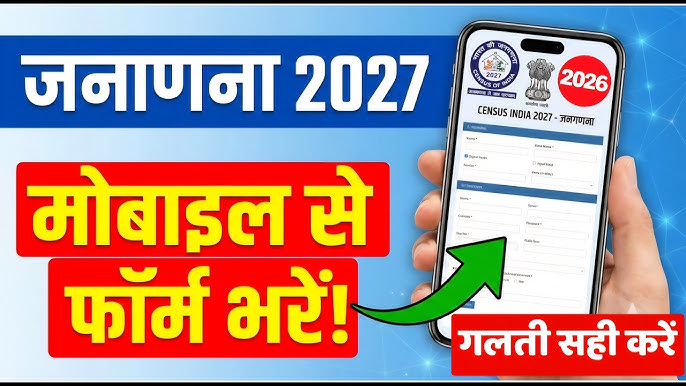
The self enumeration census 2026 marks a defining shift in how India counts its population, allowing citizens across the country to record their own household and personal data through a government-approved digital platform for the first time. The census, officially administered by the Office of the Registrar General and Census Commissioner of India (ORGI) under the Ministry of Home Affairs, was delayed from its originally scheduled 2021 cycle due to the COVID-19 pandemic. The 2026 exercise is the first census conducted entirely through digital infrastructure.
What Is the Self Enumeration Census 2026?
The self enumeration census 2026 is a process by which Indian households voluntarily fill in their own census data before enumerators conduct official verification visits. Citizens use a dedicated mobile application or the official web portal to submit details about their household size, housing conditions, education, occupation, and other demographic markers. This reduces the burden on field enumerators and improves data accuracy at the point of entry.
The self-enumeration window runs as a defined phase within the broader two-phase census operation — the Housing Listing and Housing Census phase, followed by the Population Enumeration phase. Reports suggest the self-enumeration portal opened to the public in early 2026, with the official mobile application available on both Android and iOS platforms.
How to Complete the Self Enumeration Census 2026 Online
The self enumeration census 2026 process follows a straightforward digital workflow for all eligible households:
- Download the Census of India official mobile app or visit the designated web portal
- Register using your mobile number linked to Aadhaar or a valid government ID
- Enter your House Listing details — structure type, ownership, amenities, and number of rooms
- Fill in individual household member data — name, age, gender, education, and occupation
- Submit the completed form and save the acknowledgment number for future reference
Citizens who face difficulties with the digital process can approach their local enumerator or designated Common Service Centre (CSC) for assisted self-enumeration support.
What Information Does the Self Enumeration Census 2026 Collect?
The self enumeration census 2026 collects data across two broad categories: household-level information and individual-level demographic details. Household data includes the type of building, number of dwelling rooms, source of drinking water, fuel used for cooking, access to a toilet, and ownership of assets such as mobile phones, televisions, and vehicles.
Individual-level data captures each person’s name, relationship to the head of household, date of birth, age, marital status, religion, mother tongue, educational attainment, and primary occupation. This data feeds directly into national planning decisions on housing, infrastructure, healthcare, and public service delivery at both state and district levels.
Self Enumeration Census 2026: Why It Matters for India
The self enumeration census 2026 serves as the foundational data source for updating the Socio-Economic and Caste Census (SECC), revising delimitation of parliamentary and assembly constituencies, and recalibrating central government fund allocations to states. Accurate census data determines the distribution of resources under major schemes including the National Food Security Act, the Pradhan Mantri Awas Yojana, and rural employment programs.
India last conducted a full census in 2011, meaning the country has operated on 15-year-old population data for much of its policy planning cycle. The 2026 census aims to close that data gap with real-time digital inputs.
Official Portals and Helpline for Self Enumeration Census 2026
| Resource | Details |
|---|---|
| Official Web Portal | censusindia.gov.in |
| Mobile App | Census of India (Android & iOS) |
| National Helpline | Reports suggest a dedicated toll-free number will be notified |
| Common Service Centres | Available in all districts for assisted enumeration |
| Acknowledgment | Digital receipt issued post-submission |
The Ministry of Home Affairs has urged all households to participate in the self enumeration census 2026 phase before field enumerators begin door-to-door verification visits. Participation is mandatory under the Census Act, 1948, and non-compliance may attract provisions under the Act.
Self Enumeration Census 2026: Languages and Accessibility
The self enumeration census 2026 portal and mobile application support all 22 scheduled languages listed under the Eighth Schedule of the Indian Constitution. Visually impaired users can access the portal through a screen-reader compatible version, and audio guides are available in regional languages within the app. The government has also deployed over 30 lakh trained field enumerators and supervisors nationwide to assist citizens who do not have access to smartphones or stable internet connectivity.
Reports suggest special self-enumeration support camps have been organized at gram panchayat offices, post offices, and government school premises in rural and remote areas across the country. Migrant workers and persons living in temporary shelters may self-enumerate at their current place of residence and update their permanent address in a secondary field provided on the form.