

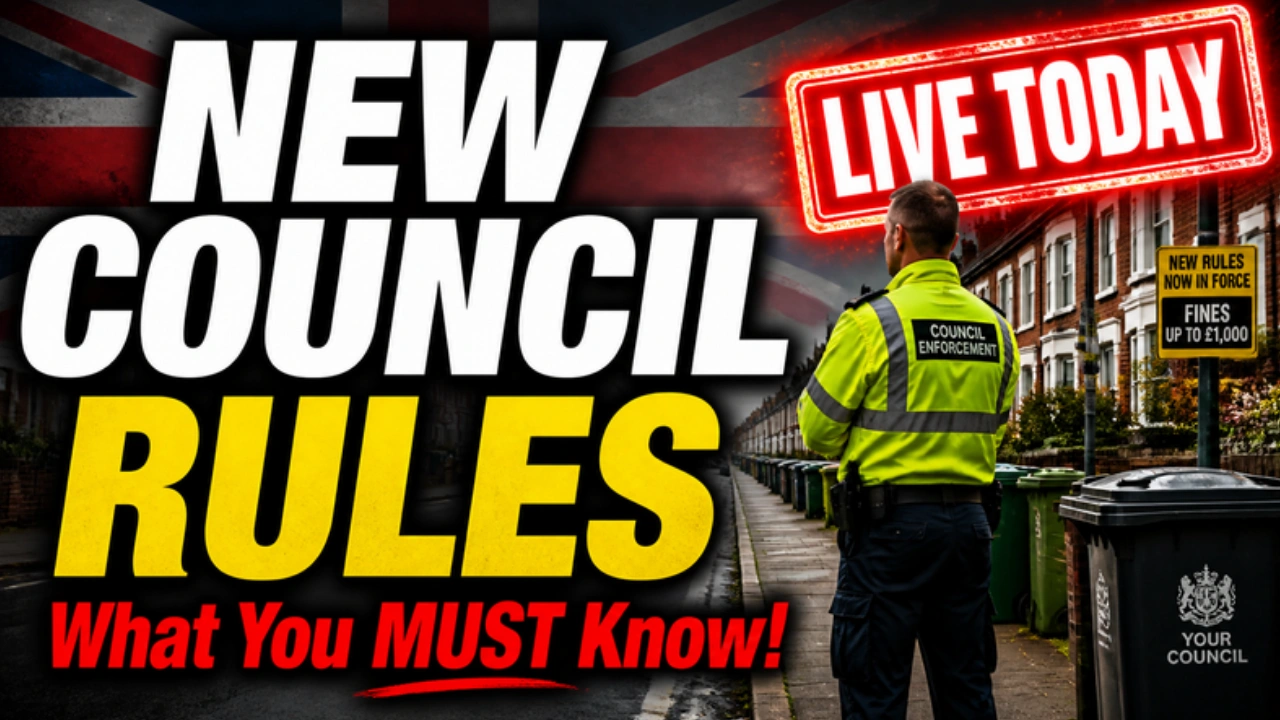
Change in Britain rarely arrives with fanfare. It doesn’t flash across your phone screen with a breaking news alert. It doesn’t interrupt your Saturday morning. It simply… begins. And today, across hundreds of local councils in England, Wales, and Scotland, a fresh wave of rules, charges, and enforcement powers has officially come into force.
From garden waste collection fees to stricter parking enforcement, from short-term rental regulations to updated planning permission thresholds — the landscape of everyday civic life in the UK shifted this morning, and millions of residents have absolutely no idea. That ends now. Here is everything you need to understand, and more importantly, everything you need to do about it.
The Rules That Changed Overnight
Local councils across the UK have been granted expanded powers and updated regulatory frameworks in 2026, many of which took effect in the current spring cycle. These are not minor administrative tweaks buried in footnotes. These are real, enforceable changes that touch the lives of ordinary people every single day.
Here is what is now live:
- Garden waste collections — dozens of councils have introduced or increased annual subscription charges, some rising to £75–£100 per year. If you haven’t paid, your green bin will no longer be collected — and leaving it out could result in a littering penalty.
- Short-term let licensing — landlords renting properties through Airbnb and similar platforms in designated areas must now hold a valid council licence. Operating without one carries fines of up to £2,500.
- Pavement parking enforcement — following the rollout of updated guidance, more councils now have the authority to issue Penalty Charge Notices (PCNs) to vehicles parked fully or partially on pavements.
- Planning permission thresholds — certain home extensions, outbuildings, and solar panel installations that previously fell under permitted development now require formal council approval in Article 4 Direction zones.
- Fly-tipping fixed penalties — the minimum fixed penalty for fly-tipping has increased, with councils now empowered to issue on-the-spot fines of up to £1,000 without court involvement.
What Homeowners Must Know Right Now
If you own your home, today’s changes carry specific weight. The updated planning rules mean that what your neighbour built in their garden last year without permission may no longer be something you can legally replicate. Before you book a builder or order materials, you must check whether your property falls within an Article 4 Direction zone — a designation that strips away many permitted development rights that most homeowners take for granted.
Additionally, the garden waste subscription changes mean your council tax payment no longer automatically covers green bin collection in many areas. You may have been paying into a service that quietly stopped last month. Check your council’s website today, not tomorrow.
What Renters Need to Act On Immediately
Renters are not off the hook. In fact, for those living in urban areas particularly, the new short-term let licensing rules carry an indirect but significant consequence. Landlords who fail to obtain the required licence may be forced to withdraw properties from the rental market entirely, reducing availability in already squeezed local housing stocks.
But more immediately — if your landlord is renting out part of a shared property on Airbnb without a licence, you could find yourself living in a property under council investigation. Know your rights, and know your landlord’s obligations.
The Parking Rules That Will Catch People Off Guard
Perhaps the most immediately impactful change for the average resident is the expanded pavement parking enforcement now active in multiple council zones. Millions of UK drivers have parked on pavements for decades without consequence — it was an accepted grey area on residential streets nationwide. That grey area is now shrinking fast.
Councils equipped with new enforcement powers are actively deploying civil enforcement officers and camera cars to identify violations. A single PCN for pavement parking can cost £70 — rising to £105 if not paid within 14 days. Multiply that across a week of school runs and supermarket trips, and you are looking at a significant and entirely avoidable expense.
How to Check What’s Changed in Your Specific Area
The critical thing to understand about UK council rules is that they are not uniform. What applies in Manchester may not apply in Bristol. What is enforced in Edinburgh may not yet be active in Cardiff. Every resident must check their own local council’s website for the specific rules now in force in their postcode.
Here is exactly what to do today:
- Go to gov.uk/find-local-council — enter your postcode and find your specific local authority
- Check the waste and recycling section — confirm whether garden waste is still included in your council tax or requires a paid subscription
- Search “Article 4 Direction” + your area — find out if your home falls within a restricted planning zone
- Read the parking enforcement update — confirm whether pavement parking penalties are now active on your street
- Check short-term let licensing requirements — essential if you rent out any part of your home, even occasionally
This takes twenty minutes. The cost of not doing it could be considerably higher.
Why Councils Are Tightening the Screws in 2026
It would be easy to frame all of this as councils simply looking for new ways to extract money from residents — and political critics have not been shy about making exactly that argument. But the broader context tells a more complicated story.
UK councils are operating under severe financial pressure in 2026. A combination of rising demand for adult social care, inflation-driven cost increases, and constrained central government funding has left dozens of local authorities teetering on the edge of effective bankruptcy. Expanded enforcement powers and new charging structures are, in many cases, a direct consequence of councils desperately trying to balance books that simply do not add up.
That does not make the fines any less real. But it does explain why the pace of change has accelerated so sharply this year — and why more rules, not fewer, are almost certainly coming.
Final Thought
The new UK council rules that went live today are not designed to trap good, attentive residents. They are designed to generate compliance, revenue, and order in a civic environment that has become increasingly strained. But good intentions at the policy level offer zero protection at the enforcement level.
The residents who will feel the pain of these changes are not the ones who ignored warnings deliberately — they are the ones who simply didn’t know. Who assumed that nothing had changed. Who figured they’d look into it next week.
There is no next week on a penalty notice. There is only the date it was issued, and the date your discount period expires.
So do the twenty-minute check. Read your council’s updates. Adjust what needs to be adjusted. Because the rules are live today — and the enforcement machinery moves faster than most people ever expect.