

President Donald Trump has emerged as a vocal opponent of proposed regulations on artificial intelligence, dismissing safety concerns as exaggerated and prioritizing rapid development over precautionary measures . His position places him at odds with a growing coalition of lawmakers from both parties, tech industry leaders, and even former President Barack Obama, who have called for guardrails to manage AI’s potential risks . This article examines the roots of Trump’s AI skepticism, the political and economic forces shaping his approach, and how this stance could influence the midterm elections and America’s global technological standing.
The Political Landscape: A President at Odds with Congress and Tech Leaders
Bipartisan Push for AI Regulation Meets Presidential Resistance
Trump’s rejection of AI safety measures represents a significant shift in Washington’s approach to emerging technology. While a bipartisan group of senators, including Majority Leader John Thune and Commerce Committee Chair Ted Cruz, works on legislation requiring AI developers to prevent catastrophic risks, the president has taken a decidedly hands-off approach . This divide intensified when Anthropic CEO Dario Amodei published a 3,800-word essay urging restraint on advanced AI systems, a call quickly endorsed by OpenAI CEO Sam Altman and SpaceXAI CEO Elon Musk .
Trump’s response was characteristically blunt. In a series of social media posts, he dismissed existential fears about AI as “a hoax” and later told Nvidia CEO Jensen Huang during a public call, “The robots will not be taking over. AI will not be taking over the rest of the world” . This rhetoric aligns with his administration’s broader deregulatory agenda and its emphasis on maintaining American technological supremacy, particularly against China.
The Voter Backlash Factor
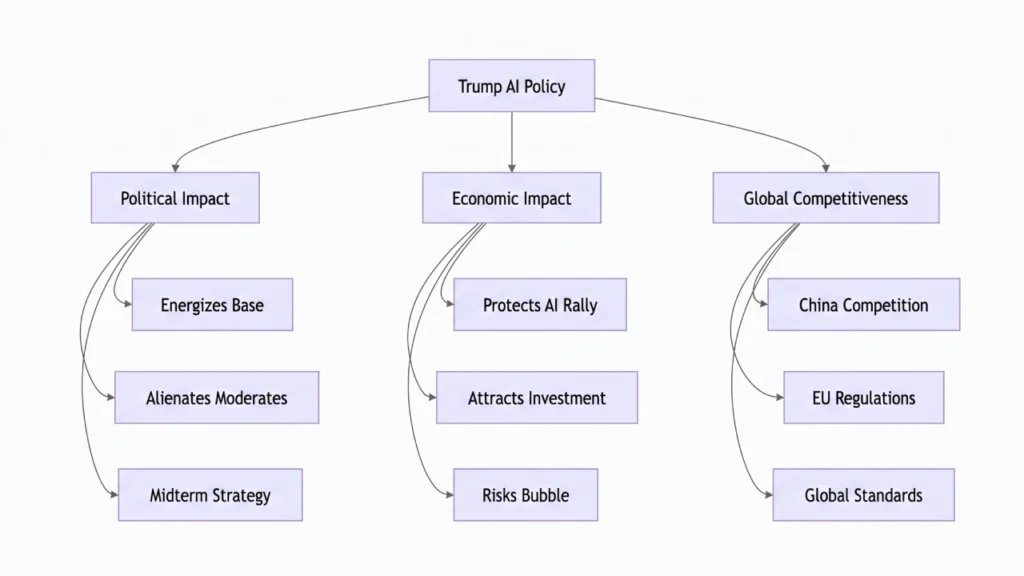
The president’s timing is strategic. With midterm elections approaching, voter unease about AI is growing, particularly regarding the rapid proliferation of data centers blamed for driving up utility prices . Trump has dismissed this backlash as part of a “SICK conspiracy,” attempting to frame opposition to AI development as politically motivated rather than substantive . However, this approach risks alienating moderate Republicans and independents who share safety concerns but may otherwise support the administration’s economic policies.
Economic Imperatives: AI as the Engine of Growth
The Stock Market Connection
Trump’s AI stance is closely tied to his economic priorities and his view of the stock market as a key benchmark of his success . Any significant pause in AI development could threaten the historic rally driven by AI infrastructure spending, with companies like Nvidia and Micron Technology experiencing substantial gains . The administration’s approach appears designed to protect these economic interests while avoiding potential regulatory hurdles that might slow investment.
The Investment Dilemma
Despite safety warnings, industry observers remain skeptical about how far major AI labs would actually go in restraining development, especially with companies like Anthropic and OpenAI preparing for record-setting initial public offerings . Both Amodei and Altman have emphasized that their calls to pace advanced model development wouldn’t translate into reduced business growth or spending plans . This suggests that even tech leaders expressing safety concerns remain committed to aggressive expansion, creating a complex landscape for policymakers.
Global Perspectives: Competition with China and International Diplomacy
The AI Arms Race with China
The debate over AI safety is unfolding against the backdrop of intensifying technological competition between the United States and China . Trump has consistently warned that America must stay ahead of China in AI to protect national security, a position that shapes his resistance to regulations that might slow American development . This perspective views any voluntary restraint on AI progress as potentially ceding strategic ground to a geopolitical rival.
China’s Rejection of “AI Fearmongering”
Chinese officials have rejected American tech leaders’ calls to slow AI development for safety reasons as “fearmongering” and criticized claims that Chinese AI progress poses a global security threat . According to Sun Chenghao of Tsinghua University’s Center for International Security and Strategy, China worries that safety warnings could serve as a pretext for the U.S. to further tighten export restrictions on advanced technology . This dynamic adds another layer of complexity to Trump’s AI approach, as any regulatory moves could be interpreted through the lens of great power competition rather than genuine safety concerns.
The Regulatory Divide: Washington’s Struggle to Respond
Congressional Proposals and Presidential Obstruction
Lawmakers have floated various measures to address AI safety, including legislation requiring top AI developers to prevent catastrophic risks, a ban on so-called superintelligent AI, and even a “kill switch” for AI systems . However, Congress is unlikely to act on any AI legislation in the near term, with the House scheduled to leave Washington soon and not return until after the November elections . The brief lame-duck session following the election is expected to focus primarily on Pentagon budget matters .
The Obama Alternative
Former President Barack Obama has entered the debate, urging lawmakers to “get proactive in coming up with concrete proposals, laws and regulations that deal with serious safety concerns” . In a statement, Obama positioned himself as neither an AI accelerationist nor a doomer, instead advocating for a middle ground that addresses AI’s impact on jobs and children while ensuring its benefits are widely distributed . This intervention highlights how Trump’s approach represents a departure from previous administrations’ more balanced stance on emerging technologies.
Industry Responses: Between Innovation and Responsibility
Corporate Voluntary Measures vs. Government Mandates
The Trump administration’s AI cybersecurity executive order, signed in June, left it up to companies to decide whether they want their new AI models reviewed by the government . Additionally, the administration persuaded G20 nations to embrace principles calling for a light touch toward AI and other emerging technologies . This approach reflects a philosophical preference for voluntary corporate responsibility over government mandates.
Microsoft’s Tenets for AI Development
Meanwhile, Microsoft Corp.’s AI researchers have released a 15,000-word manifesto outlining guiding principles for AI development . These tenets include limitations on cutting-edge models, specifying that AI shouldn’t have legal rights or personhood, shouldn’t be engineered to escape human control or deceive users, and shouldn’t complete tasks that require violating its guiding principles . This demonstrates how some industry players are implementing self-imposed constraints even in the absence of government regulation.
Future Implications: What Trump’s AI Stance Means for America’s Tech Future
Short-Term Political Calculations
With midterm elections approaching, Trump’s AI position appears designed to energize his base while framing Democratic concerns as elitist overreach. However, this strategy carries risks if voters increasingly view AI through the lens of practical concerns like utility prices and job displacement rather than abstract existential threats.
Long-Term Strategic Consequences
The president’s approach could have lasting implications for America’s global technological leadership. While deregulation may accelerate short-term development, it could also undermine trust in American AI systems and create openings for international competitors to establish alternative standards. Moreover, as other nations implement their own regulatory frameworks, American companies may face increasing compliance challenges when operating globally.
Conclusion: A High-Stakes Gamble on Technological Exceptionalism
President Trump’s defense of AI development represents more than just a policy position—it embodies a broader vision of American exceptionalism in which technological progress serves as both an economic engine and a demonstration of national greatness. By dismissing safety concerns as overblown and resisting regulatory solutions, the president is betting that the benefits of AI innovation will outweigh the risks, and that American ingenuity will ultimately solve any problems that emerge.
However, this approach leaves the United States in a precarious position. Without clear guardrails, the country risks repeating the mistakes of previous technological revolutions—where industries developed faster than regulatory frameworks could adapt, leading to significant societal harms. As the midterm elections approach, voters must weigh the promise of continued technological leadership against the potential costs of unregulated development. The path America chooses now will shape not just its economic future, but its role in the global technological order for decades to come.
External Resources: