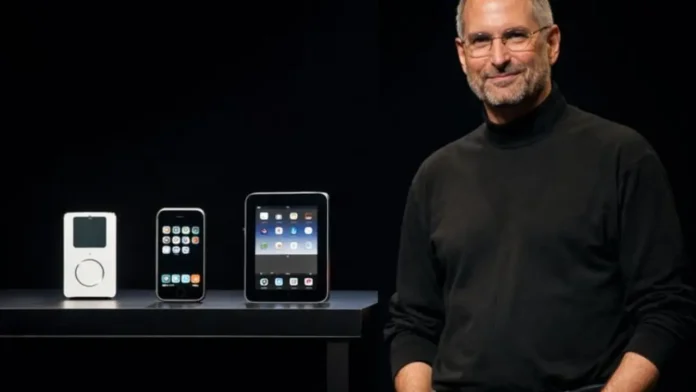
The Apple iPhone history is one of the boldest strategic decisions in modern business a story of a company that willingly destroyed its most profitable product to build something far greater, changing the technology industry forever in the process.
The Product Apple Chose to Kill: The iPod Era
Before the iPhone existed, Apple ran on iPod revenue. The iPod launched in October 2001 and quickly transformed Apple from a struggling computer company into a global consumer electronics powerhouse. By 2006, iPod sales and related services accounted for 50% of Apple’s total annual revenue, with profit margins sitting at approximately 40%.
The iPod dominated digital music through a seamless combination of hardware design, iTunes software, and the iTunes Music Store. Apple released 32 distinct iPod models across multiple product lines the Classic, Mini, Nano, Shuffle, and Touch. At its commercial peak, Apple sold approximately 22 million iPod units in a single quarter.
The Moment Steve Jobs Saw the Threat Coming
By 2005, Apple’s internal teams already identified the competitive risk that mobile phones posed to the iPod business. Mobile phone manufacturers had begun packing music players, cameras, and internet browsing into their handsets exactly the iPod’s core functions. Apple engineer Tony Fadell, who helped create the iPod, later confirmed that Apple studied prototypes combining a full-screen iPod with phone capabilities as early as 2005.



Steve Jobs famously responded to this threat with a direct philosophy: “If you don’t cannibalize yourself, someone else will.” Jobs understood that waiting for a competitor to make the iPod obsolete would cost Apple far more than doing it themselves. This single decision drove the internal project that eventually became the iPhone.
The Failed Motorola Experiment That Accelerated Everything
Apple did not immediately build its own phone. The company first partnered with Motorola in 2005 to launch the ROKR E1 the first mobile phone to run iTunes. The collaboration failed significantly. Motorola’s firmware artificially capped the ROKR at 100 songs to avoid competing with Apple’s own iPod Nano.
Jobs found the ROKR deeply unsatisfying and the partnership limiting. Apple discontinued ROKR support in September 2006 and redirected its full engineering resources toward building a proprietary phone. That decision ended Apple’s only attempt to work within another company’s hardware constraints and set the course for the iPhone.
January 9, 2007: The Day Apple iPhone History Changed Everything
Steve Jobs stood on the Macworld stage in San Francisco on January 9, 2007, and announced the iPhone as three products in one: a revolutionary mobile phone, a widescreen iPod with touch controls, and a breakthrough internet communications device. The original iPhone featured a 3.5-inch multitouch screen, a 2-megapixel camera, and started at $499 for the 4GB model with a two-year AT&T contract.
Critics initially called the price too high and questioned whether consumers would pay a premium for an unproven smartphone from a computer company. Apple proved those critics wrong. The iPhone went on sale in June 2007 and sold out at retail stores across the United States within hours of launch.
How the iPhone Systematically Replaced the iPod
The iPod did not die immediately after the iPhone launched. iPod sales actually peaked in 2008 one year after the iPhone’s debut. But the trajectory changed permanently from that point forward. Consumers who previously owned both an iPod and a basic phone simply chose the iPhone instead, eliminating the need for a separate music device entirely.
Apple’s revenue tells the clearest story of what happened next. The company generated $19.3 billion in total revenue in 2006, the year before the iPhone launched. By 2014, that figure reached $182.8 billion a nearly tenfold increase driven almost entirely by iPhone sales. Apple discontinued the last iPod model, the iPod Touch, in July 2017.
iPhone Evolution: From 2007 to Today
The iPhone has gone through nearly two decades of continuous reinvention since its 2007 debut. Each generation introduced features that redefined consumer expectations across the entire smartphone industry:
- iPhone 3G (2008) — Added App Store support and 3G connectivity, opening the platform to third-party developers
- iPhone 4 (2010) — Introduced the Retina Display and FaceTime video calling
- iPhone 4S (2011) — Launched Siri, Apple’s first voice assistant, and a dual-core A5 chip
- iPhone 6 (2014) — Brought larger 4.7-inch and 5.5-inch displays and Apple Pay via NFC
- iPhone X (2017) — Introduced Face ID, an all-screen OLED design, and eliminated the home button
- iPhone 12 (2020) — Delivered 5G connectivity across the entire iPhone lineup
- iPhone 15 Pro (2023) — Added a titanium frame and an Action Button, replacing the mute switch
The Business Lesson That Still Applies Today
Apple’s decision to replace the iPod with the iPhone represents one of the most studied cases of deliberate self-disruption in business school curricula globally. The company chose short-term revenue risk over long-term irrelevance and that single choice multiplied Apple’s total valuation by more than 50 times over the following decade.
Kodak faced the same crossroads with digital photography and chose to protect its film business instead. The result was bankruptcy. Apple chose the opposite path, and the Apple iPhone history became a permanent case study in why the most dangerous competitor a market leader faces is often itself.

