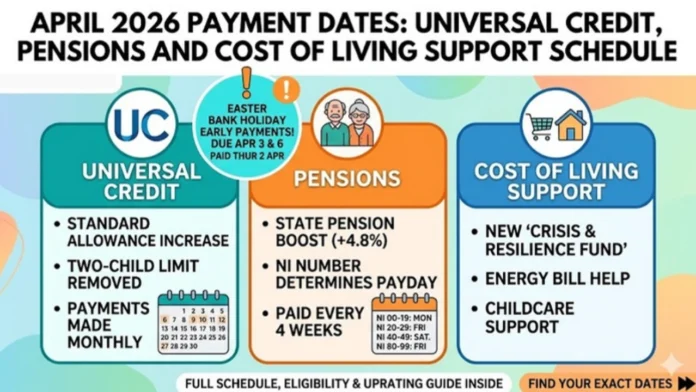
The April 2026 payment dates for millions of UK benefit recipients carry two key changes — a shift in schedule due to Easter bank holidays and a substantial rise in benefit rates from the start of the new financial year. The Department for Work and Pensions (DWP) confirms that anyone expecting a payment on Good Friday, 3 April, or Easter Monday, 6 April, received that money early on Thursday, 2 April. Around 24 million people currently receive some form of DWP support, including roughly 13.2 million state pension recipients and 10 million working-age claimants.
Easter Bank Holidays Shift Your Payment Day
Two bank holidays fall within the April 2026 payment cycle, directly affecting the dates when benefit payments land in recipients’ accounts. Good Friday (3 April) and Easter Monday (6 April) both fall within the DWP’s standard payment schedule, meaning anyone whose usual payment date falls on either of those days received their money on Thursday, 2 April instead.
The benefits affected by this Easter date shift include:
- Universal Credit
- State Pension
- Pension Credit
- Child Benefit
- Disability Living Allowance (DLA)
- Personal Independence Payment (PIP)
- Attendance Allowance
- Carer’s Allowance
No other payment dates in April change outside of these two bank holiday adjustments.
State Pension Rises 4.8% Under Triple Lock Guarantee
The State Pension increases by 4.8% from April 2026, in line with the annual earnings growth figure that drives the Triple Lock guarantee. The new full weekly rate for the New State Pension rises to £241.05, up from approximately £230 per week. This represents an above-inflation boost for pensioners, as inflation held at 3% in February 2026.
The State Pension pays directly into bank accounts every four weeks. The day of the week on which a pensioner receives payment depends on the last two digits of their National Insurance number:
- 00–19: Monday
- 20–39: Tuesday
- 40–59: Wednesday
- 60–79: Thursday
- 80–99: Friday
The same Easter bank holiday adjustment applies to pension payments due on 3 or 6 April — those moved to 2 April as well.
Universal Credit Rates: The Biggest Standard Allowance Jump in Years
Universal Credit claimants receive an above-inflation increase of approximately 6.2% to the standard allowance from April 2026 — the largest percentage rise to the standard rate in several years. For a single person aged 25 or over, the monthly rate rises from £400.14 to £424.90, an increase of around £6 per week. Couples with one or both partners aged 25 or over see their monthly payment rise from £628.10 to £666.97, equivalent to roughly £9 more per week.
New rates officially apply from 6 April 2026, the start of the new tax year. However, the timing of when individual claimants see the increase in their account depends on their personal assessment period. Claimants whose assessment period begins before 7 April must wait until their next cycle to receive the uprated amount — meaning some claimants may not see higher payments until May or June 2026.
LCWRA Health Element Cut for New Claimants
While the standard allowance rises, April 2026 also brings a significant cut to the health-related element of Universal Credit for new claimants. The monthly payment for the Limited Capability for Work and Work-Related Activity (LCWRA) element drops from £105 to £50 for anyone making a new claim from April 2026 onwards. This represents a reduction of more than £200 a month when calculated on an annualised basis.
Existing LCWRA recipients will not see a cut, but their rate is frozen until 2029 — meaning they receive no annual uprating during that period while all other benefit rates continue to rise. Reports suggest welfare organisations have raised serious concerns about the long-term impact of this freeze on households living with chronic illness or disability.
Most Other Benefits Rise by 3.8%
Benefits outside the Universal Credit standard allowance and the State Pension increase by 3.8% from April 2026, in line with September 2024’s inflation figure, which serves as the standard uprating benchmark. The uprated benefits include:
- PIP (Daily Living — Enhanced): £114.60 per week
- PIP (Daily Living — Standard): £76.70 per week
- Carer’s Allowance: £86.45 per week
- Maternity Allowance (Standard Rate): £194.32 per week
- Pension Credit (Single): £238.00 per week minimum
- Pension Credit (Couple): £363.25 per week minimum
- ESA (Single, 25 or over): £95.55 per week
New Crisis and Resilience Fund Launches This April
The government’s Crisis and Resilience Fund launches in April 2026, replacing two previous schemes — the Household Support Fund and Discretionary Housing Payments. Local councils now administer the fund directly, with two separate components: a crisis payment for households experiencing sudden financial shocks, and a housing payment for those facing rent-related shortfalls.
The crisis payment targets low-income households and does not restrict eligibility only to those already receiving benefits. The DWP instructs councils to take a cash-first approach, meaning direct cash payments to recipients rather than vouchers or goods, unless there is a specific reason to do otherwise.
The housing payment component specifically supports those in receipt of Housing Benefit or Universal Credit with a housing element. It covers costs such as rent-in-advance, rental deposits, and moving expenses — areas the old Discretionary Housing Payment scheme also addressed but with fewer formal guidelines.
Energy Bills Drop — But a Summer Rise Looms
Ofgem’s energy price cap falls to £1,641 per year for the April to June 2026 quarter — a reduction of approximately £117, or around 7%, compared to the previous quarter’s cap of £1,758. This brings some relief to households already managing tight budgets, though energy consultancy Cornwall Insight warns the cap could jump by as much as £300 for the July to September 2026 quarter, driven by ongoing instability in global oil markets linked to Middle East tensions.
Several major energy suppliers — including British Gas, EDF, E.ON, OVO, and Octopus Energy — offer hardship funds and social tariffs for households struggling to meet their bills. Eligible customers should contact their provider directly to check current eligibility thresholds.
No New Cost of Living Payment Confirmed for 2026
The DWP has made no announcement confirming a new Cost of Living Payment scheme for 2026. The previous scheme, which ran from 2022 to 2024, made its final payment to eligible households between 6 and 22 February 2024. Not publicly disclosed is whether any targeted cost of living support will be introduced later in the 2026–27 financial year.

