Bhuvan Geo Tags the location-tagging feature embedded within ISRO’s Bhuvan portal and its associated mobile applications have quietly become a ubiquitous data collection layer across dozens of Indian government programmes, from MGNREGS asset creation to PM Awas Yojana beneficiary verification, making them one of the largest operational geospatial citizen data systems in the country.
Reports suggest over 20 crore geo-tagged entries now exist in the Bhuvan database, compiled from government field workers, gram rozgar sevaks, urban local body officials and scheme beneficiaries who capture location-stamped photographs as proof of work or residency.
The scale of this data collection has prompted digital rights researchers and technology policy analysts to ask a pointed question: beyond confirming that a house was built or a road was dug, how much location intelligence do Bhuvan geo tags actually accumulate and under what rules does that data live?
What Bhuvan Geo Tags Actually Are
Bhuvan is a web-based geospatial platform developed and maintained by the National Remote Sensing Centre (NRSC) under the Indian Space Research Organisation (ISRO). It functions as India’s alternative to Google Earth for government use, combining satellite imagery, thematic maps and field data layers into a unified geospatial dashboard accessible to central and state government departments.




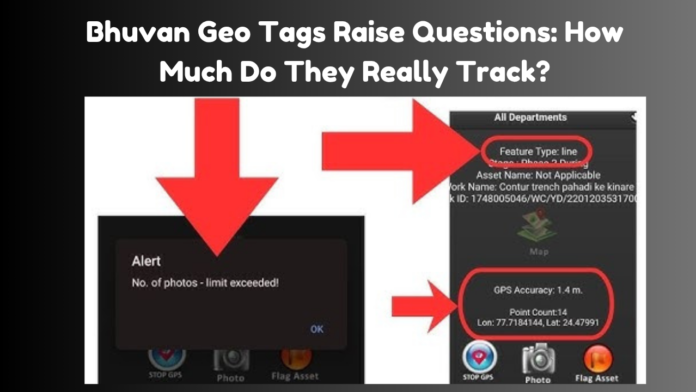
The geo-tagging component accessible via the Bhuvan mobile app allows field workers to take photographs that automatically embed GPS coordinates, timestamp, device ID and user ID into the image metadata before upload to the centralised server.
When a MGNREGS supervisor photographs a completed well or a PM Awas Yojana field verifier captures a house under construction, that photograph carries a precise latitude-longitude coordinate, the date and time of capture, and in many implementations, the mobile device’s unique IMEI number.
This metadata does not just confirm location it builds a longitudinal record of where specific government workers and beneficiaries are at specific times, over months and years of scheme operation.
The Scale of Data Collection Across Welfare Schemes
The Bhuvan geo-tagging infrastructure now spans multiple flagship central government programmes. MGNREGS (Mahatma Gandhi National Rural Employment Guarantee Scheme) uses it to verify asset creation at over 6 lakh gram panchayats. PM Awas Yojana both urban and gramin mandates geo-tagged photographs at every construction milestone for fund release.
The National Health Mission uses geo-tagged ASHAs and ANM visits for beneficiary tracking. The Swachh Bharat Mission required geo-tagged photographs of constructed toilets for ODF (Open Defecation Free) certification across every district. The combined data volume from these programmes runs into hundreds of millions of individual geo-tagged records annually.
Reports suggest that beyond the photograph and coordinate data, the Bhuvan backend also logs the network access point, upload IP address and session timing of each submission, creating a metadata trail that extends significantly beyond the primary photograph itself.
Privacy and Data Governance Concerns
The central concern raised by researchers is the absence of a clearly published, standalone data retention and access policy specific to the Bhuvan geo-tagging system. The Digital Personal Data Protection Act 2023 (DPDPA), which received presidential assent and is progressively being notified, establishes data minimisation, purpose limitation and storage limitation as foundational principles standards that the current Bhuvan data collection framework may need to demonstrate compliance with once the Act’s implementing rules are fully operational.
Not publicly disclosed is the specific retention period for geo-tagged photographs and associated metadata stored on Bhuvan servers, the access control protocols governing which state or central officials can query the database and whether any third-party analytics firms have access to the aggregated geospatial dataset for policy research purposes.
What Bhuvan’s Operators Say
NRSC positions the Bhuvan platform explicitly as a government efficiency and transparency tool, designed to eliminate fake muster rolls, ghost beneficiaries and inflated asset counts in welfare schemes. Officials from the National Informatics Centre (NIC) and NRSC have stated in public forums that geo-tagged verification has measurably reduced MGNREGS fund leakage, with irregularities in asset reporting falling by an estimated 18–22 percent in states that adopted mandatory geo-tagging between 2019 and 2023. ISRO has not publicly responded to specific queries about data retention duration, third-party data access or cross-scheme data linkage capabilities as of March 2026.
How Geo Tags Work Technically: Explanation
When a user opens the Bhuvan app and captures a photograph, the device’s GPS receiver records the current latitude and longitude coordinates to approximately 3–5 metre accuracy under open-sky conditions. This coordinate pair embeds directly into the image’s EXIF (Exchangeable Image File Format) metadata alongside the timestamp.
The app then transmits the image and its metadata to the NRSC server over an encrypted HTTPS connection, where it links to the user’s registered government employee or scheme ID. The result is not merely a photograph it is a spatial data point tied to a specific person, place and time, fully searchable and cross-referenceable within the Bhuvan GIS dashboard.
Who Can Access Bhuvan Geo-Tagged Data
The Bhuvan portal maintains multiple access tiers. Public users can access satellite imagery and thematic maps at a generalised resolution. Registered government departments receive scheme-specific dashboards showing geo-tagged data relevant to their programmes. Senior administrators at the district, state and central level access aggregated analytics.
What remains not publicly disclosed is the precise protocol for approving new departmental access requests, the audit log system for tracking who queried which beneficiary’s location data and whether judicial or law enforcement agencies can access individual-level geo-tag records without a formal data request procedure.
The Larger Question of Linked Geospatial Identity
The concern that digital rights researchers articulate most clearly is not about any single geo-tag, but about aggregation. A field worker who geo-tags MGNREGS assets for five years generates hundreds of location-time data points.
A PM Awas beneficiary photographed at multiple construction stages contributes their home address, construction timeline and neighbourhood coordinates to the database permanently. When this data links to Aadhaar as it does in most scheme workflows the result approaches what technologists term a “geospatial identity profile”: a persistent, government-held record of where a citizen is, has been and lives, cross-indexed with economic status, employment history and welfare dependency.
Reports suggest that the forthcoming DPDPA implementing rules will require government data fiduciaries including NRSC as a potential data fiduciary to publish retention schedules, purpose statements and grievance redressal mechanisms for all personal data processed. Whether Bhuvan’s geo-tagging operations will require a formal Data Protection Impact Assessment (DPIA) under the new framework is a question that official confirmation is awaited on.

