

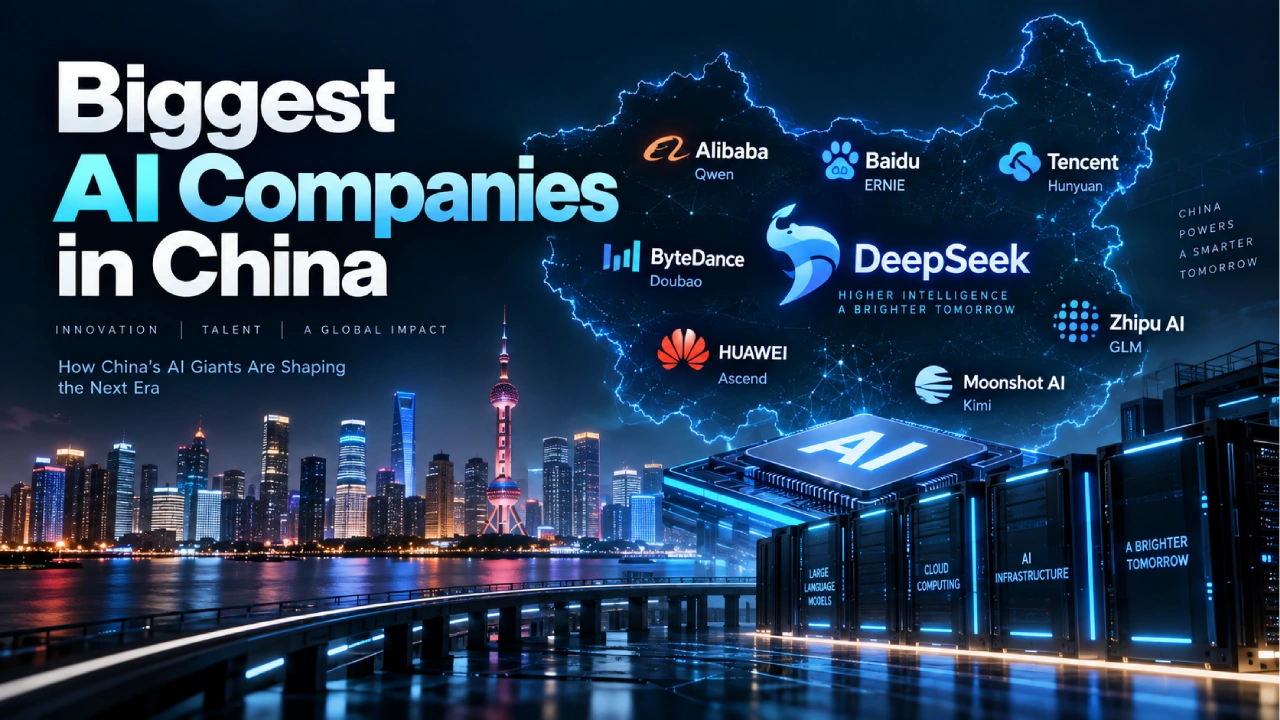
China has rapidly emerged as a global powerhouse in artificial intelligence, with its companies making significant strides in research, development, and implementation. The country’s unique combination of massive government investment, vast datasets, and a thriving tech ecosystem has enabled several Chinese firms to become leaders in AI innovation. This comprehensive guide explores the biggest AI companies in China, their core technologies, market positions, and their transformative impact on both the domestic and global AI landscapes.
China’s AI industry has grown exponentially over the past decade, with the government’s “New Generation Artificial Intelligence Development Plan” aiming to make the country the world leader in AI by 2030 . This strategic push has created fertile ground for tech giants and startups alike to develop cutting-edge AI solutions across various sectors, including healthcare, finance, manufacturing, and autonomous vehicles.
Major Players: China’s AI Titans
1. Baidu: The “Google of China” Leading AI Innovation
Baidu stands as China’s foremost AI company, often referred to as the “Google of China” due to its dominance in search and its significant investments in artificial intelligence research.
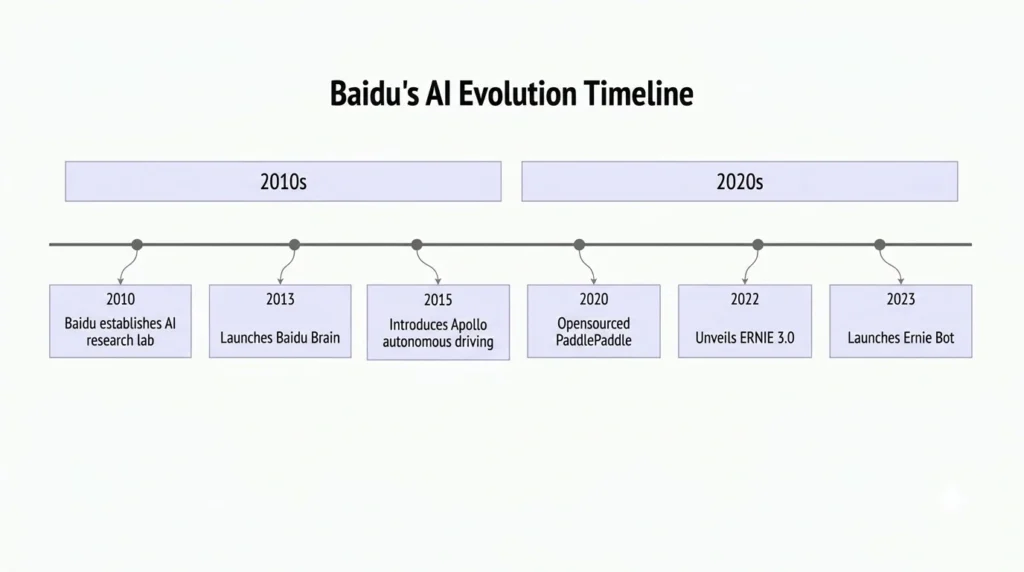
Baidu’s AI Evolution Timeline
Key AI Technologies & Achievements:
- Apollo Autonomous Driving Platform: The world’s largest open-source autonomous driving platform, with partnerships across automotive, technology, and transportation sectors
- PaddlePaddle: China’s first open-source deep learning platform, now used by millions of developers globally
- ERNIE (Enhanced Representation through kNowledge IntEgration): A sophisticated language model that has demonstrated state-of-the-art performance on various Chinese language benchmarks
- Baidu Brain: A comprehensive AI platform offering more than 250 services including vision, speech, and natural language processing capabilities
Market Position: Baidu’s Apollo has registered partnerships with over 210 industry leaders including BMW, Ford, and Volvo, while its AI Cloud services have become essential infrastructure for numerous Chinese enterprises . The company’s ERNIE language model has been particularly successful in the Chinese market, where it outperforms many Western alternatives in understanding Chinese linguistic nuances and cultural contexts.
2. Alibaba Group: E-Commerce Giant Turned AI Powerhouse
Alibaba has transformed from an e-commerce company into a comprehensive technology conglomerate with significant AI capabilities across its ecosystem.
AI Focus Areas:
- Cloud Computing: Alibaba Cloud (Aliyun) provides AI infrastructure and services to businesses globally
- City Brain: An AI system for urban management that optimizes traffic flow, emergency response, and public services in cities across China
- DAMO Academy: The research institute that conducts fundamental AI research and develops practical applications
- Retail AI: Technologies including automated stores, personalized recommendations, and supply chain optimization
Notable Achievements: Alibaba’s City Brain has been implemented in over 23 Chinese cities, reducing traffic congestion by approximately 15% in some areas . The company’s AI-powered logistics network has enabled same-day delivery across China, with algorithms optimizing delivery routes in real-time based on traffic conditions, weather patterns, and order priorities.
Alibaba’s AI Ecosystem at a Glance
| Division | AI Application | Impact |
|---|---|---|
| Alibaba Cloud | AI infrastructure services | Serves 40% of China’s AI workloads |
| City Brain | Urban management optimization | Deployed in 23+ cities, reducing traffic 15% |
| DAMO Academy | Fundamental AI research | 300+ papers published annually |
| Ant Group | Financial AI | Processes 256,000 transactions/sec |
Tencent: Social Media Giant with AI Everywhere
Tencent, the company behind WeChat, has strategically integrated AI across its vast portfolio of services, from social media to gaming to fintech.
AI Implementation Strategy:
- WeChat: Over 1.3 billion users generate massive datasets that train Tencent’s AI models
- Gaming AI: Sophisticated non-player characters and anti-cheating systems
- Healthcare AI: Tencent Healthcare develops AI diagnostic tools for hospitals
- Content Moderation: AI systems that monitor billions of messages daily
Technological Innovations: Tencent’s Miying AI system can detect diabetic retinopathy with 97% accuracy, matching human expert performance . The company’s gaming AI has created virtual opponents that learn and adapt to player behavior in real-time, creating more engaging gameplay experiences.
4. SenseTime: The World’s Most Valuable AI Startup
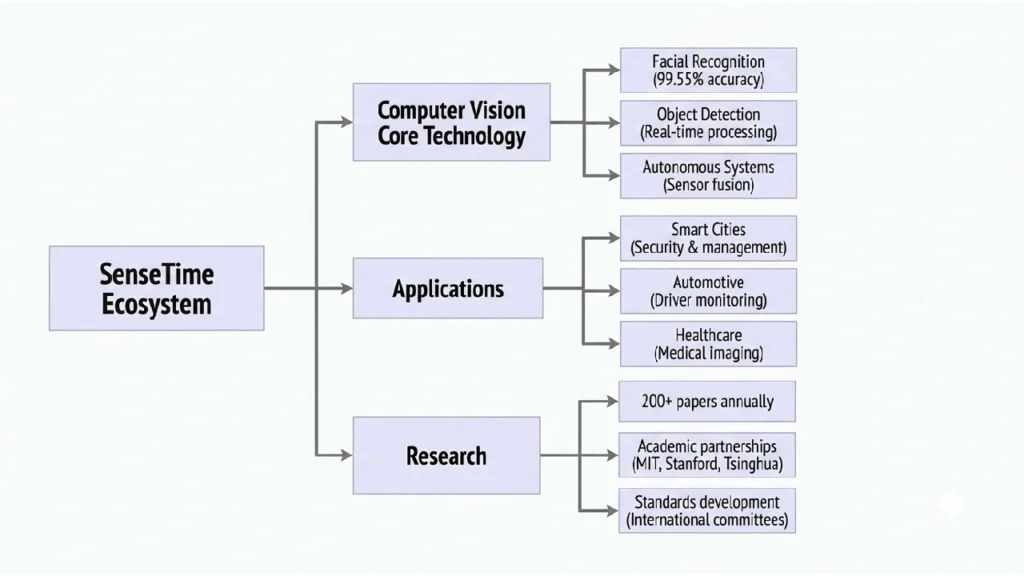
SenseTime specializes in computer vision and facial recognition technology, becoming one of the most valuable AI startups globally.
Core Competencies:
- Facial Recognition: SenseTime’s technology can identify individuals with 99.55% accuracy even with masks, glasses, or partial face occlusion
- Smart City Solutions: Comprehensive security and management systems deployed across Chinese cities
- Autonomous Vehicle Technology: Sensor fusion and perception systems for self-driving cars
- Medical Imaging AI: Diagnostic tools that assist doctors in detecting various conditions
Global Impact: SenseTime has established research partnerships with leading universities worldwide and has been instrumental in developing international AI standards. The company’s technology has been deployed in over 100 cities across China and has begun expanding internationally through strategic partnerships.
5. iFlytek: The Speech Technology Leader
iFlytek dominates China’s speech recognition and natural language processing market with its highly accurate Chinese language technologies.
Key Technologies:
- Speech Recognition: iFlytek’s systems achieve 98% accuracy for Mandarin Chinese, making them essential for Chinese voice interfaces
- Machine Translation: Real-time translation between Chinese and 60+ languages
- Voice Assistants: Powering voice interaction in smartphones, cars, and smart home devices
- Educational AI: Personalized learning platforms that adapt to individual student needs
Market Penetration: iFlytek’s technology is embedded in over 80% of Chinese mobile apps that require voice input, including WeChat’s voice-to-text feature . The company’s translation devices are used extensively in international business settings and have become essential tools for Chinese travelers abroad.
Emerging Players to Watch
Megvii: Facial Recognition Innovator
Megvii (Face++) has developed one of the world’s most advanced facial recognition platforms, with applications ranging from mobile payments to security systems. The company’s Face++ platform processes over 300 million face recognition requests daily .
Notable Applications:
- Payment Systems: Alipay’s “Smile to Pay” feature using facial recognition
- Security Screening: Airport and customs verification systems across China
- Smart Devices: Face unlock technology for smartphones and laptops
CloudWalk: Behavioral Recognition Pioneer
CloudWalk specializes in behavioral recognition technology that analyzes human movements and actions, with applications in security, retail, and public safety.
Unique Technology: The company’s systems can identify suspicious behavior patterns in crowded spaces with 96% accuracy, making them valuable for counter-terrorism and public safety applications .
UBTECH: Humanoid Robotics Leader
UBTECH focuses on humanoid robots and AI education, with robots deployed in schools, banks, and businesses across China.
Product Innovations: The company’s Cruzr robot has been deployed in over 30,000 locations worldwide, serving as customer service representatives, security guards, and educational assistants .
The Role of Government in China’s AI Success
China’s AI dominance cannot be understood without acknowledging the significant role of government support and strategic planning.
Key Government Initiatives:
- “New Generation AI Development Plan” (2017): Outlined China’s ambition to become the world’s primary AI innovation center by 2030
- Massive Funding: Government investment in AI research and development exceeding $150 billion over the past decade
- Data Localization Requirements: Policies that ensure Chinese AI companies have access to vast domestic datasets for training
- Talent Development: Programs to attract and develop AI researchers, including incentives for overseas Chinese talent to return
Strategic Advantages: The Chinese government’s approach creates unique advantages for domestic companies:
- Unified Data Ecosystem: Access to massive, standardized datasets across industries
- Rapid Implementation: Streamlined regulations enable faster deployment of AI solutions
- Infrastructure Investment: State-funded development of AI-specific infrastructure including supercomputers and data centers
Future Trends and Challenges
Emerging Trends in Chinese AI
- Multimodal AI Systems: Chinese companies are increasingly developing AI that can process multiple data types (text, image, audio, video) simultaneously
- Domain-Specific AI: Specialized AI solutions for industries like manufacturing, agriculture, and finance
- Edge AI: AI processing happening directly on devices rather than in the cloud
- AI Ethics Frameworks: Growing emphasis on responsible AI development and deployment
Challenges Facing Chinese AI Companies
- International Scrutiny: Increasing concerns about surveillance technologies and human rights implications
- Talent Competition: Fierce competition for top AI researchers globally
- Geopolitical Tensions: Export restrictions on advanced technologies to China
- Ethical Considerations: Balancing innovation with privacy and human rights concerns
Comparative Analysis: Key Metrics of Chinese AI Leaders
| Company | Market Focus | Core AI Technology | Global Reach | Key Innovation |
|---|---|---|---|---|
| Baidu | Search, Autonomous Driving | Deep Learning, NLP | 80+ countries | Apollo Autonomous Platform |
| Alibaba | E-commerce, Cloud | City Brain, Retail AI | 200+ countries | Urban Management Systems |
| Tencent | Social Media, Gaming | Speech, Vision | 130+ countries | Healthcare AI Diagnostics |
| SenseTime | Computer Vision | Facial Recognition | 100+ cities | Security Solutions |
| iFlytek | Speech Recognition | NLP, Translation | 60+ languages | Chinese Language Processing |
Conclusion: China’s AI Revolution and Global Implications
China’s biggest AI companies have transformed from domestic players into global technology leaders, driving innovation across multiple domains. Their success stems from a unique combination of government support, massive datasets, entrepreneurial spirit, and strategic focus on practical applications.
As these companies continue to grow and innovate, they are increasingly shaping the global AI landscape, offering alternative approaches to Western models. Their technologies are being deployed across continents, from smart cities in Africa to facial recognition systems in South America.
The coming years will likely see increased competition and collaboration between Chinese and Western AI companies, with potential implications for technological standards, privacy norms, and global power dynamics. What remains certain is that China’s AI giants will continue to be major players in defining how artificial intelligence transforms our world.
Frequently Asked Questions
How do Chinese AI companies compare to Western counterparts like Google and OpenAI?
Chinese AI companies typically focus more on practical applications and deployment at scale rather than fundamental research. While companies like Baidu and Alibaba are developing sophisticated models similar to GPT, their approaches often emphasize real-world implementation and integration with existing infrastructure. Chinese companies also benefit from access to massive domestic datasets that are not available to Western companies.
What are the ethical concerns surrounding Chinese AI companies?
The primary concerns revolve around surveillance and privacy, particularly regarding facial recognition technologies used in public spaces. There are also concerns about technology transfer and intellectual property practices. However, many Chinese companies are increasingly addressing these concerns by implementing ethical guidelines and transparency measures.
How accessible are Chinese AI technologies to international businesses?
Many Chinese AI companies offer cloud-based services that are accessible globally. For instance, Alibaba Cloud provides AI services in multiple languages, and Baidu’s PaddlePaddle is available as an open-source platform. However, some technologies, particularly those involving facial recognition or surveillance capabilities, may face regulatory restrictions in certain countries.