


Recent statements from Chinese officials have emphasized a pragmatic approach to artificial intelligence development, rejecting what they perceive as Western “AI fearmongering” while advocating for responsible innovation tailored to national conditions . This position reflects China’s broader strategy of technological self-reliance and its ambition to lead in the global AI landscape by 2030. Unlike Western narratives that often focus on existential risks and job displacement, China’s public discourse emphasizes practical applications, economic benefits, and the importance of maintaining social stability through technological advancement.
The divergence in AI narratives highlights fundamental differences in how societies approach emerging technologies. While Western discussions frequently center on potential harms and ethical dilemmas, Chinese officials and state media tend to highlight economic opportunities, improvements to quality of life, and the importance of maintaining technological sovereignty. This doesn’t mean China ignores risks—rather, it prioritizes different concerns based on its political system and development goals.
China’s Official Position on AI Development
Rejecting Western “AI Fearmongering”
Chinese officials have explicitly criticized what they view as exaggerated threats about AI in Western media and policy circles. This criticism focuses on several key points:
- Narrative Framing: Chinese representatives argue that Western discussions often create unnecessary panic about AI systems becoming sentient or uncontrollable, rather than focusing on practical applications and benefits . This framing serves to position China as a more rational actor in AI development.
- Regulatory Approach: China’s regulatory framework emphasizes “agile governance” that allows for rapid innovation while addressing specific risks as they emerge, rather than implementing sweeping restrictions based on hypothetical future scenarios.
- Development Priority: Chinese policy documents consistently frame AI as a tool for economic modernization and national rejuvenation, with less emphasis on theoretical risks and more on concrete applications in manufacturing, healthcare, urban management, and education.
The “Chinese Characteristics” AI Model
China’s approach to AI development incorporates what it calls “socialist characteristics” that distinguish it from Western models:
- State-Led Innovation: The government plays a central role in coordinating AI research, development, and deployment through national initiatives like the New Generation Artificial Intelligence Development Plan (AIDP) .
- Ethics with Chinese Values: China has developed its own set of AI ethics principles that emphasize harmony, fairness, and social stability, reflecting traditional Chinese philosophical values rather than Western individualistic approaches.
- Security Emphasis: Unlike Western frameworks that often prioritize privacy and individual rights, China’s AI governance emphasizes national security, social stability, and the prevention of foreign interference.
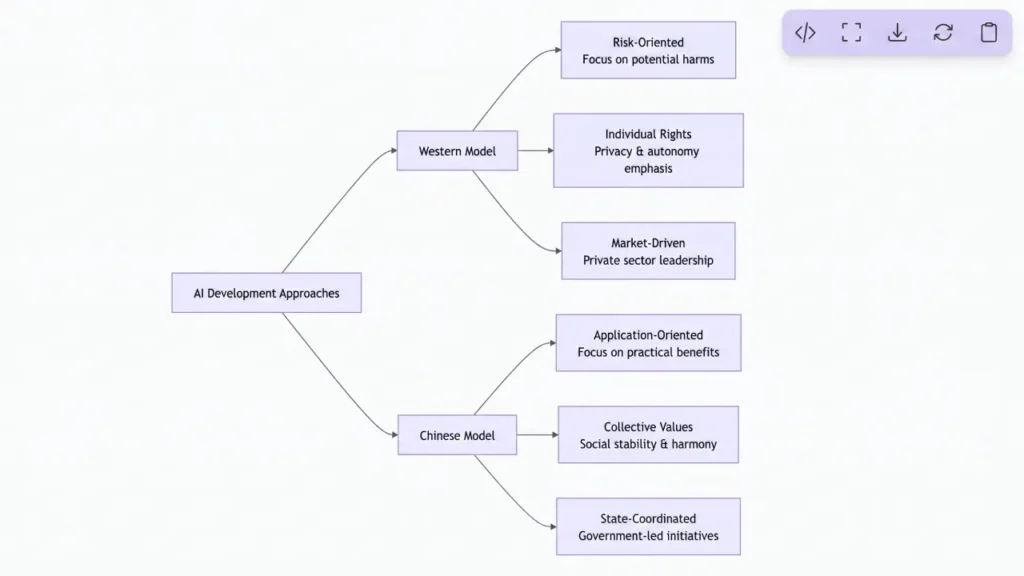
Comparative Analysis: China vs. Western AI Approaches
Regulatory Frameworks
China’s regulatory approach to AI differs significantly from Western frameworks in both philosophy and implementation:
| Aspect | China’s Approach | Western Approach |
|---|---|---|
| Primary Focus | Economic development & social stability | Risk mitigation & ethical concerns |
| Implementation | Government-led initiatives | Market-driven with government oversight |
| Timeline | Rapid deployment with iterative adjustments | Precautionary approach with extensive testing |
| Stakeholders | State research institutions & tech companies | Academic researchers, corporations, & civil society |
| International Stance | Technological sovereignty & self-reliance | Global cooperation & standards development |
Application Priorities
China’s AI development focuses on practical applications that support its economic and social goals:
- Industrial Applications: China prioritizes AI for manufacturing efficiency, quality control, and supply chain optimization through initiatives like “Made in China 2025” .
- Urban Management: AI systems for traffic management, public safety, and environmental monitoring are deployed extensively in Chinese cities.
- Social Services: AI applications in healthcare, education, and elder care address specific demographic challenges, including China’s aging population.
📊 Deep Dive: China’s AI Industrial Policy
China’s approach to AI development is deeply integrated with its industrial policy objectives:
- Strategic Sectors: AI development is prioritized in sectors deemed strategically important for economic security and global competitiveness, including semiconductors, robotics, and biotechnology.
- Regional Specialization: Different Chinese cities and regions specialize in specific AI applications—Beijing focuses on research and development, Shenzhen on hardware manufacturing, and Hangzhou on e-commerce and fintech applications.
- Military-Civil Fusion: China explicitly links AI development for civilian applications with military modernization through its Military-Civil Fusion strategy, creating dual-use technologies that serve both commercial and defense purposes.
- Standards Setting: China actively works to establish its own technical standards for AI systems, particularly in areas like facial recognition, natural language processing, and autonomous vehicles, to ensure they reflect Chinese requirements and values.
The Global Implications of China’s AI Stance
Technological Sovereignty and Self-Reliance
China’s rejection of what it perceives as Western AI fearmongering is part of a broader strategy to achieve technological independence:
- Reduced Dependence: By developing domestic AI capabilities across the entire stack—from chips to algorithms—China aims to reduce its vulnerability to foreign export controls and supply chain disruptions .
- Alternative Standards: China is actively promoting its technical standards for AI systems in international forums, offering an alternative to Western-led approaches that it views as overly restrictive.
- Global South Engagement: China exports its AI technology and governance model to developing countries through initiatives like the Digital Silk Road, providing alternatives to Western models that may come with conditions regarding human rights and governance.
The Emerging AI Geopolitical Landscape
The divergence in AI approaches is contributing to a fragmented global technology landscape:
- Competing Ecosystems: Rather than a single global AI ecosystem, we’re seeing the emergence of distinct technological spheres with different standards, values, and applications.
- Research Collaboration Challenges: Scientists and researchers increasingly face barriers to international collaboration as geopolitical tensions affect technology sharing.
- Governance Models: Countries must now choose between different AI governance models, with China offering an alternative that emphasizes state leadership and social stability over individual rights and market mechanisms.
Future Trajectories: Where China’s AI Strategy Is Headed
Short-Term Priorities (1-3 Years)
In the immediate future, China’s AI development will likely focus on:
- Application Scaling: Rapid deployment of proven AI applications in key sectors like manufacturing, healthcare, and urban management.
- Regulatory Refinement: Development of more sophisticated regulatory approaches that balance innovation with risk management, building on existing frameworks like the AI recommendation algorithm regulations.
- Talent Development: Significant investment in AI education and training to address the growing demand for skilled professionals across industries.
Long-Term Vision (5-10 Years)
China’s long-term AI strategy aims for:
- Global Leadership: Achieving dominance in AI research and application by 2030, as outlined in the New Generation AI Development Plan .
- Economic Transformation: Complete integration of AI throughout the economy, driving significant productivity gains and creating new industries.
- Governance Model Export: Establishment of China’s AI governance approach as a global standard, particularly in developing countries participating in the Belt and Road Initiative.
Conclusion: A Pragmatic Path Forward
China’s rejection of what it views as Western AI fearmongering represents more than just rhetorical positioning—it reflects a fundamentally different approach to technological development and governance. While Western discussions often center on hypothetical future risks and ethical dilemmas, China’s pragmatic approach focuses on immediate applications, economic benefits, and social stability.
This divergence has significant implications for the global AI landscape, contributing to the emergence of competing technological ecosystems with different values, standards, and applications. As AI continues to develop, understanding these different approaches will be essential for navigating the complex geopolitical and technological challenges that lie ahead.
For businesses, researchers, and policymakers worldwide, China’s AI stance offers both challenges and opportunities—challenging assumptions about universal approaches to technology governance while offering new possibilities for collaboration and learning from different development models.
External Resources: