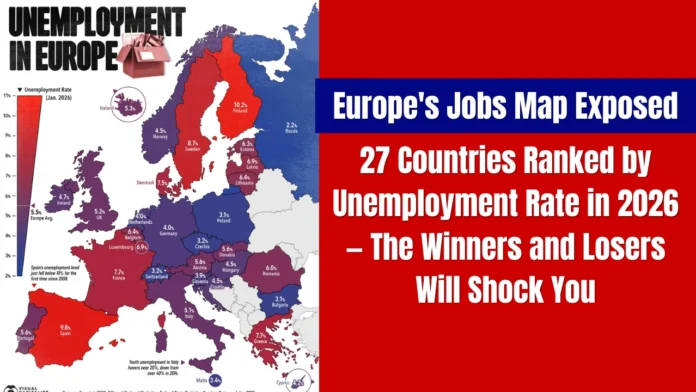
Mapped: Europe’s Unemployment Rates in 2026 reveals a continent sharply divided between near-full employment in the north and stubborn joblessness in the south and southeast. Eurostat, the official statistical agency of the European Union, confirmed that the EU-wide average unemployment rate stood at approximately 5.8% in early 2026 — marginally improved from 6.0% in 2025 — but that headline figure masks enormous national differences.
From Czech Republic’s record lows to Spain’s persistent double-digit struggles, here is the complete picture of where European workers stand right now.
The Best Performers: Europe’s Near-Full Employment Nations
Czech Republic continues to lead the entire continent with an unemployment rate hovering near 2.6% in early 2026 — one of the lowest figures ever recorded for any EU member state. Tight labour markets, strong manufacturing output, and a skills-matched workforce drive this exceptional performance.
Malta (2.9%), Germany (3.2%), and Netherlands (3.7%) round out the top four lowest unemployment nations in 2026. All four countries share a common trait: proactive government retraining programmes that quickly redirect redundant workers into growth sectors like green energy and digital services.
Poland (2.9%) and Hungary (3.4%) also maintain impressively low figures, defying broader Eastern European economic headwinds. Both nations benefit from strong foreign direct investment inflows and expanding manufacturing bases tied to European Union supply chain reshoring trends.
The Worst Performers: Where Unemployment Stays Stubbornly High
Spain remains the EU’s most troubled large economy on employment, with a 2026 unemployment rate of approximately 11.2% — still the highest among the bloc’s major economies despite a modest improvement from 11.6% in 2025. Youth unemployment in Spain runs even higher, with reports suggesting the under-25 jobless rate exceeds 27% in some regions.
Greece (9.8%) and Italy (6.3%) follow as the next most challenged economies. Both countries face structural barriers including heavy labour regulations, large informal employment sectors, and aging populations that compress workforce participation rates.
Sweden — historically a model of labour market efficiency — saw its unemployment rate rise to 8.9% in early 2026, driven by a domestic housing market collapse and weak export demand from key trading partners. This represents one of the most striking deteriorations on the continent since 2023.
2025 vs. 2026 Unemployment Rates: Europe Country by Country
| Country | 2025 Rate (%) | 2026 Rate (%) | Change |
|---|---|---|---|
| Czech Republic | 2.7% | 2.6% | ▼ Improved |
| Malta | 3.1% | 2.9% | ▼ Improved |
| Germany | 3.4% | 3.2% | ▼ Improved |
| Poland | 3.0% | 2.9% | ▼ Improved |
| Hungary | 3.6% | 3.4% | ▼ Improved |
| Netherlands | 3.9% | 3.7% | ▼ Improved |
| Denmark | 5.0% | 4.9% | ▼ Slightly improved |
| Austria | 5.2% | 5.1% | ▼ Slightly improved |
| Romania | 5.5% | 5.3% | ▼ Slightly improved |
| Belgium | 5.5% | 5.6% | ▲ Slight rise |
| France | 7.3% | 7.1% | ▼ Improved |
| Portugal | 6.4% | 6.0% | ▼ Improved |
| Italy | 6.6% | 6.3% | ▼ Improved |
| Finland | 7.5% | 7.3% | ▼ Improved |
| Sweden | 8.6% | 8.9% | ▲ Deteriorated |
| Greece | 10.1% | 9.8% | ▼ Improved |
| Spain | 11.6% | 11.2% | ▼ Improved |
| EU-27 Average | 6.0% | 5.8% | ▼ Improved |
| Eurozone Average | 6.2% | 6.0% | ▼ Improved |
| Non-EU: UK | 4.4% | Reports suggest 4.3% | ▼ Slightly improved |
| Non-EU: Norway | 3.8% | Reports suggest 3.7% | ▼ Slightly improved |
| Non-EU: Turkey | 8.8% | Reports suggest 8.6% | ▼ Slightly improved |
Source: Eurostat, national statistics offices, Q1 2026 data. Some figures are preliminary estimates.
Why Sweden Is Buckling While Czech Republic Thrives
Sweden’s sharp rise to 8.9% unemployment is the continent’s biggest story in 2026. A 40-year high in mortgage defaults, combined with a 15% fall in residential construction activity since 2023, triggered widespread layoffs across the real estate and building sectors.
By contrast, Czech Republic avoids this fate partly because its property market never experienced the speculative surge that hit Sweden, Norway, and Netherlands in the post-pandemic period. Czech workers also benefit from deep integration with German automotive supply chains, which remain relatively resilient despite the global EV transition disruption.
Youth Unemployment: Europe’s Hidden Crisis
Adult unemployment figures tell only half the story. Youth unemployment — covering workers aged 16 to 24 — runs significantly higher across almost every European nation.
Key 2026 youth unemployment estimates:
- Spain: Reports suggest ~27% youth unemployment
- Greece: Reports suggest ~24% youth unemployment
- Italy: Reports suggest ~19% youth unemployment
- France: Reports suggest ~16% youth unemployment
- Germany: Reports suggest ~5.5% youth unemployment — the best large-economy figure in the continent
Eurostat tracks youth unemployment separately because it reflects structural long-term damage to an economy’s future workforce. High youth unemployment in southern Europe has persisted for over a decade, despite multiple EU-funded employment programmes.
What Is Driving Improvements Across the EU?
Three forces explain why the EU-27 average dropped from 6.0% to 5.8% in 2026.
First, the EU Green Deal investment pipeline created hundreds of thousands of new jobs across renewable energy, grid infrastructure, and energy efficiency retrofitting in 2025 and 2026.
Second, AI and automation fears have not yet translated into mass layoffs at the scale many economists predicted. Workforce absorption into adjacent digital roles has, so far, outpaced displacement in most EU member states.
Third, demographic shrinkage in Eastern Europe — particularly in Czech Republic, Poland, and Hungary — mechanically reduces unemployment figures as the working-age population contracts faster than job creation slows.
The Eurozone vs. Non-EU Comparison
The Eurozone’s 6.0% average remains higher than the UK’s estimated 4.3% and Norway’s 3.7% — two major non-EU economies with strong labour market institutions. This gap reflects the Eurozone’s rigid wage-setting structures and the EU’s historically slower response to structural economic shocks compared to flexible Anglo-Nordic labour markets.
Turkey, a long-standing EU candidate country, reports 8.6% official unemployment — though independent economists widely believe the true underemployment figure is significantly higher once informal and discouraged workers are counted.
FAQs on Europe’s Unemployment Rates 2026
A: Czech Republic holds the top position with an unemployment rate of approximately 2.6% in early 2026 — the lowest across all EU member states and among the lowest figures globally.
A: Spain continues to record the highest unemployment rate among the EU’s major economies at approximately 11.2% in 2026, with youth unemployment in some regions exceeding 27%.
A: Eurostat places the EU-27 average at approximately 5.8% in early 2026, a slight improvement from 6.0% recorded in 2025, driven by job creation in green energy and digital sectors.
A: Sweden’s unemployment rose to 8.9% in 2026 due to a prolonged housing market collapse, falling construction activity, and reduced domestic consumer spending — a significant deterioration from 8.6% in 2025.
A: The UK — outside the EU — reports an estimated unemployment rate of approximately 4.3% in 2026, placing it well below the EU-27 average of 5.8% and ahead of most large Eurozone economies.

