

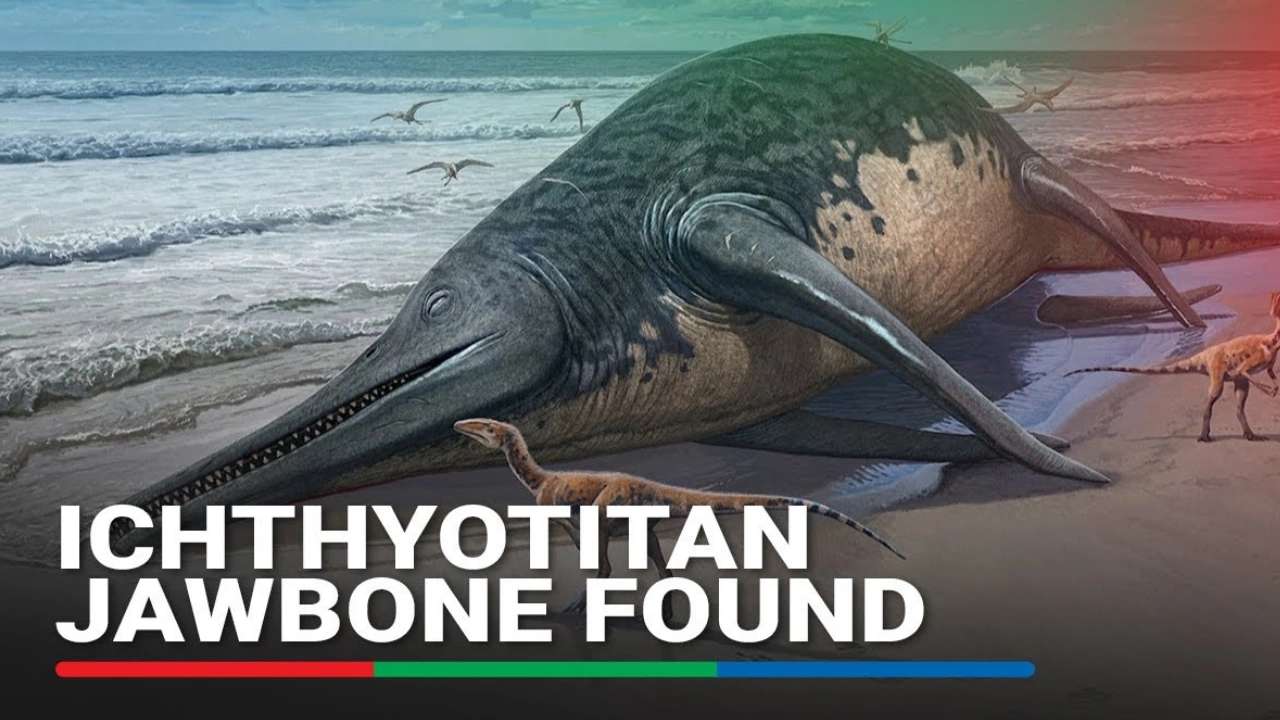
Ichthyotitan severnensis is a giant prehistoric marine reptile whose fossil remains were formally described and named in a scientific paper published in the open-access journal PLOS ONE in April 2024. Based on two fragmentary jawbone fossils found in Somerset, England, scientists estimate the creature reached a body length of approximately 25 metres (82 feet), potentially making it the largest marine reptile ever formally described.
The species lived approximately 202 million years ago, during the final stage of the Triassic Period known as the Rhaetian age.
What Is Ichthyotitan severnensis?
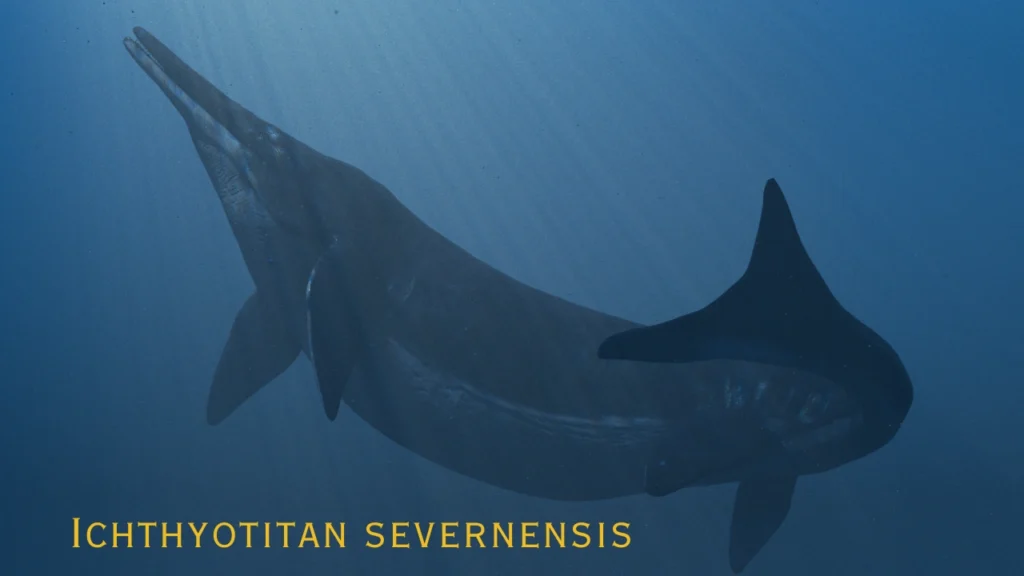
Ichthyotitan severnensis belongs to a group of large marine reptiles called ichthyosaurs, which swam in ancient seas while dinosaurs dominated land. Scientists place it within or close to the family Shastasauridae, a group known for producing the largest ichthyosaur species.
The name Ichthyotitan means “fish giant” and severnensis refers to the Severn Estuary in Somerset, England, where both fossil specimens were found. The genus currently holds a single species — I. severnensis.
The Discovery: Two Finds, Four Years Apart
The story of Ichthyotitan severnensis begins in May 2016, when amateur fossil collector Paul de la Salle found multiple fragments of a fossilised bone on the beach at Lilstock, Somerset. He identified the bone as a surangular — part of the lower jaw — and shared it with palaeontologist Dr Dean Lomax of the University of Bristol, who confirmed it belonged to an unusually large ichthyosaur.
The second, more significant specimen turned up on 28 May 2020 on the beach at Blue Anchor, Somerset, roughly 10 kilometres west of the original Lilstock site. An unnamed member of the public had left a large bone section on a boulder at the top of the beach, and it was found there by Justin Reynolds and his daughter Ruby Reynolds, who were out fossil hunting that day.
Ruby Reynolds was 11 years old at the time. She found the first fragments, then located a larger, better-preserved section clearly showing the Meckelian canal characteristic of an ichthyosaur jaw. Justin and Ruby contacted Dr Lomax and Paul de la Salle, who joined them on multiple follow-up trips to the site to recover additional fragments.
The Fossils: What Was Found
Both discovered fossils are surangular bones — a specific element of the lower jaw. The Blue Anchor specimen (BRSMG Cg3178), found by the Reynolds family, is the holotype (the defining specimen) of the new species. It is a large, robust, right surangular preserved in three dimensions and uncrushed.
The earlier Lilstock specimen (BRSMG Cg2488), found by Paul de la Salle, is the referred specimen and measures approximately 96 centimetres (close to 3 feet) in length. The Blue Anchor specimen is notably more complete and better preserved than the Lilstock bone, which allowed scientists to confidently compare the two specimens and establish them as the same new species.
Both fossils come from the same geological formation — the uppermost Triassic Westbury Mudstone Formation — and the same geographic region of Somerset, England.
How Big Was It?
Scientists cannot state an exact body length without a complete skeleton. However, by scaling up the jawbone measurements against better-known ichthyosaur species, Dr Lomax estimated Ichthyotitan severnensis could have measured approximately 25 metres (82 feet) in length.
That estimate places it roughly equal in size to a blue whale — the largest animal currently alive — and makes it the largest marine reptile formally described in the scientific literature. The jawbone alone measured over 2 metres (6.5 feet) in length.
Bone histology analysis carried out by master’s student Marcello Perillo at the University of Bonn, Germany, revealed that the individual found at Blue Anchor was still growing at the time of its death, suggesting adult specimens may have grown even larger.
Scientific Classification and Context
Ichthyotitan severnensis is approximately 13 million years younger than its closest known relatives — Shonisaurus sikanniensis from British Columbia, Canada, and Himalayasaurus tibetensis from Tibet. This makes it one of the last known members of the giant shastasaurid ichthyosaurs, which are thought to have gone extinct at the end of the Triassic.
Stable-isotope evidence from related ichthyosaur bones points to warm-blooded metabolisms, live birth, and streamlined bodies that allowed them to fill ecological roles similar to modern whales, long before mammals entered the sea.
The Research Team
The paper formally naming Ichthyotitan severnensis was published in PLOS ONE on 16 April 2024. The lead author is Dr Dean Lomax of the University of Bristol. Co-authors include Paul de la Salle, Justin Reynolds, Ruby Reynolds, and Marcello Perillo, among others.
The Bristol Museum and Art Gallery holds the fossil specimens under the catalogue references BRSMG Cg3178 (Blue Anchor/holotype) and BRSMG Cg2488 (Lilstock/referred).
FAQ — Ichthyotitan severnensis
Q1. What is Ichthyotitan severnensis?
It is a newly described species of giant ichthyosaur — a prehistoric marine reptile — that lived approximately 202 million years ago in the Late Triassic Period. Scientists estimate it could have reached 25 metres (82 feet) in length, making it the largest marine reptile formally described.
Q2. Where were the fossils found?
Both fossils were found on beaches in Somerset, England. The first specimen was found at Lilstock in May 2016, and the second was found at Blue Anchor in May 2020, approximately 10 kilometres to the west.
Q3. Who discovered Ichthyotitan severnensis?
Paul de la Salle, an amateur fossil collector, found the first specimen at Lilstock in 2016. The second and more complete specimen was found by Justin Reynolds and his daughter Ruby Reynolds, who was 11 years old at the time, at Blue Anchor in May 2020.
Q4. What does the name mean?
Ichthyotitan translates to “fish giant” in Latin/Greek. Severnensis refers to the Severn Estuary in Somerset, the coastal area where both fossil specimens were recovered.
Q5. What type of fossils were found?
Both found fossils are surangular bones — fragments of the lower jaw. No other skeletal material has been formally assigned to the species.