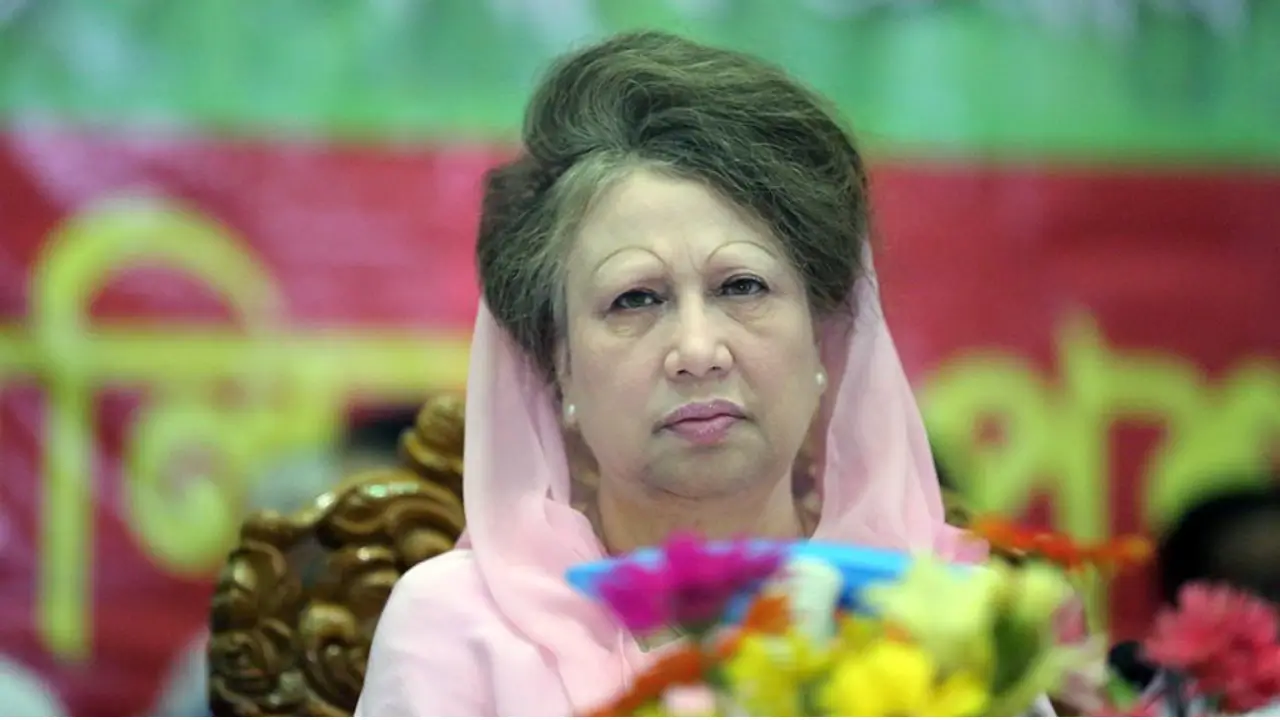
Khaleda Zia is a prominent Bangladeshi politician who served as the Prime Minister of Bangladesh for two terms. She was the first woman in the country’s history to hold this position and the second in the Muslim world. As the chairperson of the Bangladesh Nationalist Party (BNP), she has been a major figure in Bangladeshi politics for decades. She is the widow of former President Ziaur Rahman. As of late 2025, she is facing serious health challenges while her party prepares for upcoming national elections.
Who is Khaleda Zia?
Khaleda Zia is a key leader in South Asian politics known for her resilience. She entered politics after the assassination of her husband, President Ziaur Rahman, in 1981. Before that, she was a shy housewife who stayed away from the public eye. Her entry into politics was to save her husband’s party, the BNP, from collapsing.
She led the movement against the military rule of Hussain Muhammad Ershad in the 1980s. Her strong stance earned her the nickname “Uncompromising Leader.” She served as Prime Minister from 1991 to 1996 and again from 2001 to 2006. In recent years, she faced imprisonment and house arrest under the rival government but was released in August 2024 after a major political change in the country. Currently, in December 2025, she is critically ill and receiving treatment in a hospital in Dhaka.
Khaleda Zia Age
Khaleda Zia age is 80 years old as of 2025. She was born on August 15, 1945, in the Dinajpur district of undivided Bengal (now in Bangladesh). There has been some debate in the past about her official birthday, but August 15 is the date commonly cited in her biography.



Despite her age, she remains the symbolic head of her party. However, her health has deteriorated significantly over the last few years. In late 2025, reports confirmed she was battling multiple age-related complications involving her heart, lungs, and kidneys. Her 80th year has been difficult, marked by frequent hospital visits and critical care support.
Khaleda Zia Biography / Wiki
| Category | Details |
|---|---|
| Full Name | Khaleda Zia (née Majumder) |
| Date of Birth | August 15, 1945 |
| Age (2025) | 80 Years Old |
| Birthplace | Dinajpur, Bangladesh |
| Political Party | Bangladesh Nationalist Party (BNP) |
| Position | Former Prime Minister, Chairperson of BNP |
| Husband | Ziaur Rahman (Former President) |
| Children | Tarique Rahman, Arafat Rahman Koko |
| Current Status | Hospitalized (Critical Condition, Dec 2025) |
Early Life and Background
Khaleda Zia was born into a respectable family in Dinajpur. Her father was Iskandar Majumder, a businessman, and her mother was Taiyaba Majumder. She was the third of five children. Her early life was quite ordinary compared to her later stormy political career. She spent her childhood in Dinajpur and later studied at Surendranath College.
In 1960, while she was still young, she married Ziaur Rahman, who was then an army captain. Her life as an army wife was disciplined and private. She did not participate in politics during her husband’s lifetime. When her husband became the President of Bangladesh, she focused on raising her two sons and performing ceremonial duties as the First Lady. It was only after his tragic death that she was thrust into the political spotlight.
Political Career Journey
Khaleda Zia’s career began in the early 1980s. After her husband’s assassination, she became the vice-chairperson and later the chairperson of the BNP. She spent years on the streets protesting against military dictatorship. Her hard work paid off when her party won the 1991 general elections. She became the first female Prime Minister of Bangladesh, a historic achievement.
Her first term (1991–1996) is remembered for moving the country from a presidential to a parliamentary system. She improved the education sector, especially for girls. She won a second term in 2001, governing until 2006. However, her career also saw many challenges, including corruption charges and jail time during the rule of the Awami League. After the fall of the Sheikh Hasina government in 2024, Khaleda Zia was freed, but her poor health has limited her active participation in the 2025 political scene.
Timeline of Khaleda Zia political career
Terms as Prime Minister
First Term (1991–1996)
Key Highlights: Sworn in as Bangladesh’s first female PM. Shifted the country back to a Parliamentary system. Implemented major education reforms, including free primary education and stipends for girls.
Second Term (1996)
Key Highlights: A short-lived term following a boycotted election. Passed the 13th Amendment to introduce the Neutral Caretaker Government system.
Third Term (2001–2006)
Key Highlights: Won with a 2/3rds majority leading a four-party alliance. Focused on economic reforms and law enforcement initiatives (including the establishment of RAB).
Later Years & Current Status
- 2007–2008: Detained by the military-backed caretaker government.
- 2018: Convicted in corruption cases and sentenced to 17 years in prison.
- 2020–2024: Released under executive order, effectively under house arrest due to health.
- August 2024: Fully released following the fall of the Sheikh Hasina government.
- December 2025: Currently in critical condition in a hospital in Dhaka.
Khaleda Zia Family: Husband and Sons
Khaleda Zia husband was Ziaur Rahman, a decorated freedom fighter and the former President of Bangladesh. He founded the BNP. His assassination in 1981 changed Khaleda Zia’s life forever, turning her from a homemaker into a politician. She often speaks about fulfilling his dream for the country.
Khaleda Zia son details are significant in her life. She had two sons:
- Tarique Rahman: He is the eldest son, born in 1967. He is the acting chairman of the BNP. After living in exile in London for many years, news in late 2025 suggests plans for his return to Bangladesh to lead the party in the upcoming elections.
- Arafat Rahman Koko: He was the younger son, born in 1969. He was not very active in politics but faced legal issues. Sadly, he died of a cardiac arrest in Malaysia in 2015. His death was a massive personal blow to Khaleda Zia.
Also Read: Tarique Rahman wife: Age, Wiki, Family, Relationship and More
Khaleda Zia Death – December 30, 2025
A Nation Mourns
Bangladesh lost its first female Prime Minister on December 30, 2025. Begum Khaleda Zia died at the age of 80 following a prolonged illness at Evercare Hospital in Dhaka, where she had been undergoing intensive treatment. The Bangladesh Nationalist Party (BNP) announced her passing at 6:00 AM on Tuesday morning, shortly after Fajr (dawn) prayers.
Final Days and Health Complications
Khaleda Zia was admitted to Evercare Hospital on November 23, 2025, with a severe lung infection that rapidly deteriorated. Over the following 36 days, her condition became increasingly critical as the infection developed into pneumonia, causing respiratory failure. Her medical team placed her on ventilator support on December 11 after her oxygen levels fell dangerously low and her breathing difficulties intensified
Cause of Death
Medical reports confirm that Khaleda Zia died from multi-organ failure resulting from severe infections in her heart and lungs, compounded by long-standing health conditions. According to her doctors, she was battling multiple chronic ailments that weakened her body over the years:
- Advanced liver cirrhosis
- Heart disease (she relied on a permanent pacemaker)
- Diabetes
- Kidney complications
- Rheumatoid arthritis
- Pneumonia and chest infections
Despite efforts to arrange advanced medical treatment abroad, her fragile condition prevented any international travel in her final days.
State Mourning and Tributes
Chief Adviser Prof. Muhammad Yunus declared three days of national mourning and a public holiday on December 31, 2025, for Khaleda Zia’s state funeral. She was laid to rest at Zia Udyan in Sher-e-Bangla Nagar, beside the grave of her late husband, former President Ziaur Rahman, who was assassinated in 1981.
Tributes poured in from world leaders. Prime Minister Narendra Modi expressed deep sadness and noted her contributions to India-Bangladesh relations, stating: “As the first woman Prime Minister of Bangladesh, and for her role in the struggle to establish democracy, her contributions to the nation were significant and will be remembered.” Even her political rival, former PM Sheikh Hasina, acknowledged Khaleda’s role in Bangladesh’s democratic struggle.

 is a prominent Bangladeshi politician who served as the Prime Minister of Bangladesh for two terms.)