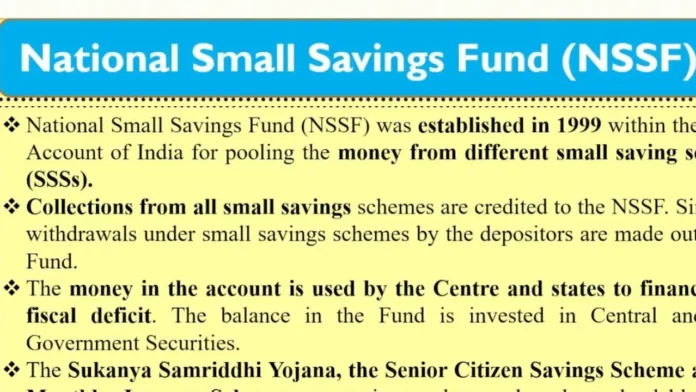
The National Small Savings Fund (NSSF) forms one of India’s most significant domestic financial infrastructure pillars a government-managed, non-lapsable fund that collects every rupee deposited into any small savings scheme across the country and channels it into government securities, financing development expenditure, reducing fiscal deficits and providing millions of ordinary Indian households with a secure, sovereign-guaranteed return on their savings.
Established in 1999 under the Public Account of India, the NSSF operates separately from the Consolidated Fund of India meaning its transactions do not directly impact the Centre’s fiscal deficit calculations, a design feature that gives the government structural flexibility in managing public debt.
The fund covers the complete spectrum of small savings instruments available at Post Offices and designated banks nationwide from the Public Provident Fund (PPF) and National Savings Certificate (NSC) to the Sukanya Samriddhi Yojana (SSY), Senior Citizens Savings Scheme (SCSS), Kisan Vikas Patra (KVP) and all Post Office time and recurring deposit products.
Origin and Constitutional Foundation of the NSSF
The NSSF traces its origins to the R.V. Gupta Committee on Small Savings (1998), which recommended creating a self-sustaining, separately accountable structure to ring-fence small savings collections from general government revenue.



The committee identified a critical governance gap: small savings funds were previously pooled into general government accounts without transparent linkage between the money collected from depositors and its ultimate deployment.
The government accepted this recommendation and established the NSSF with effect from April 1, 1999, giving it a formal constitutional footing under Article 283(1) of the Constitution of India, which governs the custody, investment and application of funds in the public account.
The National Small Savings Fund (Conservation and Investment) Rules, 2001 issued by the President of India govern the day-to-day administration of the fund, specifying investment norms, borrowing conditions and disbursement rules for both the central government and state governments accessing the fund.
The Ministry of Finance’s Department of Economic Affairs (DEA) holds administrative responsibility for the NSSF, overseeing compliance with investment rules and interest rate notifications issued quarterly.
How the NSSF Works: The Collection and Disbursement Mechanism
The operational cycle of the NSSF follows a straightforward flow:
- Collection: Every deposit made by an individual into any small savings scheme whether at a Post Office, State Bank of India or other authorised bank flows directly into the NSSF as a credit entry in the public account
- Disbursement to Investors: When a depositor matures or withdraws their investment, the repayment amount is sourced from the NSSF not from the government’s general revenue
- Investment of Surplus: After meeting ongoing repayment obligations, the net surplus balance in the NSSF is invested in special government securities issued by both the central government and state governments
- Interest Payment: Interest earned on government securities held by the NSSF funds the interest payments the government makes to depositors under each small savings scheme
The NSSF is a non-lapsable fund any unspent balance at the end of a financial year carries forward automatically to the next year without lapsing, ensuring continuity of the savings-to-investment cycle.
Three Categories of Small Savings Instruments Under NSSF
The NSSF covers all small savings instruments that fall across three broad categories:
| Category | Instruments Covered |
| Savings Instruments (Postal Deposits) | Post Office Savings Account, Recurring Deposits, Time Deposits (1, 2, 3, 5 years), Monthly Income Scheme (POMIS) |
| Monthly Income and Certificate Schemes | National Savings Certificate (NSC), Kisan Vikas Patra (KVP), Mahila Samman Savings Certificate |
| Social Security Schemes | Public Provident Fund (PPF), Sukanya Samriddhi Yojana (SSY), Senior Citizens Savings Scheme (SCSS) |
Each category serves a distinct investor profile postal deposits suit short-to-medium term savers, certificate schemes serve investors seeking fixed lump-sum returns, and social security schemes address long-term goals including retirement planning and the education and marriage of a girl child.
Where NSSF Funds Get Invested: The Government Securities Route
The NSSF does not invest in equity markets, corporate bonds or any private-sector instruments. All investible funds flow exclusively into government securities:
- Central Government Special Securities: The Union Government issues special non-tradeable securities to the NSSF, receiving loan proceeds that the government uses to fund fiscal deficit requirements and development expenditure
- State Government Special Securities: State governments historically borrowed significantly from the NSSF through their own special securities however, following the 14th Finance Commission recommendations, most states shifted to market borrowings (State Development Loans) after April 2016, leaving only a handful of states notably Arunachal Pradesh, Kerala, Delhi (UT) and Madhya Pradesh still borrowing from the NSSF
- Public Sector Undertakings (PSUs): The NSSF occasionally invests in specific PSUs or government agencies for targeted infrastructure or social sector projects for example, the India Budget 2026–27 receipt document confirms NSSF investment in Chenab Valley Power Projects Ltd with additions of ₹330 crore in the relevant year, alongside Central Government security investments and other categories
The shift of states away from NSSF borrowing since 2016 has increased the proportion of the fund available for central government borrowings and PSU financing, reducing the benchmark 10-year G-Sec yield pressure and lowering the cost of extra-budgetary borrowings.
Key Features of the NSSF: What Makes It Distinctive
The NSSF carries several structural features that distinguish it from other government funds and make it uniquely important for India’s fiscal architecture:
- Non-Lapsable Nature: Unspent balances carry forward across financial years ensuring continuity of investment without the pressure to exhaust funds before year-end
- Sovereign Guarantee: All deposits into NSSF-linked schemes carry the full faith and credit of the Government of India principal and interest face no default risk
- Separate from Fiscal Deficit Calculations: Because the NSSF sits in the public account rather than the Consolidated Fund, NSSF borrowings by the central government do not directly appear in headline fiscal deficit figures though they contribute to total public debt
- Quarterly Rate Review: The Ministry of Finance reviews and notifies interest rates for all NSSF-linked schemes every quarter, with a formula benchmarked to comparable G-Sec yields plus statutory spreads
- Self-Sustaining Design: The fund’s structure matches inflows (new deposits) against outflows (maturities and withdrawals) through the securities portfolio, theoretically requiring no annual budget allocation for routine operations
Why the NSSF Matters: Its Importance for India’s Economy
The NSSF serves multiple strategic functions simultaneously within India’s broader economic and financial framework:
Mobilisation of Household Savings: The NSSF provides a formal, accessible savings channel to tens of millions of households especially in rural, semi-urban and low-income segments who would otherwise keep savings as cash or in informal instruments. By bringing these savings into the formal financial system, the fund deepens financial inclusion nationwide.
Financing Government Expenditure: NSSF collections provide the government with a cost-effective, domestically sourced borrowing channel that reduces dependence on external debt or volatile foreign portfolio investment. Reports suggest the government’s reliance on NSSF borrowings as a share of total financing needs increased significantly from approximately 3% in FY15 to over 21% in FY20, reflecting the fund’s growing strategic importance.
Counter-Cyclical Stability: During periods of economic slowdown or low private investment, NSSF collections tend to remain resilient individuals continue depositing into secure instruments regardless of market conditions providing the government a steady non-market funding source precisely when market borrowings become more expensive or difficult.
Interest Rate Transmission Challenge: The NSSF creates a recognised tension in monetary policy. When the Reserve Bank of India (RBI) cuts the repo rate to stimulate economic activity, banks should ideally reduce both lending and deposit rates — but if NSSF-linked small savings rates remain higher than bank deposit rates, savers redirect funds toward Post Office schemes rather than banks, limiting banks’ ability to reduce deposit costs and pass on rate cuts to borrowers.
Challenges Facing the NSSF in 2026
Despite its critical role, the NSSF faces mounting structural challenges that analysts and policymakers continue to flag:
| Challenge | Description |
| Interest Rate Rigidity | Administered rates slow monetary policy transmission through the banking system |
| Rising Interest Obligations | As the fund corpus grows, interest payouts to depositors add to government’s implicit fiscal burden |
| Investment Concentration | Near-total exposure to government securities limits returns and diversification flexibility |
| Market Borrowing Coordination | Balancing NSSF borrowings against open-market G-Sec issuances requires careful debt management |
| Competitive Pressure | Rising mutual fund and equity market awareness among younger investors shifts savings away from traditional NSSF instruments |
Not publicly disclosed is the current total corpus of the NSSF as of March 31, 2026 reports suggest it runs into several lakh crore rupees based on cumulative annual small savings collection trends and the Sources and Application document published in the Union Budget receipt papers.

)