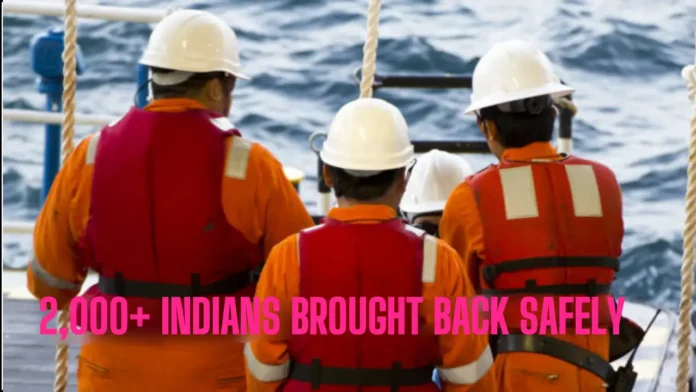
The latest Seafarer Repatriation Update from India’s maritime authorities confirms the successful return of over 2,000 Indian seafarers stranded across multiple geopolitical hotspots, including vessels caught in Red Sea disruptions and cases of ship abandonment across Gulf, Southeast Asian, and European ports. Reports suggest the coordinated operation involved the Directorate General of Shipping (DGS), the Ministry of External Affairs (MEA), and Indian diplomatic missions at multiple overseas locations. The repatriation drive reflects India’s growing resolve to protect its maritime workforce the largest national group in global shipping, contributing over 12% of the world’s total seafarer supply.
Seafarer Repatriation Update: Why Thousands Were Stranded
The primary driver behind this repatriation surge is the prolonged Red Sea shipping crisis triggered by Houthi militant attacks on commercial vessels in the Bab-el-Mandeb Strait since late 2023. Many shipping companies rerouted vessels around the Cape of Good Hope, dramatically extending voyage durations and leaving crew members aboard ships well beyond their contracted service periods. Indian seafarers on these vessels found themselves unable to sign off at their designated ports, as owners and operators struggled to arrange replacement crews along altered routes.
A secondary cause involves the rising global count of abandoned ships — vessels where owners ceased operations, stopped paying wages, and left crews without fuel, food, or a safe passage home. The International Transport Workers’ Federation (ITF) and the International Maritime Organization (IMO) classify ship abandonment as a serious violation of the Maritime Labour Convention (MLC) 2006, which guarantees all seafarers the right to repatriation at the shipowner’s expense. India, as a signatory to MLC 2006, holds legal standing to intervene through its consular network when Indian nationals face abandonment abroad.
Seafarer Repatriation Update: Role of Indian Government Agencies
The Directorate General of Shipping, operating under the Ministry of Ports, Shipping and Waterways, serves as the nodal agency for all Indian seafarer welfare interventions. DGS maintains a live database of Indian seafarers registered under the Indian CDC (Continuous Discharge Certificate) system and coordinates with Indian missions to track distress cases in real time. Reports suggest DGS activated its emergency response protocol at multiple consulates — including those in Dubai, Singapore, Colombo, and Manila — to fast-track visa support, flight arrangements, and documentation clearances for stranded crew members.
The MEA’s consular teams took charge of on-ground logistics for cases involving seafarers detained due to port state control actions against substandard vessels. In several instances, Indian consular officials directly negotiated with local port authorities to secure crew release before arranging repatriation flights. Not publicly disclosed is the exact breakdown of cases by port or shipowner nationality, though reports suggest Gulf ports accounted for the largest share of abandoned-vessel cases among the 2,000+ returnees.
The MLC 2026 Framework and Seafarer Rights
The Maritime Labour Convention, upheld under the ILO’s MLC framework, mandates that shipowners bear full responsibility for repatriating seafarers when contracts expire, when ships are abandoned, or when the seafarer becomes medically unfit for duty. Under MLC provisions, repatriation costs — including airfare, accommodation during transit, and medical expenses — must draw from the shipowner’s insurance or a state-backed guarantee fund when the owner defaults. India’s DGS has been progressively tightening enforcement of MLC compliance for ships flagged in India and for Indian-crewed vessels operating under foreign flags.
The Indian government also operates the Seafarers’ Welfare Fund through the National Shipping Board, which disburses emergency financial support to distressed seafarers and their families while repatriation proceedings are underway. Not publicly disclosed is the total amount disbursed during the current repatriation cycle, though reports suggest the fund handled a significantly higher volume of claims in early 2026 compared to the same period in 2025.
Red Sea Crisis: Direct Impact on Indian Crew
India supplies crew to a large share of the world’s bulk carriers, tankers, and container ships — many of which transited the Red Sea corridor regularly before the Houthi crisis. The rerouting of over 500 container ships per week away from the Suez Canal added approximately 10 to 14 extra days per voyage, meaning contracts signed for four-month tours stretched to five and a half months or longer without formal extension agreements. Several Indian officers reported to maritime unions that they received no formal contract amendment, no additional wages for extended service, and no clear sign-off date from their operators.
The Indian government’s response included direct engagement with the International Chamber of Shipping (ICS) to press member shipping companies into issuing formal contract extensions with revised repatriation guarantees. Reports suggest at least 18 shipping companies operating Indian-crewed vessels received formal diplomatic communication from New Delhi regarding their obligation to comply with MLC repatriation provisions.
Seafarer Repatriation Update: How the Process Worked
The repatriation pipeline for each crew member followed a structured four-stage process coordinated across DGS, the MEA, and the relevant Indian embassy:
- Stage 1 — Distress Registration: Seafarers or their families filed complaints through the DGS online portal or the MEA’s MADAD consular assistance platform, providing vessel name, flag state, current port, and contract expiry status
- Stage 2 — Diplomatic Intervention: Indian consular officials contacted port authorities and shipowners, formally invoking MLC Article 23 on repatriation obligations and demanding crew release timelines
- Stage 3 — Documentation Clearance: DGS facilitated emergency CDC endorsements and travel document renewals to ensure no seafarer faced immigration complications upon return
- Stage 4 — Flight Coordination: MEA partnered with Indian carriers — primarily Air India — to block seat allocations on repatriation-linked flights from Dubai, Singapore, Port Klang, and Rotterdam
Not publicly disclosed is whether any charter flights were deployed during the peak of operations, though a senior maritime official confirmed to industry media that group repatriation flights handled at least three batches of over 100 crew members in a single week.
India’s Seafarer Workforce: Scale of Responsibility
India currently holds the status of the world’s single largest supplier of maritime officers, with over 2,39,000 Indian seafarers actively employed on international vessels as of the most recent DGS estimate. This figure places an extraordinary welfare and consular obligation on the Indian state whenever global shipping faces systemic disruption. The country’s maritime training infrastructure — spread across Mumbai, Chennai, Kolkata, and Kochi — feeds a continuous pipeline of certified STCW-compliant officers and ratings into the international fleet.
The repatriation effort also draws attention to the chronic underinvestment in seafarer insurance frameworks by mid-size shipping operators, who often carry only the minimum MLC-required coverage. Industry bodies such as the ITF and BIMCO have renewed calls for stronger flag state enforcement and higher minimum financial security limits under MLC amendment cycles currently under discussion for 2026.
What This Means for Families and Future Sailings
For the families of the over 2,000 returned seafarers, the repatriation marks the end of a period of significant financial and emotional uncertainty, as many households depend entirely on remittances from a single crew member aboard. The Indian seafarer community remits an estimated USD 3 billion annually, making maritime employment a critical contributor to household income across coastal districts in states like Goa, Kerala, Andhra Pradesh, Maharashtra, and West Bengal.
The DGS has also issued an advisory urging all Indian seafarers signing new contracts to verify that their prospective employers carry valid P&I (Protection and Indemnity) club membership and MLC Financial Security certificates before departure. Reports suggest a revised pre-departure checklist will become mandatory under upcoming amendments to India’s Merchant Shipping Act.

