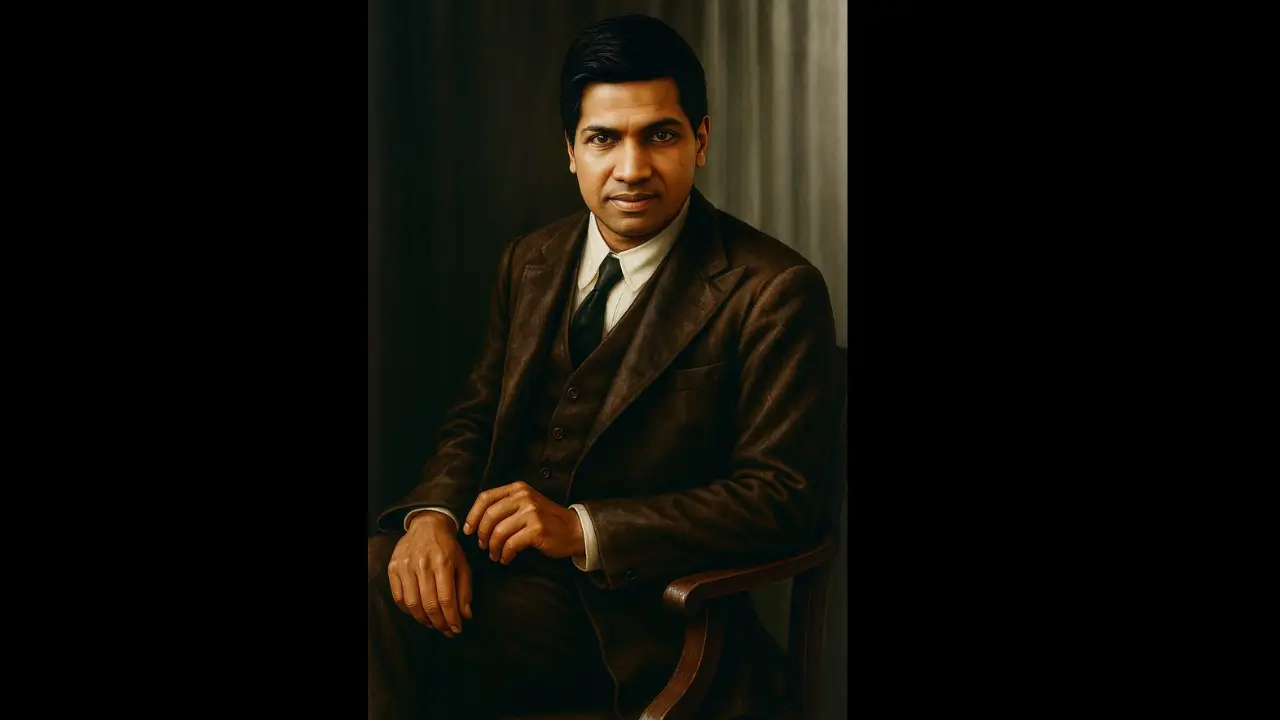
Srinivasa Ramanujan was one of the greatest mathematicians in history. He was born in India and had almost no formal training in pure mathematics. Yet, he made extraordinary contributions to mathematical analysis, number theory, infinite series, and continued fractions. His life story is a powerful example of talent and hard work.
Quick Facts About Srinivasa Ramanujan
| Fact | Details |
|---|---|
| Full Name | Srinivasa Aiyangar Ramanujan |
| Born | December 22, 1887 (Erode, India) |
| Died | April 26, 1920 (Kumbakonam, India) |
| Age at Death | 32 Years |
| Known For | Number Theory, Infinite Series, Partition Theory, 1729 |
| Spouse | Janaki Ammal |
| Education | Government Arts College (no degree), Cambridge University (Bachelor of Arts by Research) |
| Famous Quote | “An equation for me has no meaning unless it expresses a thought of God.” |
| Awards | Fellow of the Royal Society (1918) |
Early Life and Childhood
Srinivasa Ramanujan was born on December 22, 1887, in Erode, Madras Presidency (now Tamil Nadu, India). His father, Kuppuswamy Srinivasa Iyengar, worked as a clerk in a sari shop. His mother, Komalatammal, was a housewife and a singer at a local temple.
Ramanujan grew up in the town of Kumbakonam. From a young age, he showed a special talent for numbers. By age 11, he had already exhausted the mathematical knowledge of two college students who lived in his home. He later borrowed a book called A Synopsis of Elementary Results in Pure and Applied Mathematics by G.S. Carr. This book changed his life. It contained thousands of theorems but very few proofs. Ramanujan spent years working through the book and discovering new ideas on his own.
Struggles with Education
Although he was a genius in mathematics, Ramanujan faced many challenges in school. He won a scholarship to Government Arts College in Kumbakonam, but he lost it because he failed other subjects like English and history. He was so focused on math that he ignored everything else. He later enrolled at Pachaiyappa’s College in Madras but again failed his non-math exams.



Without a college degree, he had to find work to support his family. In 1912, he found a job as a clerk at the Madras Port Trust. Even while working, he never stopped doing math. He filled notebook after notebook with his formulas and theories.
The Turning Point: Letter to G.H. Hardy
Ramanujan knew his work was important, but no one in India could fully understand it. In 1913, he decided to write to mathematicians at Cambridge University in England. The most famous letter he sent was to G.H. Hardy, a brilliant British mathematician.
Ramanujan’s letter contained 120 mathematical theorems. Hardy first thought it might be a fraud, but when he looked closer, he realized the formulas were incredible. He said they “must be true because, if they were not true, no one would have the imagination to invent them.” Hardy invited Ramanujan to come to Cambridge.
Journey to England and Success
Traveling to England was difficult for Ramanujan because of his religious beliefs. He was a strict Brahmin, and crossing the ocean was considered forbidden. However, after his mother had a vivid dream where the family goddess, Namagiri Thayar, gave permission, he agreed to go.
He arrived in England in April 1914. For the next five years, Ramanujan and Hardy worked together. It was a perfect partnership. Hardy provided the rigorous proofs, and Ramanujan provided the brilliant ideas.
In 1918, Ramanujan became a Fellow of the Royal Society (FRS). He was one of the youngest people ever to receive this honor and the first Indian to do so. Later that year, he was also elected a Fellow of Trinity College, Cambridge.
Major Contributions to Mathematics
Srinivasa Ramanujan’s contribution to mathematics is vast. He discovered thousands of new theorems. Some of his most famous works include:
- The Number 1729: This is often called the “Hardy-Ramanujan number.” When Hardy visited Ramanujan in the hospital, he mentioned that his taxi number was 1729, which he thought was a boring number. Ramanujan immediately replied, “No, it is a very interesting number; it is the smallest number expressible as the sum of two cubes in two different ways” (13+123 and 93+103).
- Infinite Series for Pi: He discovered new, faster ways to calculate the value of Pi. His formulas are still used today in computer algorithms.
- Partition Theory: He made major breakthroughs in understanding how numbers can be broken down into sums of smaller numbers.
- Mock Theta Functions: These were some of his final discoveries, which physicists now use to understand black holes.
Personal Life and Wife
In 1909, Ramanujan married Janaki Ammal. She was only 10 years old at the time, which was common in those days. She joined him later in 1912. Janaki supported his work, even though they spent years apart when he went to England. She lived a long life after his death and often shared stories about his dedication to mathematics.
Illness and Death
Ramanujan’s health was never strong. In England, the cold weather and difficulty finding vegetarian food made things worse. He was diagnosed with tuberculosis at the time, but modern doctors believe he likely suffered from hepatic amoebiasis, a curable liver infection he had contracted years earlier in India.
He returned to India in 1919, hoping the warmer climate would help. Sadly, he did not recover. Srinivasa Ramanujan died on April 26, 1920, in Kumbakonam. He was only 32 years old. Even on his deathbed, he continued to write mathematical formulas.
Legacy and National Mathematics Day
Ramanujan left behind three notebooks and a “lost notebook” full of unpublished work. Mathematicians are still studying his ideas today, more than 100 years later.
To honor his achievements, the Indian government declared his birthday, December 22, as National Mathematics Day.
There have been many books and movies about his life. The most famous is the book The Man Who Knew Infinity by Robert Kanigel, which was made into a movie in 2015 starring Dev Patel.
Conclusion
Srinivasa Ramanujan was a true genius. He proved that great ability can come from anywhere. His life teaches us that passion and curiosity are the most important tools for success. Today, he is remembered not just as an Indian mathematician but as a hero of science for the whole world.

