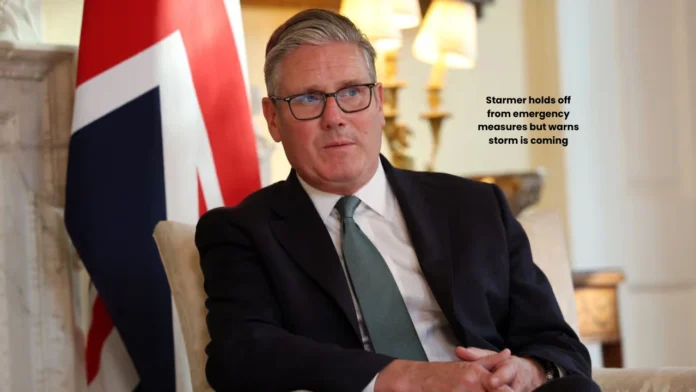
Britain’s Prime Minister Sir Keir Starmer chose a cautious but firm tone on April 5, 2026, telling the nation he would not rush into emergency economic intervention in response to the dual shocks of President Donald Trump’s sweeping global tariff regime and rising geopolitical instability but that an economic storm amid Iran conflict and the wider international trade rupture now posed a direct and serious threat to British households and businesses.
Starmer acknowledged global financial markets had endured one of the most volatile weeks in recent memory since Trump’s April 2 “Liberation Day” tariff announcement sent shockwaves across the US, Europe and Asia, wiping trillions from global equity markets within 48 hours.
Reports suggest Downing Street convened an emergency economic advisory session over the Easter bank holiday weekend, bringing together Treasury officials, the Bank of England and senior Cabinet ministers to assess the scale of the incoming pressure on the UK economy.
No Emergency Package: But Door Left Firmly Open
Starmer’s decision to hold back from announcing immediate emergency economic measures reflects a deliberate strategy of avoiding what government insiders describe as “premature intervention” that could itself unsettle markets and signal panic at a moment when stability of tone matters as much as policy action.



The Prime Minister indicated that the government already holds a range of economic tools in reserve, adding that the Chancellor of the Exchequer Rachel Reeves would set out a detailed assessment of the UK’s exposure to global tariff impacts in the coming days.
Not publicly disclosed at the time of writing is the precise threshold or economic indicator that would trigger the government’s formal emergency response package reports suggest the Treasury is monitoring unemployment claims, manufacturing output and sterling exchange rate movements as its primary warning indicators.
Trump Tariffs: The Trigger Behind the Storm Warning
The immediate catalyst for Starmer’s warning was President Trump’s “Liberation Day” tariff announcement on April 2, 2026, which placed a sweeping 10% baseline tariff on all imports to the United States, with significantly higher reciprocal tariffs targeting major US trading partners.
The United Kingdom faces the baseline 10% tariff on its goods exports to the United States a significant blow to British manufacturing, automotive, pharmaceutical and agricultural sectors that collectively depend on transatlantic trade worth hundreds of billions of pounds annually.
Reports suggest the UK government had hoped its close diplomatic relationship with Washington and its relatively balanced trade position with the US might earn an exemption or preferential treatment however, Trump’s announcement applied the baseline rate universally, leaving London with limited immediate leverage.
The FTSE 100 experienced sharp declines in the days following the announcement, mirroring severe drops across Wall Street, European bourses and Asian markets. Not publicly disclosed is the precise total loss in market capitalisation across the FTSE 100 over the week, though analysts at major investment banks placed the figure in the tens of billions of pounds.
Iran Tensions Add a Second Front to Economic Pressure
Beyond the trade war, Starmer’s warning explicitly referenced rising geopolitical instability connected to Iran, which analysts say adds a secondary layer of economic risk through energy markets and regional security uncertainty. Reports suggest heightened military tensions in the Gulf and the Strait of Hormuz a critical chokepoint through which approximately 20% of global oil supply passes have pushed Brent crude oil prices upward in recent sessions, adding to inflationary pressure that UK households were only recently beginning to see ease.
The Bank of England’s monetary policy committee faces a particularly difficult calculation: cutting interest rates to stimulate a tariff-battered economy risks reigniting inflation driven by energy price spikes, while holding rates steady risks deepening a demand slowdown.
Starmer declined to confirm whether the UK would join any coordinated Western response to Iran or adopt additional energy security measures, saying only that Britain’s national security posture “reflects our values and our alliances.” Not publicly disclosed is whether the UK’s COBRA emergency committee convened specifically to address the Iran-related dimension of the crisis during the Easter weekend.
UK Tariff Diplomacy: Where Talks Stand
The UK government has made securing a bilateral UK-US trade deal a flagship economic objective since Labour took office in July 2024, with Business Secretary Jonathan Reynolds and Trade Secretary Douglas Alexander both investing significant diplomatic effort in Washington negotiations. Reports suggest the “Liberation Day” announcement effectively paused those negotiations, with both sides needing time to assess how the new tariff architecture affects the terms of any prospective agreement.
Starmer stressed that the UK would pursue negotiations rather than retaliation, in a deliberate contrast to the European Union’s stance the EU announced it intends to impose retaliatory counter-tariffs on American goods in response to Trump’s package. The Prime Minister argued that retaliation would ultimately harm British consumers and businesses more than it would pressure Washington into concessions, framing restraint as a strategic rather than a weak position.
What The Economic Storm Could Mean for British Households
Independent economists and think tanks outlined the concrete risks the combination of tariffs and geopolitical instability poses to ordinary UK households:
| Risk Area | Potential Impact |
| Manufacturing Jobs | British exporters facing US tariffs may cut production and staffing |
| Food and Goods Prices | Supply chain disruption and sterling weakening could push prices higher |
| Mortgage Costs | Inflation uncertainty complicates Bank of England rate cut decisions |
| Energy Bills | Oil price rises from Gulf tension could reverse recent domestic energy cost declines |
| Business Investment | Uncertainty typically causes firms to delay capital spending and hiring |
| Export Revenues | UK goods sectors — particularly automotive, Scotch whisky, steel — face direct US tariff costs |
Reports suggest the Office for Budget Responsibility (OBR) may revise its UK growth forecast downward in light of the new tariff environment though not publicly disclosed is whether Chancellor Rachel Reeves has formally requested an emergency OBR assessment outside the standard fiscal event schedule.
Opposition Response: Criticism from Left and Right
Starmer’s measured approach drew criticism from both sides of the political spectrum. Conservative leader Kemi Badenoch accused the Prime Minister of being “too slow and too passive” in the face of a direct economic threat, calling for immediate targeted support for British exporters and a more assertive posture in trade talks with Washington. Reports suggest Badenoch will use the coming parliamentary week to push the government for a specific emergency support package for the manufacturing sector.
From the left, several Labour backbenchers and the Liberal Democrats expressed concern that ordinary working families already stretched by mortgage costs, energy bills and food prices could not wait for the government’s measured timeline before support arrived. Liberal Democrat Treasury spokesperson Sarah Olney called for “immediate action, not warm words,” demanding direct cost-of-living relief be attached to any trade response framework. Not publicly disclosed is whether any Labour MPs formally tabled internal motions pushing for a faster government response during the Easter recess period.
Scotland and Wales: Devolved Nations Flag Separate Concerns
Scotland’s First Minister John Swinney issued a separate statement on April 5, highlighting the particular vulnerability of Scottish exports especially Scotch whisky and salmon to the US tariff regime, noting that Scotland sends approximately £1 billion worth of whisky exports to the American market annually.
Swinney called for Scotland to receive a direct voice in UK-US trade negotiations and for the Scottish Government to receive emergency economic powers to support affected Scottish exporters if a deal cannot be reached swiftly.
Wales’s First Minister Eluned Morgan similarly raised concerns about the impact on Welsh steel already under structural pressure and on Welsh agricultural exports. Reports suggest the UK Government will hold a formal joint ministerial session with devolved administrations this coming week to co-ordinate a unified response to the tariff threat, though the terms and outcomes of that session are not publicly disclosed.
Bank of England: Under Pressure to Act
The Bank of England faces a uniquely difficult policy environment as the tariff storm hits. Governor Andrew Bailey indicated in late March 2026 that the Monetary Policy Committee remained on course for gradual rate cuts through 2026 but the “Liberation Day” shock and Iran-related energy price pressure now complicate that path significantly.
Reports suggest the Bank’s May 2026 MPC meeting will include a full assessment of the tariff impact on UK growth and inflation projections, with markets now pricing in a lower probability of an early rate cut compared to the pre-tariff outlook.
Not publicly disclosed is whether Bailey held direct conversations with Starmer or Reeves over the Easter weekend to co-ordinate messaging on the Bank’s likely response trajectory.

