The UK State Pension Age enters a new chapter in April 2026 as the government begins its legislated phased increase from 66 to 67 a process that directly affects every worker in England, Scotland and Wales born on or after April 6, 1960, who will now find they must wait longer before receiving their State Pension than previous generations.
The transition, legislated under the Pensions Act 2014, does not happen overnight instead it takes effect on a sliding scale based on the individual’s exact date of birth, meaning some people born in 1960 will reach pension age at 66 years and a few months, while those born from April 6, 1977 onwards will face a full State Pension Age of 67.
April 2026 simultaneously delivers the biggest State Pension payment increase in years a 4.8% Triple Lock rise pushing the full New State Pension to £230.25 per week.
What the April 2026 Start Date Actually Means
The phrase “rollout starts April 2026” does not mean everyone suddenly shifts to a pension age of 67 on the same date. The Pensions Act 2014 sets up a gradual two-year transition window running from April 6, 2026 to April 5, 2028, during which the State Pension Age incrementally rises from 66 to 67 depending on each individual’s date of birth.




People born before April 6, 1960 retain a State Pension Age of 66 and are entirely unaffected by this change. Everyone born on or after April 6, 1977 will have a full State Pension Age of 67. Those born between April 6, 1960 and April 5, 1977 fall within the transition window and face a pension age somewhere between 66 and 67, calculated precisely on their birth date.
Who Is Affected: Birth Date Breakdown
The transition from State Pension Age 66 to 67 affects different birth cohorts in specific ways:
| Date of Birth | State Pension Age |
| Before 6 April 1960 | 66 years — no change |
| 6 April 1960 to 5 May 1960 | 66 years and 1 month |
| 6 May 1960 to 5 June 1960 | 66 years and 2 months |
| 6 June 1960 to 5 July 1960 | 66 years and 3 months |
| 6 July 1960 to 5 August 1960 | 66 years and 4 months |
| 6 August 1960 to 5 September 1960 | 66 years and 5 months |
| 6 September 1960 to 5 October 1960 | 66 years and 6 months |
| 6 October 1960 to 5 November 1960 | 66 years and 7 months |
| 6 November 1960 to 5 December 1960 | 66 years and 8 months |
| 6 December 1960 to 5 January 1961 | 66 years and 9 months |
| 6 January 1961 to 5 February 1961 | 66 years and 10 months |
| 6 February 1961 to 5 March 1961 | 66 years and 11 months |
| 6 March 1961 to 5 April 1977 | 67 years |
| 6 April 1977 onwards | 67 years — full increase applied |
Workers approaching their mid-sixties should check their personal State Pension age using the official GOV.UK State Pension Age calculator at gov.uk/state-pension-age rather than assuming either 66 or 67 applies to them — the exact date varies by birth month during the transition window.
April 2026 New State Pension Rate
April 2026 simultaneously delivers a significant increase in the value of the State Pension itself. Under the government’s Triple Lock guarantee, the State Pension rises every April by whichever of three measures is the highest: average earnings growth, the Consumer Prices Index (CPI) inflation rate or 2.5%.
For April 2026, average earnings growth came in as the highest of the three measures at 4.8%, triggering the largest State Pension increase in several years:
| Pension Type | Weekly Rate 2025–26 | Weekly Rate 2026–27 (+4.8%) |
| Full New State Pension | £221.20 | £230.25 |
| Full Basic State Pension | £169.50 | £177.65 |
| Pension Credit Standard Minimum (Single) | £218.15 | £227.10 |
| Pension Credit Standard Minimum (Couple) | £332.95 | £348.95 |
Over a full year, the New State Pension increase adds approximately £470 per year to the income of a qualifying pensioner in receipt of the full rate. The new rates took effect from the first payment cycle on or after April 6, 2026, meaning most pensioners will see the higher amount in their bank account from the week of April 7, 2026 onwards.
How to Check Your Personal State Pension Age and Forecast
The DWP gives every UK worker tools to check exactly when they will reach State Pension Age and how much they stand to receive:
- State Pension Age Checker: Visit gov.uk/state-pension-age — enter your date of birth and the tool returns your exact pension age and the date you qualify
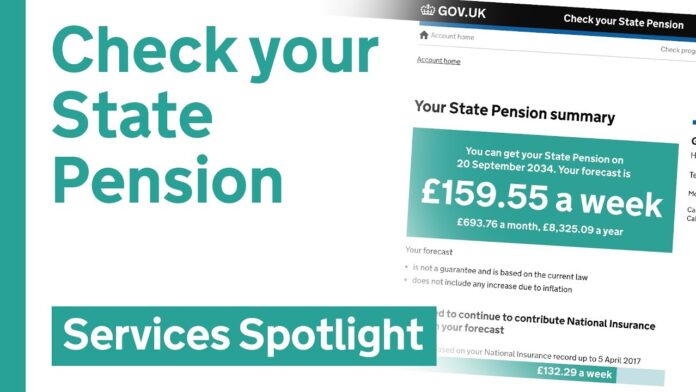
- State Pension Forecast: Log into your Personal Tax Account at gov.uk/personal-tax-account using Government Gateway credentials — the forecast shows your projected pension based on your National Insurance record
- National Insurance Record: Check your NI contribution history at the same Personal Tax Account portal — identifies any gaps in your record and tells you whether buying voluntary NI contributions would increase your eventual pension
- Future Pension Centre: Call 0800 731 0175 (Monday to Friday, 8:00 AM to 6:00 PM) to speak to a DWP adviser about your personal State Pension position
Reports suggest a significant number of people approaching retirement age remain unaware their State Pension Age has shifted due to the transition — the DWP has issued communications urging all workers in their early-to-mid sixties to verify their personal entitlement date immediately rather than assuming they qualify at 66.
What Happens If You Claim Before or Defer After Your State Pension Age
The UK State Pension does not pay automatically workers must actively claim it on or after reaching their State Pension Age. Claiming early is not possible; the DWP will not pay the State Pension before the qualifying date regardless of employment status. However, deferring the pension beyond State Pension Age increases the eventual weekly payment:
- Deferring under the New State Pension rules adds approximately 1% for every 9 weeks you delay claiming beyond your State Pension Age — equivalent to roughly 5.8% extra for every full year of deferral
- Deferring under the Basic State Pension (old rules, pre-April 2016) added 1% for every 5 weeks deferred — roughly 10.4% for every full year
- Reports suggest deferral becomes more financially advantageous the healthier and longer-lived the individual — a decision best reviewed with a qualified independent financial adviser
Not publicly disclosed is whether the government plans to revise the deferral enhancement rates ahead of any future State Pension Age increase to 68 — a further rise currently legislated but not yet confirmed for its specific implementation timeline.
State Pension Age 68: The Next Rise on the Horizon
Looking further ahead, the Pensions Act 2007 legislates a further rise in State Pension Age from 67 to 68, though the timing of that transition is subject to periodic review. The most recent government review, completed under the previous Conservative administration, proposed the 67-to-68 transition take place between 2044 and 2046, affecting people born from April 1977 onwards. The current Labour Government has not publicly confirmed whether it will retain, accelerate or delay that timeline following the current 66-to-67 transition.
Reports suggest the DWP conducts statutory reviews of State Pension Age every six years, assessing life expectancy data, labour market participation rates and fiscal sustainability before recommending any adjustment. Not publicly disclosed is when the next statutory review report will be laid before Parliament — though given the April 2026 transition start, analysts widely expect the next formal review to address the 68 timeline before the end of this parliament.
Planning Your Finances Around the Pension Age Change
Financial advisers and retirement planning organisations identify several steps anyone born from April 6, 1960 onwards should take immediately in light of the April 2026 change:
- Verify your exact State Pension Age using the GOV.UK calculator — do not assume 66 or 67 without checking
- Review your National Insurance record for gaps — you may be able to pay voluntary Class 3 NI contributions to fill shortfalls and maximise your pension entitlement
- Assess whether workplace or private pension arrangements bridge the gap if you want to retire before your State Pension Age
- Check Pension Credit eligibility if you retire before State Pension Age and have low income — Pension Credit supplements income for those who qualify
- Speak to a regulated independent financial adviser registered with the Financial Conduct Authority (FCA) — especially if the change forces a recalculation of your planned retirement date
Not publicly disclosed is whether the government will provide a dedicated communications campaign to directly notify all individuals born between 1960 and 1977 of their revised State Pension Age a gap that critics argue leaves too many workers unprepared for the change.

