

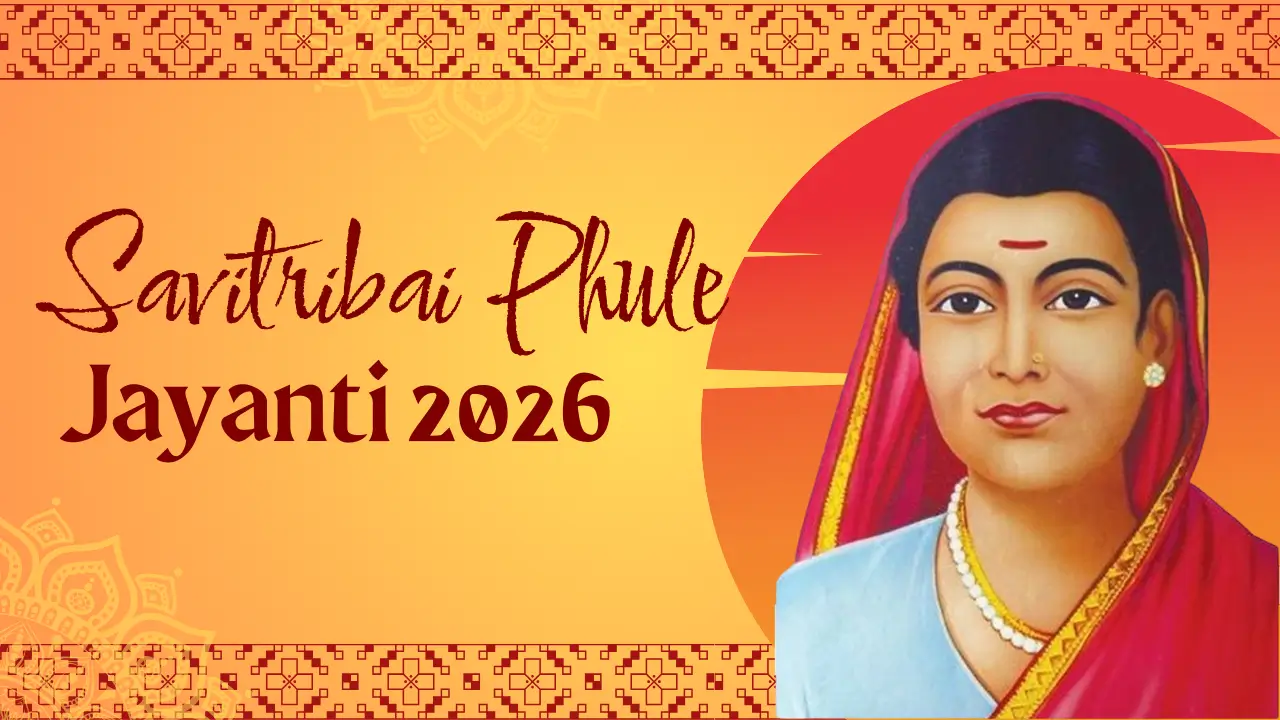
Savitribai Phule Jayanti is observed annually on January 3rd to honor the birth anniversary of Savitribai Phule, India’s pioneering female teacher and renowned social reformer. In 2026, this significant day falls on Friday, January 3rd, marking the 195th birth anniversary of a woman whose courage and determination transformed education and women’s rights in India during the 19th century.
Savitribai Phule’s legacy extends far beyond her lifetime. Her revolutionary work in establishing India’s first girls’ school and her unwavering commitment to social justice continue to inspire educators, activists, and citizens across the country. This comprehensive guide explores her life, contributions, and how communities celebrate her Jayanti today.
Who Was Savitribai Phule?
Savitribai Phule (1831–1897) was born on January 3, 1831, in Naigaon village in Satara District, Maharashtra. She is recognized as India’s first female teacher and a pioneering advocate for women’s education, gender equality, and social justice.

Born into the Mali community, Savitribai was married to Jyotirao Phule at age 10 (he was 13) according to common practices of that era. Like most girls of her time, she was initially illiterate. However, her husband recognized her potential and personally educated her at home. She later received formal teacher training in Pune and Ahmednagar, becoming India’s first professionally trained female headmistress.
Key Characteristics That Defined Her
Savitribai possessed exceptional courage and intellectual acuity. Despite facing intense social opposition, violent attacks, and family rejection, she remained steadfast in her mission to educate marginalized communities. Her belief that education was a universal right rather than a privilege for the upper castes shaped every initiative she pursued.
Life Timeline and Key Events
Understanding the chronological progression of her work reveals the scale of her achievements:
| Year | Event | Significance |
|---|---|---|
| 1831 | Born January 3 in Naigaon, Satara | Birth of India’s future first female teacher |
| 1840 | Married to Jyotirao Phule at age 10 | Started marital life and began education under husband’s guidance |
| 1847 | Completed teacher training in Pune | First Indian woman to receive formal teacher certification |
| 1848 | Opened first girls’ school at Bhidewada, Pune | Established India’s first girls’ school on January 1, 1848 |
| 1849 | Father-in-law evicted the family | Family rejected her for “sinful” acts of educating lower castes |
| 1851 | Three girls’ schools operating | Over 150 girls enrolled across three Phule-run schools |
| 1851 | Founded Mahila Seva Mandal | Organization dedicated to women’s rights and empowerment |
| 1852 | Honored as “Best Teacher” | British government recognized her excellence in education |
| 1853 | Opened Balhatya Pratibandhak Griha | Prevention center for infanticide targeting widow oppression |
| 1854 | Published “Kavya Phule” | First poetry collection; established herself as a writer |
| 1855-1873 | Expanded educational network | Total of 18 schools opened across Pune region |
| 1873 | Co-founded Satyashodhak Samaj | Led women’s wing; pioneered “Satyashodhak Marriage” ceremony |
| 1892 | Published “Bavan Kashi Subhodh Ratnakar” | Second literary work; continued intellectual contributions |
| 1897 | Died March 10 in Pune | Legacy cemented as transformative social reformer |
Educational Contributions
Savitribai’s educational legacy forms the bedrock of her historical significance. Her initiatives weren’t merely about opening schools—they represented a fundamental challenge to social hierarchies and gender discrimination.
Establishment of India’s First Girls’ School
On January 1, 1848, Savitribai and Jyotirao opened the nation’s first school exclusively for girls at Bhidewada in Pune. This wasn’t a residential school in a major building—it operated from a residential space provided by their supporter, Tatyasaheb Bhide. Despite its humble physical setting, the school’s curriculum was revolutionary.
The institution taught subjects previously considered inappropriate for women: mathematics, science, geography, history, and social studies. This progressive curriculum reflected Savitribai’s conviction that women’s intellectual capacity was equal to men’s and that education should enable critical thinking.
Rapid Expansion and Scale
The success of the first school led to rapid expansion. By 1851—just three years later—the Phules operated three schools with approximately 150 students. Their ultimate achievement was opening a total of 18 schools across the Pune region, serving girls, Shudras (lower castes), and Ati-Shudras (communities outside the caste system).
Innovative Pedagogical Practices
Savitribai implemented practices ahead of her time:
- Stipends for Students — She introduced financial incentives to motivate attendance, recognizing that poverty prevented many from attending school
- Parental Engagement — Regular meetings with parents emphasized education’s value, challenging traditional beliefs that girls’ education was unnecessary
- Inclusive Admissions — Schools welcomed girls regardless of caste, religion, or socioeconomic background
- Practical Curriculum — Teaching included not just academics but also practical life skills and social awareness
Social Reform Initiatives
Beyond formal education, Savitribai championed several interconnected social reform movements:
The Satyashodhak Samaj (Society of Truth Seekers) — 1873
Savitribai co-founded this organization alongside her husband. The Samaj represented a systematic challenge to Brahminical orthodoxy and caste-based oppression. She led the women’s wing, organizing women across social boundaries.
Key Activities:
- Promoted inter-caste marriages, challenging Brahminical restrictions
- Advocated for widow remarriage, opposing the practice of widows living as social outcasts
- Established the “Satyashodhak Marriage” ceremony, where couples took public oaths to promote education and equality
- Conducted awareness campaigns on caste discrimination and gender justice
Mahila Seva Mandal (Women’s Service Society) — 1851
This organization focused explicitly on women’s empowerment and rights. It served as a collective platform where women learned about their rights, supported each other through social challenges, and participated in reform activities.
Balhatya Pratibandhak Griha (Infanticide Prevention Center) — 1853
Savitribai and Jyotirao established this shelter targeting a horrific social practice—the infanticide of female children born to widows. The center provided refuge to destitute widows and children, offering them protection and education as alternatives to infanticide.
Savitribai Phule Jayanti 2026 Date
Savitribai Phule Jayanti falls on Friday, January 3, 2026, marking her 195th birth anniversary. The celebration date remains consistent annually because Savitribai’s birth date—January 3, 1831—is fixed in the Gregorian calendar.
Why January 3rd?
The specific date honors her literal birth date, making the celebration historically precise. Unlike some observances that shift to weekends for convenience, Jayanti celebrations occur on the actual calendar date, sometimes requiring people to celebrate on weekdays.
How Jayanti is Celebrated
Celebrations in Educational Institutions
Schools, colleges, and universities across India mark the occasion with meaningful activities:
- Lamp-Lighting Ceremonies — Events begin with “deepa prajwalanam” (lighting oil lamps), symbolizing knowledge dispelling ignorance
- Floral Tributes — Students place flowers at Savitribai’s portraits and statues displayed in school grounds
- Guest Lectures — Historians, social activists, and scholars discuss her contributions and contemporary relevance
- Student Performances — Girls dress as Savitribai and deliver speeches about her work, embodying her legacy
- Essay and Poem Competitions — Students write about her reform work and social vision
- Educational Exhibits — Displays showcase her life, achievements, timeline, and historical context
Community and Civic Celebrations
Beyond educational settings, broader communities engage with the observance:
- Public Gatherings — Municipal and state governments organize events at civic centers and parks
- Marches and Processions — In Maharashtra particularly, people participate in heritage walks highlighting locations associated with Savitribai’s work
- Social Media Campaigns — Educators and activists share resources, quotes, and discussions online
- Documentary Screenings — Organizations screen films about her life and work
- Library Exhibitions — Libraries display her writings and historical documents
Regional Variations
Maharashtra observes the most elaborate celebrations, reflecting Savitribai’s deep roots in the state:
- State Holiday Recognition — Maharashtra officially recognizes January 3rd as a state holiday in her honor
- Official Ceremonies — State government representatives participate in formal tributes
- School Closures — Some schools remain closed to allow participation in community-wide observances
- Historical Site Visits — People visit locations where Savitribai opened schools, particularly sites in Pune
Other Indian States observe the day through:
- School Programs — Most schools nationwide conduct assembly programs
- Social Organization Events — NGOs and women’s groups organize awareness sessions
- University Observances — Academic institutions host seminars and discussions
Significance and Impact
Why Savitribai Phule Jayanti Matters Today
The observance carries profound contemporary relevance:
1. Gender Equality Advocacy — Her life exemplifies women’s capacity for leadership and transformation, challenging persistent gender stereotypes. Schools use the occasion to discuss ongoing gender disparities in education access.
2. Educational Equity — Savitribai pioneered inclusive education. Her Jayanti reminds societies of the moral imperative to provide quality education regardless of gender, caste, religion, or economic status.
3. Social Justice Consciousness — The celebration encourages reflection on systemic discrimination and individual responsibility for dismantling injustice.
4. Empowerment Through Education — Her model demonstrates that education is the most powerful tool for personal liberation and social transformation.
5. Historical Awareness — Young generations learn about 19th-century social movements and the sacrifices earlier reformers made.
Lessons for Modern Society
Perseverance Despite Opposition: Savitribai faced violent attacks—upper-caste men threw mud and stones at her while traveling to school. She carried an extra sari to change into after being targeted. This resilience offers inspiration for contemporary activists facing resistance.
Systemic Thinking: Rather than viewing women’s education in isolation, Savitribai connected it to broader social reform—caste abolition, widow rights, inter-caste marriage. This integrated approach to social change remains relevant.
Strategic Partnerships: She worked with her husband, employed Fatima Begum Shaikh (India’s first Muslim woman teacher), and built networks across communities. Coalition-building proves essential for sustainable reform.
Long-term Vision: Establishing 18 schools represented methodical, sustained effort rather than symbolic gestures. Durable social change requires institutional building and patient persistence.
Challenges She Faced
Understanding the obstacles Savitribai overcame deepens appreciation for her achievement:
Social Ostracism and Family Rejection
In 1849, Savitribai’s own father-in-law evicted her and Jyotirao from the family home. The family accused them of committing a grave “sin” against Brahmins by educating lower castes. This familial rejection meant losing inheritance, social status, and emotional support—sacrifices that would discourage most people.
Physical Violence and Harassment
Traveling to and from school, Savitribai endured systematic violence from upper-caste men:
- Stone-pelting and mud-throwing — Orchestrated campaigns to humiliate and intimidate her
- Caste-based slurs — Verbal abuse designed to shame her for transgressing social boundaries
- Threats of bodily harm — Intimidation attempts intended to force her to abandon teaching
She reportedly kept an extra sari with her specifically because her regular clothing would become soiled during these attacks.
Institutional Resistance
Beyond individual actors, institutional forces opposed her work:
- Landlords refused to rent spaces for schools, forcing them to operate from supporters’ homes
- The Brahminical establishment systematically opposed educating lower castes and women
- Economic barriers existed — without family wealth, funding schools required seeking financial support
Societal Taboos
The society held deeply ingrained beliefs that education for women and lower castes was spiritually polluting. Challenging these fundamentally held worldviews required not just institutional change but cultural transformation.
Legacy and Modern Relevance
Historical Legacy
It is worth noting that the British government officially recognized Savitribai’s excellence in 1852, declaring her the “best teacher in the Bombay Presidency” according to records from the British-run education department. This external validation, while ironic given colonial context, indicated her impact transcended her immediate circle.
Her literary contributions—Kavya Phule (1854) and Bavan Kashi Subhodh Ratnakar (1892)—preserved her ideas in written form. Her poetry combined personal reflection with social commentary, making philosophical ideas accessible.
Institutional Continuity
The schools Savitribai opened did not disappear after her death. Under the guardianship of her student Fatima Begum, the institutions continued operating. This continuity demonstrated that meaningful educational infrastructure could outlive founders when properly established.
Contemporary Educational Reforms
Modern Indian education policy increasingly reflects principles Savitribai advocated:
- National education policies emphasize gender parity in school enrollment and completion
- Scheduled Caste and Scheduled Tribe reservations in education directly address discrimination she fought
- Midday meal schemes resemble her stipend model for improving attendance
- Community involvement in education echoes her parental engagement initiatives
- Inclusive curriculum discussions reflect her conviction that education should serve all social groups
Feminist Movement Recognition
Contemporary scholars and activists recognize Savitribai as a foundational figure in Indian feminism. Unlike some later feminist movements that emerged in elite, Westernized contexts, her work:
- Intersected caste and gender — understanding that lower-caste women faced compounded oppression
- Centered marginalized women — focusing on widows, Dalit women, and women from oppressed castes
- Connected individual empowerment to systemic change — individual education linked to social transformation
Ways to Participate in Savitribai Phule Jayanti 2026
For Students
- Participate in school programs organized on January 3rd or nearby dates
- Write essays or poems about her life and contributions
- Present on her reforms to classmates
- Create visual projects like posters, infographics, or digital presentations
- Organize discussions about gender equality and educational access
For Educators
- Incorporate her story into history, social studies, and civic education curricula
- Organize assemblies with multimedia presentations about her life
- Facilitate student-led commemorations where young people take leadership roles
- Connect her work to contemporary issues like gender gaps in education and caste discrimination
- Partner with local community organizations for extended observances
For Community Members
- Attend public events organized by schools, colleges, and civic bodies
- Support educational initiatives for girls and marginalized communities
- Engage in volunteer work with education-focused organizations
- Share Savitribai’s story on social media to raise awareness
- Support women’s education organizations in her memory
Eco-Friendly Celebration Practices
- Use fresh flowers from local gardens rather than commercially grown alternatives
- Prepare digital materials rather than printing to reduce paper waste
- Organize plantation drives in schools named after Savitribai or women’s colleges
- Avoid single-use plastics during event celebrations
- Conduct virtual events to reduce transportation emissions
The Enduring Relevance of Savitribai Phule
Savitribai Phule’s Jayanti transcends historical commemoration. It represents an annual opportunity for societies to ask fundamental questions: Are we providing equitable educational opportunities? Are we challenging systemic discrimination? Are we empowering marginalized communities?
Her life demonstrates that individual conviction, strategic action, and persistent effort can generate transformative social change. In 2026, as schools and communities mark her 195th birth anniversary on January 3rd, they participate in a tradition that honors not just her memory but also her unfinished mission of ensuring education as a universal right for all.