

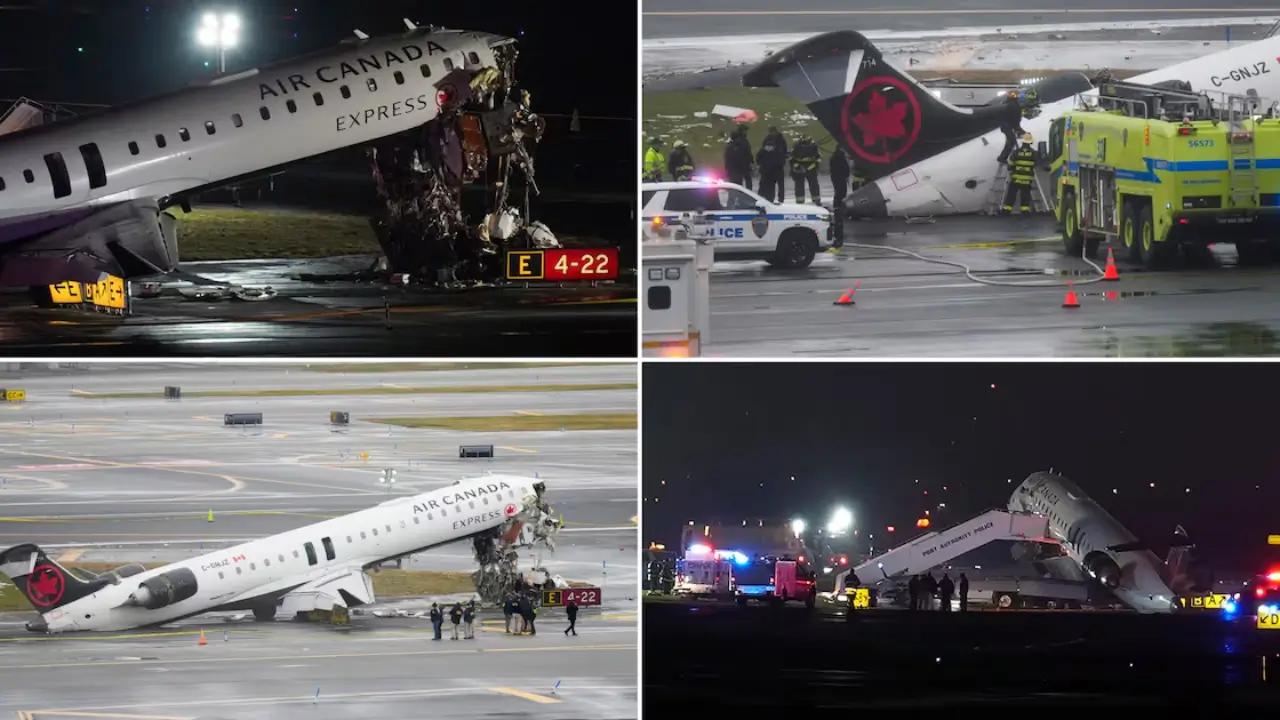
The Air Canada Plane Crash 2026 occurred around 11:30 p.m. when flight AC8646, en route from Montreal, touched down on Runway 4 and collided with a Port Authority Aircraft Rescue and Firefighting vehicle that was responding to a separate incident.
The aircraft involved was a Bombardier CRJ‑900 regional jet operated by Jazz Aviation LP under the Air Canada Express brand. Officials confirmed that the impact happened while the plane was still rolling after touchdown, causing the jet to veer and come to rest atop the fire‑truck.
Flight Information and Timeline
Flight AC8646 departed Montreal‑Trudeau Airport carrying 72 passengers and four crew members, for a total of 76 people aboard. The flight proceeded normally until the final approach to LaGuardia, where air‑traffic‑control transmissions indicated the crew attempted to stop or reverse after spotting the ground vehicle.
The aircraft struck the fire‑truck at approximately 11:40 p.m. local time, according to multiple eyewitness recordings and airport statements. After the collision, the jet came to rest at an angle, with its nose tilted upward and the forward cabin severely damaged.
Casualties and Injuries
Both pilots died as a direct result of the impact, while 41 passengers and crew members were transported to area hospitals for treatment. Among the injured, 32 were later released after receiving care for minor to moderate injuries, and nine remained hospitalized with more serious conditions.
Passenger Jack Cabot described the moment as a “truly distressing experience” in which he felt the cabin lurch forward before the violent backward jolt of the collision. Joe Capio, another traveler, reported that many occupants suffered head injuries after being thrown forward into the seat backs and then backward upon impact.
Eyewitness and Passenger Accounts
Surveillance footage captured by airport cameras shows the aircraft approaching the fire‑truck, the moment of impact, and the subsequent evacuation of passengers onto the runway. Passengers described hearing a loud “slam” and seeing luggage, phones and personal items scatter across the cabin as the jet jerked violently.
Several witnesses noted a sensation of two distinct motions: an initial forward surge as the pilots tried to brake, followed by a hard rearward thrust when the plane hit the vehicle. The cabin lights flickered and oxygen masks deployed in some rows as the aircraft came to a halt.
Airport and Authority Response
Immediately after the crash, the Port Authority of New York and New Jersey ordered LaGuardia Airport to remain closed to all arrivals and departures to facilitate rescue operations and evidence collection.
The airport announced it would stay shut until 2:00 p.m. on March 23, 2026, allowing investigators full access to the wreckage and runway area. Emergency crews, including firefighters, paramedics and law‑enforcement officers, rushed to the scene to extract passengers and provide medical aid. Two firefighters who were aboard the struck vehicle also sustained injuries and were taken to hospital for evaluation.
Investigation Status
The National Transportation Safety Board (NTSB) of the United States and the Transportation Safety Board of Canada (TSBC) have deployed investigative teams to LaGuardia to examine the aircraft, the fire‑truck, air‑traffic‑control recordings and wreckage patterns.
Investigators are reviewing cockpit voice recorder data, radar tracks and the timing of the fire‑truck’s movement onto the runway. Early statements from authorities emphasize that the probe will determine whether any procedural, communication or mechanical factors contributed to the collision. Neither Air Canada nor Jazz Aviation has released speculation about cause, stating they are fully cooperating with the official inquiries.