

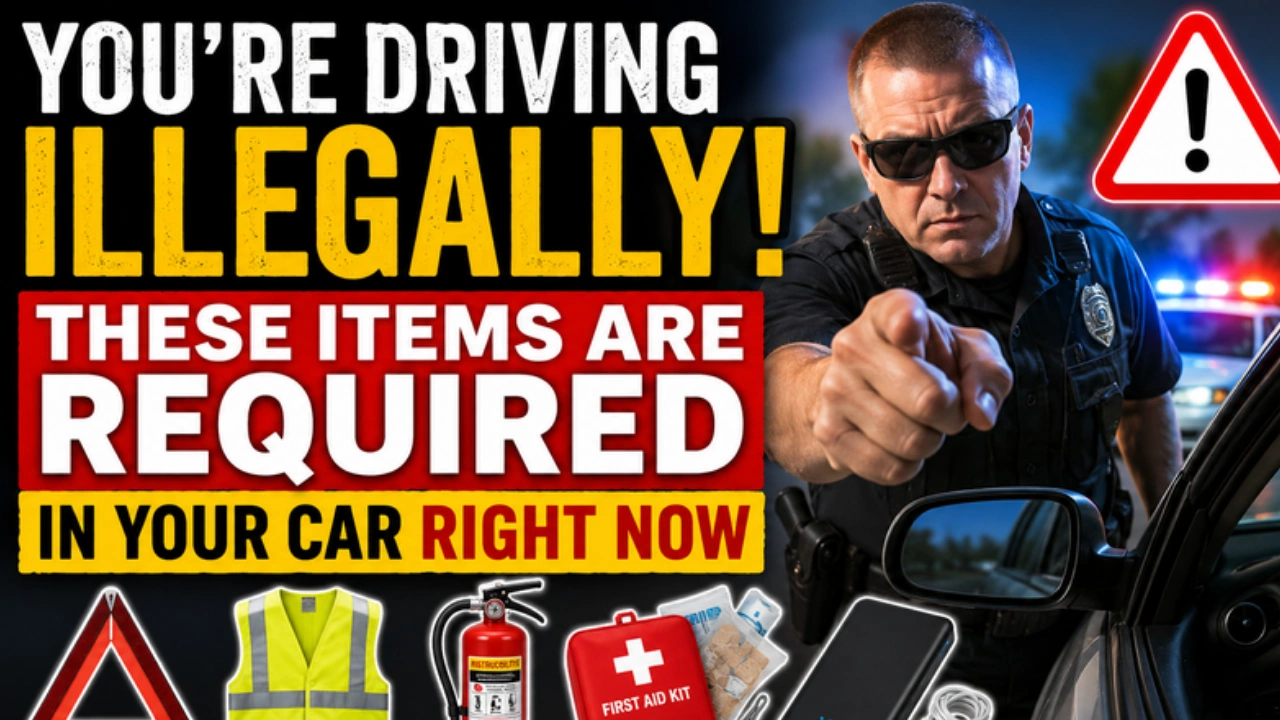
Most drivers hit the road every day without realizing they’re breaking the law. Not because they’re speeding or running red lights — but because they’re missing a few legally required items that must be inside their vehicle at all times. Traffic police can fine you on the spot, and in some cases, your insurance could even be voided. So before you start your engine today, read this carefully.
Why This Matters More Than You Think
Traffic laws aren’t just about how you drive — they’re also about what you carry. Whether you’re in the UK, India, the US, or Europe, road safety regulations require every driver to have specific documents and equipment in their vehicle. Ignorance is not a valid excuse in court, and “I didn’t know” won’t save you from a heavy fine.
Let’s break down exactly what you need right now.
✅ Legally Required Documents (Always Keep These in Your Car)
- Driving Licence — Original or digital copy depending on your country’s rules
- Vehicle Registration Certificate (RC Book) — Proof that your car is legally registered
- Insurance Policy Document — Third-party insurance is mandatory in most countries; comprehensive is recommended
- Pollution Under Control (PUC) Certificate — Mandatory in India; equivalent emissions certificates required in the UK and EU
- Road Tax Receipt — Required in several countries as proof of annual road tax payment
🚨 Required Safety Equipment (Missing These = Instant Fine)
- Reflective Warning Triangles — Mandatory in the UK, EU, and India; must be placed behind your car in case of breakdown
- First Aid Kit — Legally required in Germany, Austria, and several other European nations; strongly recommended everywhere
- Fire Extinguisher — Mandatory in India for commercial vehicles; recommended for all private cars
- Spare Tyre + Jack + Wrench — Required in many countries; no spare tyre means you’re stranded AND potentially non-compliant
- Seatbelts for All Passengers — Every seat must have a functional seatbelt; broken ones are illegal
- Reflective Safety Vest — Mandatory in France, Spain, Italy, and many EU countries; must be accessible from inside the car (not the boot)
- Child Safety Seat — If travelling with children under the required age/height, a proper car seat is the law, not optional
🇮🇳 India-Specific Must-Haves (Motor Vehicles Act)
Under the Motor Vehicles Act, Indian drivers can be fined for not carrying:
- Valid driving licence (fine up to ₹5,000)
- RC Book and insurance papers
- Updated PUC certificate (fine up to ₹10,000 for first offence)
- Functional headlights, indicators, and horn
- Properly inflated tyres with legal tread depth
Traffic police in cities like Delhi, Mumbai, and Bengaluru are actively checking all of the above during routine stops.
🇬🇧 UK-Specific Requirements
- Valid MOT certificate (for cars over 3 years old)
- Proof of car insurance (can be shown digitally)
- Vehicle Excise Duty (road tax) — checked automatically via ANPR cameras
- Functional seatbelts and working lights
- Tyre tread depth of at least 1.6mm — driving below this is illegal and carries a fine of up to £2,500 per tyre
Things People Forget That Can Get You Fined
- Expired insurance — Even one day over is illegal
- Cracked windscreen — If it obstructs the driver’s view, it’s an offence
- Broken tail lights or headlights — Easy to miss, expensive to ignore
- Unsecured cargo — Items flying off your car are your legal responsibility
- Using a phone without a hands-free kit — Still one of the most common fines worldwide
- Dirty number plates — Yes, an unreadable plate can get you pulled over
Quick Checklist Before Every Drive 🗒️
- ☐ Driving licence in wallet or on phone
- ☐ Insurance and RC documents accessible
- ☐ PUC/MOT certificate valid and in car
- ☐ Warning triangle in boot
- ☐ Spare tyre inflated and jack available
- ☐ All lights functional
- ☐ Seatbelts working for all seats
- ☐ Phone mounted or on hands-free
Don’t Wait for a Traffic Stop to Find Out
The scary truth is that most people only discover they’re non-compliant when they’re already pulled over — and by then it’s too late. A quick 10-minute car check today could save you thousands in fines and, more importantly, could save your life or someone else’s in an emergency.