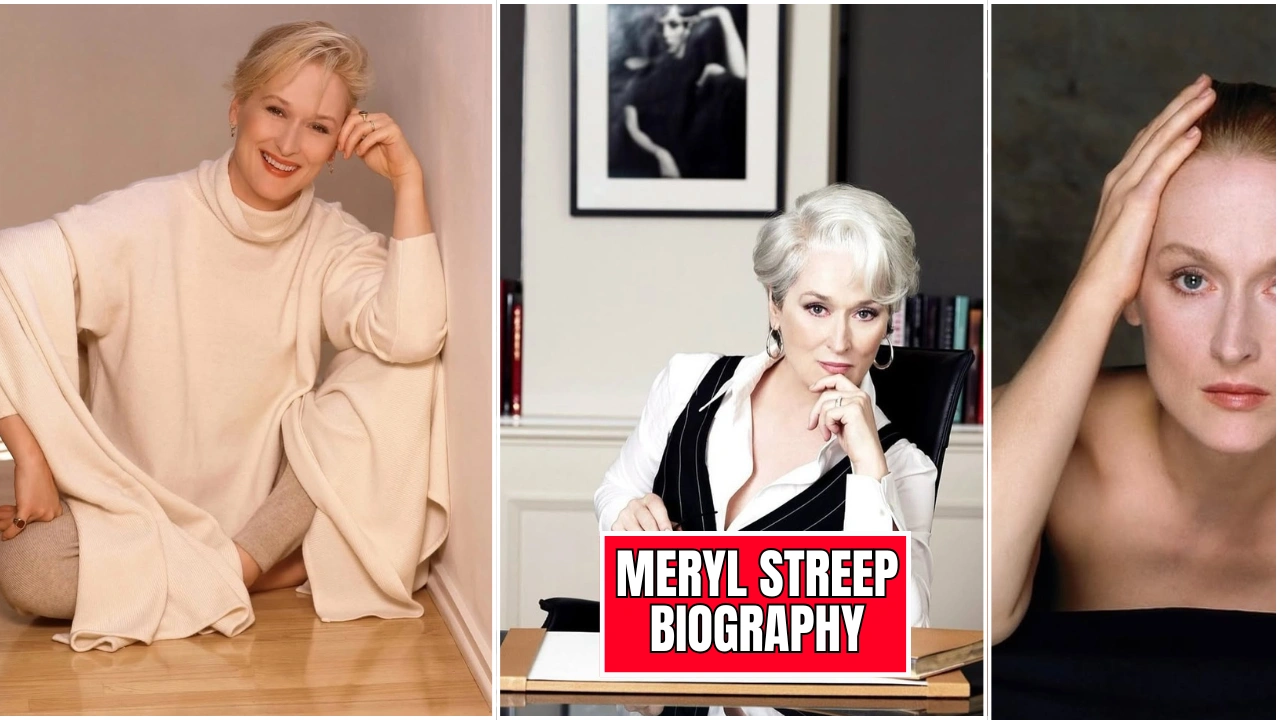
Meryl Streep, born Mary Louise Streep on June 22, 1949, in Summit, New Jersey, is an American actress widely regarded as one of the greatest performers in film history. With an unprecedented 21 Academy Award nominations and three wins for “Kramer vs. Kramer” (1979), “Sophie’s Choice” (1982), and “The Iron Lady” (2011), she holds the record for most Oscar nominations by any actor. Known for her exceptional technique, mastery of dialects, and versatile performances across drama and comedy, Streep has maintained a distinguished career spanning over four decades in film, television, and theater.
Meryl Streep Early Life and Education
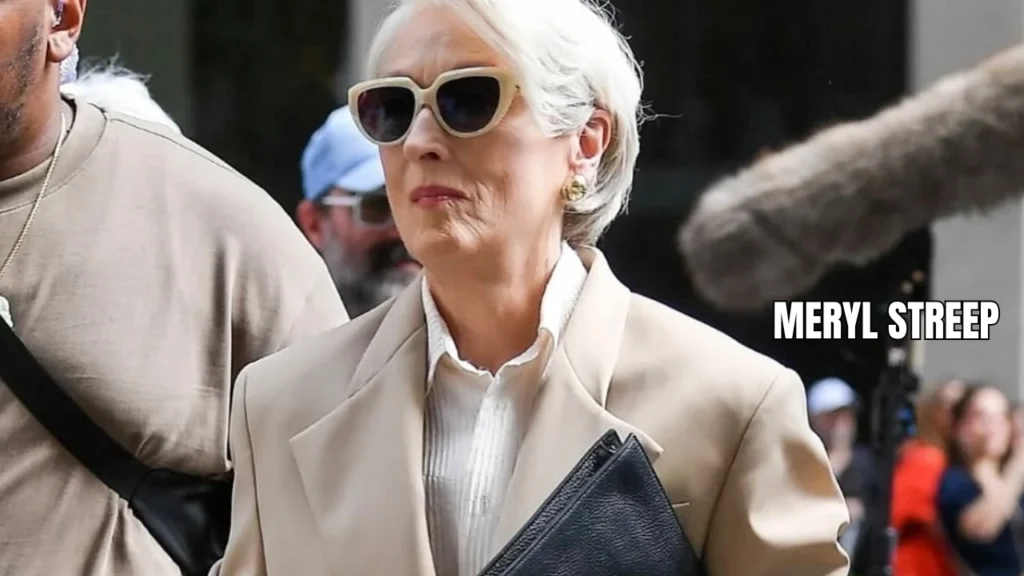
Mary Louise Streep was born on June 22, 1949, in Summit, New Jersey, to Mary Wolf Wilkinson, a commercial artist, and Harry William Streep Jr., a pharmaceutical executive. Her father was of German and Swiss-German descent. She grew up with her two younger brothers in a middle-class suburban family.
Streep attended Bernards High School in Bernardsville, New Jersey, where she became involved in school plays and musicals. She initially pursued opera singing before discovering her passion for acting during high school. After graduation, she enrolled at Vassar College, where she studied drama and English literature.
Following her undergraduate studies, Streep attended the Yale School of Drama, one of the most prestigious acting programs in the United States. At Yale, she earned a Master of Fine Arts degree and honed her craft through intensive training in classical and contemporary theater. Her time at Yale prepared her for a professional career that would span multiple performance mediums.
Meryl Streep Age
Meryl Streep was born on June 22, 1949, making her 76 years old as of 2026. Despite her age, she continues to work actively in film and television, maintaining a prolific career that shows no signs of slowing. Her longevity in Hollywood and consistent high-quality performances across five decades distinguish her career.
Meryl Streep Early Career and Theater Work
After completing her education at Yale, Streep began her professional acting career in New York theater. She performed with the Public Theater and appeared in several off-Broadway productions. Her stage work during the 1970s earned critical acclaim and established her reputation as a serious dramatic actress.
In 1976, Streep made her Broadway debut in “27 Wagons Full of Cotton” and “A Memory of Two Mondays,” earning a Tony Award nomination. She continued performing in theater while beginning to pursue film and television opportunities. Her theatrical training provided the foundation for her exceptional technical skills that would define her film career.
Streep won an Obie Award for Best Featured Actress for “Alice in Concert” in 1981, demonstrating her continued commitment to stage performance even as her film career accelerated. Her theater background contributed to her reputation for meticulous preparation and attention to character detail.
Breakthrough in Film
Meryl Streep’s film debut came in 1977 with “Julia,” though her role was small. Her breakthrough performance arrived in 1978 with “The Deer Hunter,” where she played Linda, a working-class woman affected by the Vietnam War. This role earned her first Academy Award nomination for Best Supporting Actress.
In 1978, Streep also starred in the television miniseries “Holocaust,” portraying a German woman married to a Jewish artist during World War II. Her performance won her the Primetime Emmy Award for Outstanding Lead Actress in a Miniseries or Movie. This dual success in film and television established her as a rising star.
Her first Academy Award came in 1980 for Best Supporting Actress in “Kramer vs. Kramer” (1979), where she played a woman who leaves her husband and child, then returns to fight for custody. The role showcased her ability to portray complex, flawed characters with nuance and humanity.
Major Film Roles and Critical Acclaim
“Sophie’s Choice” (1982) brought Streep her second Academy Award, this time for Best Actress. Her portrayal of a Polish Holocaust survivor tormented by an impossible decision required her to master Polish and German accents while delivering an emotionally devastating performance. The film cemented her status as one of cinema’s most talented actresses.
Throughout the 1980s, Streep delivered acclaimed performances in “The French Lieutenant’s Woman” (1981), “Silkwood” (1983), “Out of Africa” (1985), and “Ironweed” (1987), earning Oscar nominations for each. Her ability to inhabit diverse characters while mastering various accents and mannerisms became her trademark.
In “A Cry in the Dark” (1988), Streep portrayed Lindy Chamberlain, an Australian woman accused of murdering her infant daughter who claimed a dingo took the baby. Her accurate Australian accent and portrayal of a controversial real-life figure earned another Oscar nomination. The film demonstrated her willingness to take on challenging, polarizing roles.
Career Revival and Continued Success
After a period of fewer nominations in the early to mid-1990s, Streep experienced a career resurgence with “The Bridges of Madison County” (1995), “One True Thing” (1998), and “Music of the Heart” (1999), each earning Oscar nominations. Her ability to transition between dramatic and lighter roles expanded her range.
“Adaptation” (2002) showcased Streep’s versatility as she played real-life New Yorker writer Susan Orlean, earning a Best Supporting Actress nomination. That same year, she appeared in “The Hours,” further demonstrating her commitment to complex ensemble pieces.
“The Devil Wears Prada” (2006) became one of Streep’s most commercially successful and iconic roles. Her portrayal of Miranda Priestly, a demanding fashion magazine editor, earned her another Oscar nomination and became a cultural touchstone. The role demonstrated her command of comedy and created one of cinema’s most quotable characters.
“Doubt” (2008) and “Julie & Julia” (2009) brought consecutive Best Actress nominations, with the latter showcasing her comedic talents as celebrity chef Julia Child. Critics praised her ability to capture Child’s distinctive voice and physicality while making the character feel authentic rather than imitative.
Meryl Streep Academy Award Record
Streep won her third Academy Award for Best Actress in “The Iron Lady” (2011), portraying British Prime Minister Margaret Thatcher. Her transformation into the controversial political figure required mastering Thatcher’s voice, mannerisms, and physical presence across different ages. This victory came 29 years after her previous Best Actress win, demonstrating her sustained excellence.
She received additional Oscar nominations for “August: Osage County” (2013), “Into the Woods” (2014), “Florence Foster Jenkins” (2016), and “The Post” (2017), bringing her total to 21 nominations. No other actor in Academy Award history has received more nominations. Her record reflects not only longevity but consistent recognition at the highest level of her craft.
Notable Film Performances
Streep’s filmography includes numerous critically acclaimed performances beyond her Oscar-nominated roles. “Mamma Mia!” (2008) and its sequel “Mamma Mia! Here We Go Again” (2018) became major commercial successes, showcasing her singing abilities and appeal in musical comedy. These films demonstrated her star power in popular entertainment.
Other significant films include “The Manchurian Candidate” (2004), “A Prairie Home Companion” (2006), “It’s Complicated” (2009), “Hope Springs” (2012), “The Giver” (2014), and “Suffragette” (2015). She has worked with acclaimed directors including Robert Redford, Clint Eastwood, Mike Nichols, Nora Ephron, Steven Spielberg, and Phyllida Lloyd throughout her career.
In “Big Little Lies” (2019), Streep appeared in the second season of the HBO series, earning an Emmy nomination for Outstanding Supporting Actress in a Drama Series. She later appeared in “Only Murders in the Building” (2024), winning the Critics’ Choice Award for Best Supporting Actress in a Comedy Series and receiving Emmy nominations.
Television Work
Beyond “Holocaust” (1978), Streep’s television work includes the critically acclaimed miniseries “Angels in America” (2003), for which she won her second Primetime Emmy Award for Outstanding Lead Actress in a Limited Series or Movie. She portrayed multiple characters in Tony Kushner’s epic work about the AIDS crisis in 1980s America.
Streep won a Primetime Emmy Award for Outstanding Narrator for the documentary “Five Came Back” (2017). In 2025, she won a Children’s and Family Emmy Award for Outstanding Children’s Personality for “Storyline Online: The Three Questions”. These awards demonstrate her range across different television formats.
Awards and Honors
In addition to her three Academy Awards and three Emmy Awards, Streep has won nine Golden Globe Awards from 33 nominations, another record. She has won two BAFTA Awards for Best Actress for “The French Lieutenant’s Woman” (1981) and “The Iron Lady” (2011). Her Critics’ Choice Awards include wins for “Doubt” (2008), “Julie & Julia” (2009), “Florence Foster Jenkins” (2016), and “Only Murders in the Building” (2024).
Streep received the American Film Institute’s Life Achievement Award in 2004, becoming one of the youngest recipients of this honor. In 2010, President Barack Obama awarded her the National Medal of Arts, recognizing her contributions to American culture. She received the Presidential Medal of Freedom in 2014, the nation’s highest civilian honor.
The Kennedy Center honored Streep in 2011 for lifetime contributions to American culture through the performing arts. She has received honorary doctorates from Yale, Harvard, Princeton, and other prestigious universities. These honors reflect her impact beyond acting, including her advocacy work and cultural influence.
Meryl Streep Husband and Personal Life
Meryl Streep married sculptor Don Gummer on September 30, 1978. The couple has four children: Henry Wolfe Gummer (born 1979), Mamie Gummer (born 1983), Grace Gummer (born 1986), and Louisa Jacobson Gummer (born 1991). Three of their daughters have pursued acting careers, following their mother into the entertainment industry.
Streep and Gummer maintained a long marriage while she pursued her demanding film career. They divided their time between residences in Connecticut and New York City. In October 2023, representatives confirmed that Streep and Gummer had been separated for six years, though they did not publicly announce the separation earlier.
Before her marriage to Gummer, Streep was in a relationship with actor John Cazale, her co-star in “The Deer Hunter”. Cazale died of lung cancer in March 1978, a loss that deeply affected Streep. She met Gummer through her brother just months after Cazale’s death.
Acting Technique and Reputation
Streep is renowned for her meticulous preparation and commitment to authenticity in her roles. She often works with dialect coaches to master accents, ranging from Polish and Danish to Australian and British varieties. Her technical precision combined with emotional depth creates performances that critics describe as transformative rather than merely imitative.
Many critics and fellow actors consider Streep the greatest film actress of her generation, if not all time. Her subtly expressive face and ability to convey complex emotions through minimal gestures distinguish her performances. She brings intelligence and thoughtfulness to character development, researching backgrounds thoroughly.
Streep’s versatility across genres sets her apart from many dramatic actors. She moves seamlessly between intense dramas like “Sophie’s Choice,” comedies like “The Devil Wears Prada,” musicals like “Mamma Mia!,” and action films, demonstrating range that few actors achieve. This adaptability has sustained her career across changing Hollywood trends.
Activism and Advocacy
Beyond acting, Streep has been an advocate for women’s rights and gender equality in the entertainment industry. She has spoken publicly about ageism and sexism in Hollywood, using her platform to address systemic issues. Her advocacy work includes support for the National Women’s History Museum and various arts education programs.
Streep has supported environmental causes and human rights organizations throughout her career. She serves on the board of several cultural institutions and has donated to educational initiatives. Her activism reflects her belief in using celebrity status to advance social causes.
Meryl Streep Legacy and Cultural Impact
Meryl Streep’s influence on cinema extends beyond her individual performances to her impact on how female actors are perceived in Hollywood. She has demonstrated that women can maintain leading roles and critical acclaim throughout their careers, not just in youth. Her success challenges industry ageism and has opened doors for other actresses.
Her record-breaking Oscar nominations reflect consistent excellence that spans five decades. Few actors have maintained such high standards across such a long career. Her work ethic, preparation methods, and commitment to craft serve as models for aspiring actors.
Streep’s cultural impact includes iconic characters that have entered popular consciousness, from Miranda Priestly to Margaret Thatcher to Julia Child. Her performances have influenced how audiences understand historical figures and complex women. She remains one of the most respected and admired figures in American cinema, with a legacy that continues to grow.

