

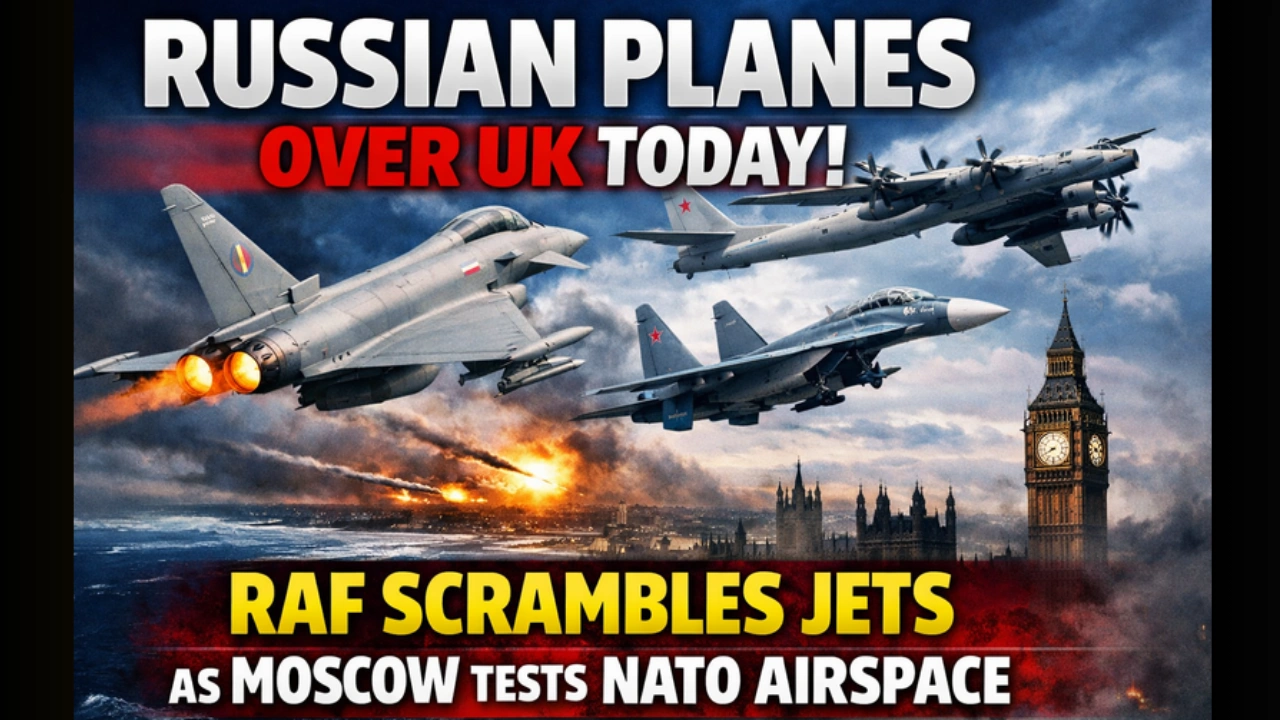
Royal Air Force Typhoon jets scramble today in response to Russian military aircraft approaching UK-monitored airspace, continuing a pattern of airspace probing that NATO defence officials have tracked with growing concern throughout 2025 and into 2026.
RAF on Alert as Russian Aircraft Approach UK Airspace
Russian planes over UK airspace represent one of the most closely watched security incidents in Europe’s ongoing confrontation with Moscow, and reports today indicate the RAF has responded to the latest incursion. The UK’s Quick Reaction Alert (QRA) force — permanently stationed at RAF Lossiemouth in Scotland and RAF Coningsby in Lincolnshire — maintains 24-hour readiness specifically to intercept aircraft that approach UK-monitored airspace without prior authorisation. Reports suggest Russian military aircraft today tested this boundary, prompting a scramble response from RAF Typhoon fighters.
The UK Ministry of Defence (MoD) has not publicly disclosed the specific number of aircraft involved or the precise flight path as of this morning. Official confirmation typically follows an interception within several hours through a formal MoD statement.
What “UK Airspace Monitoring” Actually Means
The United Kingdom does not claim sovereignty over all airspace in the North Atlantic and North Sea corridors where these interceptions occur. Rather, the UK works within a NATO framework to monitor the UK Flight Information Region (FIR) — a defined zone of airspace responsibility that extends well beyond UK territorial waters into the North Atlantic.
Russian military aircraft routinely fly through international airspace but approach these monitored zones without filing flight plans or activating transponders, which triggers the QRA response. The RAF intercepts the aircraft, visually identifies them, and escorts them away from the boundary. No weapons fire is involved in these encounters.
A Pattern of Provocation: How Frequent Are These Incidents?
The UK MoD and NATO’s Combined Air Operations Centre (CAOC) at Uedem, Germany, document Russian airspace probing incidents across Europe regularly. In 2023, NATO recorded over 300 interceptions of Russian aircraft across all member-state airspace boundaries — a figure that represented a significant increase from pre-2022 levels. The UK specifically scrambles its QRA force multiple times per year in response to Russian Bears, Backfires, and other strategic military aircraft.
The most commonly intercepted aircraft near UK airspace are the Tupolev Tu-95 “Bear” — a long-range turboprop strategic bomber — and the Tupolev Tu-160 “Blackjack” supersonic strategic bomber. Russia uses these flights for multiple purposes: testing NATO radar and response times, gathering electronic intelligence, and signalling strategic intent during periods of diplomatic tension.
Today’s Geopolitical Context Makes This Significant
The timing of Russian aircraft activity near UK airspace on April 15, 2026 carries particular weight. UK-Russia relations remain at a historic low following Russia’s continued military operations in Ukraine and a series of diplomatic expulsions and sanctions exchanges that have effectively ended bilateral communication channels. The UK has committed billions of pounds in military and financial aid to Ukraine since 2022, making it a direct target of Russian strategic pressure.
Reports suggest that Russian long-range aviation activity over the North Sea and Arctic corridor has intensified in the first quarter of 2026, coinciding with renewed NATO discussions about expanding air defence coverage across the Nordic-Baltic region. Finland and Sweden’s entry into NATO in 2023 and 2024 respectively has altered the strategic geography of Russian air approaches, pushing some flight corridors further west — closer to UK monitoring zones.
RAF Lossiemouth and Coningsby: Britain’s QRA Shield
The RAF’s Quick Reaction Alert operation runs from two main bases. RAF Lossiemouth in Moray, Scotland covers the northern approaches — the primary entry corridor for Russian aircraft coming from Arctic routes over Norway and the Greenland-Iceland-UK (GIUK) gap. RAF Coningsby in Lincolnshire covers the southern and eastern approaches, including the North Sea corridor.
Eurofighter Typhoon FGR4 jets form the core of both QRA stations. These aircraft carry ASRAAM short-range missiles and Meteor beyond-visual-range missiles — weapons they do not deploy during interceptions but carry as standard armament. The RAF also operates Boeing E-3D Sentry airborne early warning aircraft to track approaching contacts before QRA jets launch.
Not publicly disclosed is the specific squadron tasked with today’s interception or the duration of the escort before the Russian aircraft departed the monitored zone.
NATO’s Response Framework and UK’s Role
The UK operates within NATO’s integrated air defence architecture, which means today’s interception feeds into a broader alliance-wide picture. The Combined Air Operations Centre at Uedem coordinates real-time information sharing between all NATO member air forces. When one nation intercepts an aircraft, that data reaches all alliance partners within minutes.
The UK contributes significantly to NATO’s northern air defence posture. Beyond the QRA force, the RAF regularly deploys Typhoons to Iceland, the Falklands, and Baltic Air Policing missions — all of which extend Britain’s overall ability to track and challenge Russian strategic aviation across a wide geographic arc.
Reports suggest the NATO alliance intends to review its northern air patrol schedules at its next defence ministers’ meeting, with enhanced coverage of the Arctic corridor expected to feature prominently in those discussions.
What Happens After an Interception
Once the RAF escorts Russian aircraft away from the UK-monitored zone, the MoD typically issues a brief formal statement confirming the interception, the type of aircraft involved, and the RAF units that responded. These statements deliberately avoid characterising the incident as provocative or dangerous, maintaining a calibrated diplomatic tone.
The Russian Ministry of Defence rarely comments on individual interceptions, though it occasionally issues statements claiming that its aircraft operated “in strict compliance with international law” and did not violate any national airspace boundaries — a position that is technically correct in most cases, as the interceptions occur in international airspace rather than over UK sovereign territory.
Not publicly disclosed is whether today’s incident involved any radio communication between the RAF pilots and the Russian aircrew during the escort phase.