

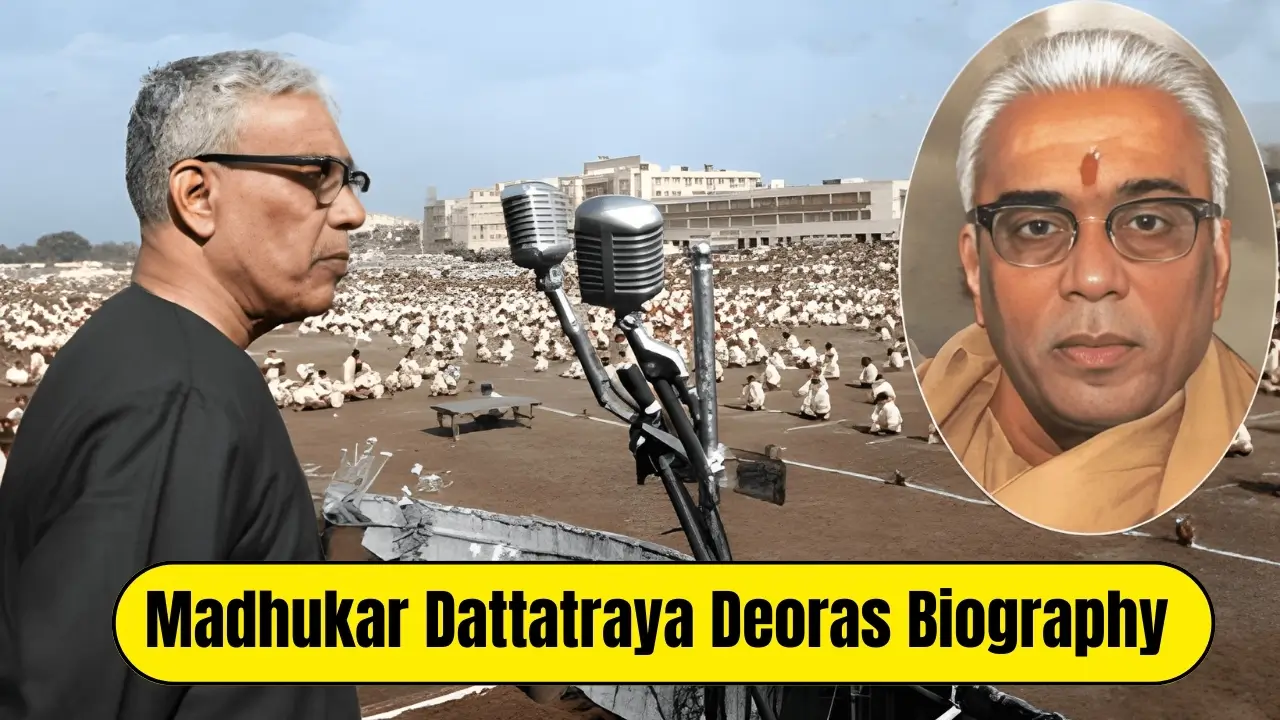
Madhukar Dattatraya Deoras, popularly known as Balasaheb Deoras, was the third Sarsanghchalak (chief) of the Rashtriya Swayamsevak Sangh (RSS) and one of the most influential strategists in the history of the organization. He is often remembered as the leader who took the RSS from a primarily cadre-building cultural body to a more socially and politically interventionist force that significantly shaped post-Independence Hindu nationalist politics in India.
Born in 1915 in Nagpur, Deoras joined the RSS as a teenager under the influence of its founder, Dr. K.B. Hedgewar, and quickly emerged as a key organizer and ideologue. Over the decades, he held crucial positions, worked as a pracharak in Bengal, and later led the organization through critical phases such as the ban on the RSS, the Emergency (1975–77), and the early stages of the Ram Janmabhoomi movement. Consequently, many historians and observers consider him a “kingmaker” of the Sangh Parivar due to his long-term impact on the RSS network and its political affiliates.
As Sarsanghchalak from 1973 to 1994, Deoras oversaw rapid expansion of the RSS shakhas nationwide and promoted an agenda that combined Hindu unity, anti-untouchability campaigns, and a more pragmatic engagement with politics. At the same time, his role during the Emergency and his letters to Prime Minister Indira Gandhi remain subjects of intense debate, with different accounts interpreting them as either pragmatic outreach or political compromise. Even after his death in 1996, his organizational vision continues to influence the RSS, its affiliates, and contemporary debates around caste, social harmony, and nationalism.
Key Profile: Quick Facts Table
| Attribute | Detail |
|---|---|
| Full Name | Madhukar Dattatraya Deoras |
| Popular Name | Balasaheb Deoras |
| Birth Date | 11 December 1915 |
| Death Date | 17 June 1996 |
| Place of Birth | Nagpur, Central Provinces (now Maharashtra), India |
| Nationality | Indian |
| Main Role | Third Sarsanghchalak (chief) of RSS |
| Term as Sarsanghchalak | 5 June 1973 – 11 March 1994 |
| Preceded By | M.S. Golwalkar (Guruji) |
| Succeeded By | Rajendra Singh (Rajju Bhaiya) |
| Occupation | Social and political organizer, RSS pracharak, ideologue |
| Known For | Organizational expansion of RSS, anti-untouchability stance, role during Emergency, long-term Sangh strategy |
Early Life
Balasaheb Deoras was born into a middle-class orthodox Brahmin family in Nagpur on 11 December 1915. Sources describe him as belonging to a Telugu-speaking Deshastha Rigvedi Brahmin (DRB) background, with family roots in the Andhra region but settlement in Nagpur, Maharashtra. Therefore, discussions on “Madhukar Dattatraya Deoras caste” usually classify him within an upper-caste Brahmin milieu that was common among early RSS leadership.
His parents were Dattatraya Krishnarao Deoras and his wife, and the family reportedly had four children—Balasaheb, one brother (Bhaurao Deoras) and two sisters. His brother Bhaurao Deoras later also became a noted RSS leader, underlining how the Deoras family as a whole became deeply tied to the RSS organizational culture. This background strongly influenced Balasaheb’s early exposure to Hindu scripture, discipline, and the idea of a Hindu national identity.
Madhukar Dattatraya Deoras Caste
Madhukar Dattatraya Deoras came from a Brahmin family, often identified specifically as Deshastha Rigvedi Brahmin with Telugu-speaking roots. This background places him in the upper-caste segment that historically dominated much of the early RSS leadership.
However, he consistently attempted to broaden the organization’s social base by emphasizing caste inclusion and criticising untouchability. Therefore, discussions around “Madhukar Dattatraya Deoras caste” frequently highlight the contrast between his Brahmin origin and his public advocacy for greater social equality within the Hindu fold.
Education and Entry into RSS
Balasaheb Deoras studied in Nagpur, where he eventually obtained a law degree from Nagpur University, although he chose to dedicate himself full-time to organizational work rather than legal practice. As a young schoolboy around the age of twelve, he came in contact with Dr. K.B. Hedgewar, the founder of the RSS, and quickly joined local shakhas.
By his late teens and early twenties, he had become one of Hedgewar’s trusted organizers and was appointed Nagpur Karyavah (city secretary) in 1937. In 1939, he was sent as a pracharak (full-time worker) to Bengal to expand the RSS beyond its central Indian base, marking the beginning of his long career as a key field organizer. Consequently, he was often described by biographers as a “true child of the organization,” having grown within the RSS from a very early stage.
Organizational Rise within RSS
From the 1940s onward, Madhukar Dattatraya Deoras steadily rose through the ranks of the RSS, taking on important responsibilities as the organization expanded across India. In 1946, he was appointed Sahsarkaryavah (Joint General Secretary), and later, in 1965, he became Sarkaryavah (General Secretary) of the RSS.
These positions placed him at the centre of daily organizational strategy, cadre building, and communication. After the death of second Sarsanghchalak M.S. Golwalkar (Guruji), Balasaheb Deoras became the third Sarsanghchalak on 5 June 1973, formally assuming the top leadership of the organization. Under his tenure, the RSS saw both intense state pressure and significant growth.
Madhukar Dattatraya Deoras History
Role as Third Sarsanghchalak
As Sarsanghchalak, Deoras oversaw one of the most critical periods in RSS history, including the Emergency (1975–77), post-Emergency democratic resurgence, and the early phases of the Ram Janmabhoomi movement. He is often credited with pushing the RSS towards a more “activist” and politically engaged stance compared to earlier, more inward-focused phases.
During his leadership, the RSS expanded affiliate organizations such as the Akhil Bharatiya Vidyarthi Parishad (ABVP) among students and the Bharatiya Mazdoor Sangh (BMS) among workers, strengthening the Sangh’s influence across social sectors. Moreover, he promoted outreach towards backward communities and emphasized social harmony as part of the RSS mission.
Approach to Caste and Social Reform
Although Deoras came from a Brahmin background, he repeatedly spoke against untouchability and caste-based discrimination. In a widely cited 1974 speech at the Vasant Vyakhyanmala lecture series, he declared that if untouchability was not wrong, then nothing in the world could be considered wrong, signaling a strong public stance from the RSS chief.
He encouraged inter-dining and greater interaction across caste lines among swayamsevaks, and some accounts note that his own family home stopped questioning the caste of visitors who dined there. As a result, many supporters highlight his tenure as a period when the RSS more consciously projected itself as working for “samajik samarasata” (social harmony) and caste inclusion.
Also Read: Indresh Upadhyay Biography (2025) Net Worth, Age, Family, Wife
Balasaheb Deoras and the Emergency
Support to JP Movement and Ban on RSS
In the mid-1970s, Deoras steered the RSS into active support of the JP Movement led by Jayaprakash Narayan against what was seen as the authoritarian tendencies of Prime Minister Indira Gandhi. When the Emergency was declared in 1975, the RSS was banned, and many of its leaders, including Balasaheb Deoras, were jailed.
Under his guidance, thousands of RSS workers participated in underground activities and satyagraha, with large numbers reportedly imprisoned across the country. Therefore, within the Sangh narrative, this phase is remembered as a period of sacrifice and resistance.
Balasaheb Deoras Letter to Indira Gandhi
However, the “Balasaheb Deoras letter to Indira Gandhi” remains one of the most debated aspects of his life. According to some accounts, including critical and left-leaning commentaries, Deoras wrote multiple letters from Yerwada Jail to Indira Gandhi, allegedly offering cooperation with her government and its Twenty-Point Programme in exchange for lifting the ban on RSS.
On the other hand, sympathetic narratives argue that these letters were an attempt to open communication channels and secure an “honourable retreat” for the government while RSS workers continued to participate in anti-Emergency protests. Consequently, the exact interpretation of these letters is contested: critics see them as signs of compromise, while supporters frame them as tactical correspondence within a wider resistance strategy.
Legacy, Ideology and Impact
Balasaheb Deoras is often described as a pragmatic organizer who helped move the RSS from the margins into the mainstream of Indian public life. Under his leadership, shakhas multiplied, affiliates gained strength, and the broader Sangh Parivar began to play a much more visible role in politics and society, especially through formations that later contributed to the rise of the Bharatiya Janata Party (BJP).
Many supporters credit him with shaping a long-term strategy that blended cultural work, social reform, and political engagement. He stepped down as Sarsanghchalak in March 1994 due to ill health and passed away on 17 June 1996, having lived to see Atal Bihari Vajpayee briefly sworn in as Prime Minister in 1996, a moment often viewed as a milestone for the Sangh Parivar.
Balasaheb Deoras Hospital and Institutions
In later years, several institutions have been named after Balasaheb Deoras, reflecting his influence within the Sangh ecosystem and associated social organisations. For example, Balasaheb Deoras Multispeciality Hospital in Pune is cited as a healthcare institution carrying his name, often associated with RSS-inspired service work and charitable medical initiatives.
Such institutions aim to link his legacy with practical service to society, consistent with the RSS emphasis on “seva” (service). Therefore, when users search for “Balasaheb Deoras Hospital Pune,” they usually find references to hospitals and projects intended to commemorate his contribution to organizational work and social outreach.
Bhaurao Deoras Brother and Colleague
Bhaurao Deoras, the younger brother of Balasaheb, was also an important RSS worker and organizer. Like Balasaheb, he joined the RSS early in life and devoted himself to full-time organizational responsibilities in various regions of India.
Both brothers are often mentioned together in internal RSS histories as a pair that played a vital role in strengthening the Sangh’s network at the grassroots level. Consequently, research on “Bhaurao Deoras” usually appears alongside literature on Balasaheb’s life and the broader story of the RSS in the 20th century.
Also Read: Ravindra Kaushik Wife