

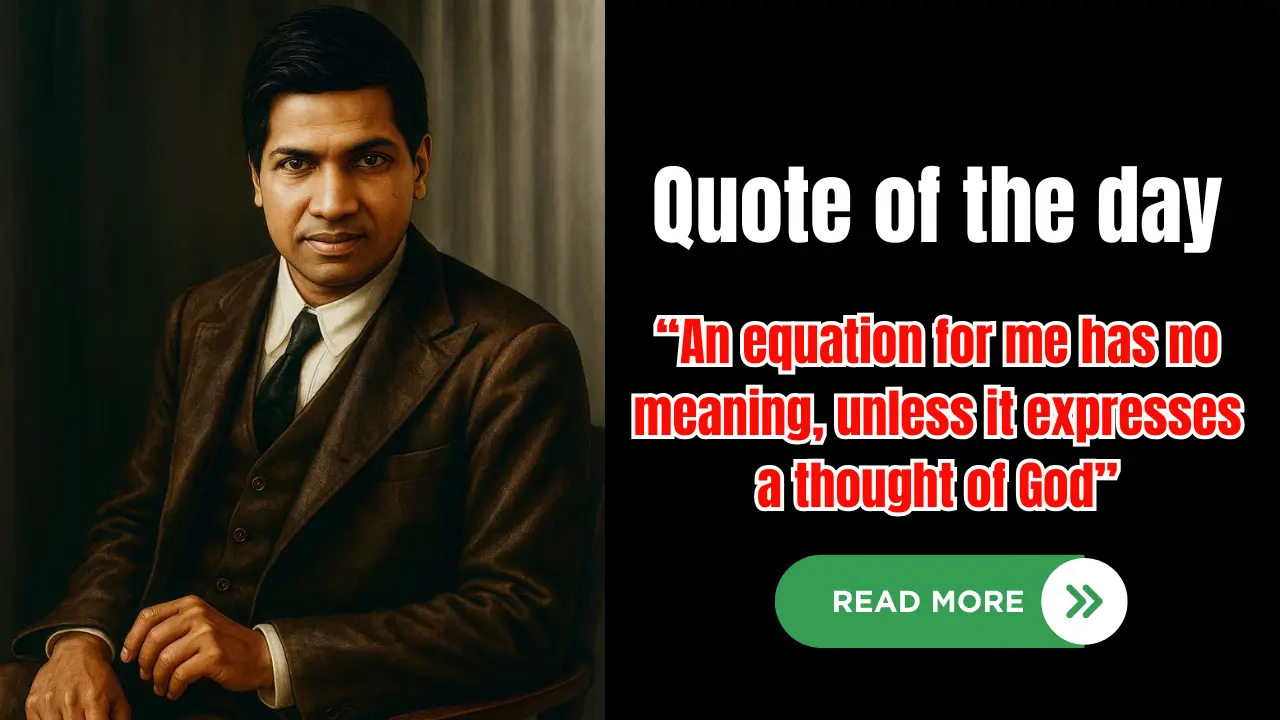
The Quote of the day by Srinivasa Ramanujan
“An equation for me has no meaning, unless it expresses a thought of God.”
Who said this?
Srinivasa Ramanujan (1887–1920) was one of the most brilliant mathematicians in history. Born in Erode, India, he came from a poor family and had almost no formal training in pure mathematics. Despite these challenges, he made extraordinary contributions to mathematical analysis, number theory, infinite series, and continued fractions.
He is famous for his collaboration with British mathematician G.H. Hardy at Cambridge University. Ramanujan became the first Indian to be elected a Fellow of the Royal Society. Today, his formulas are still used in studying black holes and computer algorithms.
Also See: Srinivasa Ramanujan Biography: Age, Wiki, Family, Relationship and More
Understanding the quote
To understand this famous quote, we must look at how Ramanujan viewed the world differently from other mathematicians. Most scientists view mathematics as a tool—a language humans invented to measure things. Ramanujan believed the opposite.
He believed that mathematics was the fundamental “source code” of the universe. In his view, a mathematical formula already existed in the cosmos before anyone wrote it down. A mathematician does not create a formula; they only discover what is already there. Therefore, if an equation is true, it must reflect the mind of the Creator (God). If a formula was just a clever trick without a deeper connection to reality, Ramanujan found it useless.
The “Red Screen” Visions
While many biographies mention Ramanujan dreamed of formulas, few explain how it happened. Ramanujan described a specific, vivid process to his friends. He said that in his dreams, a “red screen” formed of flowing blood would appear before his eyes.
Suddenly, a hand would appear and begin writing complex elliptic integrals and geometric formulas on this red screen. He was merely the spectator watching these “thoughts of God” appear. As soon as he woke up, he would scribble them down on any paper he could find, often using green ink. This is why he credited his work entirely to his family goddess, Namagiri Thayar of Namakkal, rather than his own intellect.
Modern Science Proves His “Divine” Intuition
For decades, skeptics thought Ramanujan’s talk of “God’s thoughts” was just superstition. However, modern science has surprisingly validated his intuition.
In 1920, while on his deathbed, Ramanujan wrote down a set of mysterious functions called “Mock Theta Functions.” He claimed they came to him in a vision. At the time, they seemed like abstract pure mathematics with no real-world use.
Fast forward to 2012, nearly 100 years later. Researchers at Emory University discovered that these exact functions are what physicists need today to describe the behavior of black holes. Ramanujan could not have known about black holes in 1920. Yet, his “divine” formulas described the physics of the universe perfectly. This suggests his belief—that he was tapping into the fundamental truths of nature—was not just faith, but a unique kind of mental connection to physical reality.
Key Facts about Srinivasa Ramanujan
- The “Man Who Knew Infinity”: His life story was made into a famous movie starring Dev Patel.
- The Number 1729: This is known as the “Hardy-Ramanujan Number.” It is the smallest number that can be expressed as the sum of two cubes in two different ways.
- National Mathematics Day: India celebrates this day on December 22 every year to mark his birthday.
- Short Life: He died at the young age of 32, likely due to a liver infection called hepatic amoebiasis, but he left behind thousands of theorems that scientists are still studying today.