

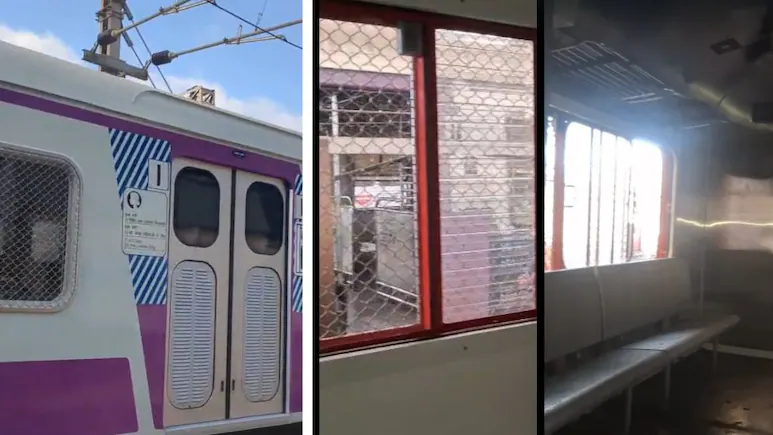
India’s first non-AC closed-door Mumbai local train has arrived at Kurla car shed, marking a landmark moment in suburban railway safety across the country. Central Railway will operate this 12-car Electric Multiple Unit (EMU) rake on the Mumbai suburban network making it the first time in Indian Railways history that a General Class train carries the automatic door-closing system previously exclusive to air-conditioned services.
The new train addresses one of Mumbai’s most persistent and deadly commuter safety problems: passengers falling from overcrowded open-door trains, particularly during peak hours. Officials describe this launch as part of a larger plan to introduce closed-door systems in all future Mumbai local trains.
Mumbai Local Train Gets Its Biggest Safety Upgrade in Years
The development of this rake comes directly against the backdrop of the Mumbra tragedy a fatal incident that once again put Mumbai’s open-door train safety under national scrutiny. Mumbai’s suburban network currently runs more than 3,000 local train services daily, carrying over 65 lakh commuters across the Central Railway and Western Railway zones.
The open-door design of existing non-AC EMU coaches, while allowing ventilation in the absence of air conditioning, creates significant danger in an overcrowded system. Every monsoon season and peak rush hour brings fresh reports of passengers hanging out of doorways or falling from moving trains. The new closed-door rake directly targets this structural safety gap.
Built at ICF Chennai: Key Features of the New Rake
The Integral Coach Factory (ICF) in Chennai manufactured the new rake the same facility responsible for the majority of Indian Railways’ rolling stock. ICF received the project brief in December 2025 after the Railway Board approved the design and development of two such non-AC closed-door prototypes specifically for the Mumbai suburban network.
The new train carries several features that distinguish it sharply from the standard non-AC coaches currently in service:
- Automatic sliding door closure system — doors close and lock before the train moves, preventing commuters from hanging out or falling
- Forced ventilation system — roof-mounted units pump fresh air through the coaches at a higher air-change rate than standard coaches, compensating for the absence of air conditioning
- Louvers for natural airflow — supplementary ventilation channels built into the coach walls
- Talk-back emergency communication system — passengers can directly contact the guard or motorman from inside the coach during an emergency
- GPS-based passenger information displays — digital screens show upcoming stations and route information in real time
- LED lighting — brighter, energy-efficient interior lighting throughout all coaches
- Improved seating arrangements — upgraded bench geometry compared to aging non-AC fleet coaches
Central Railway’s Chief Public Relations Officer (CPRO) Swapnil Nila confirmed these specifications to the Free Press Journal, stating the train carries automatic door closure systems, louvers, and a roof-mounted ventilation system — aiming to balance safety with comfort in non-AC conditions.
Trials Before Public Launch RDSO Approval Required
The new rake does not enter passenger service immediately. As of April 2026, the train undergoes a structured multi-stage trial process before receiving clearance for regular operations.
The trial schedule includes:
- COCR (Commissioner of Railway Safety) trials — safety compliance evaluation across the Mumbai suburban track geometry
- Oscillation trials — testing ride quality, vibration levels, and track interaction at varying speeds
- Test runs across routes — assessing real-world commuter experience and system performance
- RDSO approval — the Research Designs and Standards Organisation must certify the rake before it enters regular service
Only after RDSO grants its approval will Central Railway introduce the train for public use. Not publicly disclosed is the exact timeline or target date for completing these trials, though reports suggest the process could conclude within a few months of the rake’s arrival at Kurla.
Fare Structure: Cheaper Than AC, Details Still Pending
One of the most critical questions for Mumbai’s millions of daily commuters concerns the fare. The railway ministry has not officially finalised a fare structure for the new non-AC closed-door service. However, sources indicate the fare will remain significantly below AC local train rates, likely closer to standard first-class or second-class fares that General Class commuters already pay.
This positioning makes the new train genuinely accessible to the majority of Mumbai’s suburban commuters — the working-class and lower-middle-class passengers who currently cannot afford the premium AC local fares but face the greatest safety risks in open-door coaches.
Currently, 17 AC EMU rakes with automatic door closure systems operate across the Mumbai suburban network. The new non-AC closed-door rake brings this technology to a far larger potential ridership base, given that non-AC trains still carry the overwhelming majority of Mumbai’s daily suburban passengers.
Railway Protection Force to Monitor New Services
The Railway Protection Force (RPF) will deploy personnel to oversee safety and crowd management on the new non-AC closed-door services after launch. This additional oversight reflects the railway administration’s awareness that commuter behaviour adjustment — particularly on a network where hanging from open doors is deeply normalised — will take time and active enforcement.
Reports suggest the railway also plans awareness campaigns at major stations to educate commuters about how to use the automatic door system correctly, particularly the importance of not obstructing doors during closing.
Mumbai’s Suburban Network: Scale and Stakes
The sheer size of Mumbai’s suburban railway network makes every safety upgrade significant at scale. Central Railway alone runs 1,810 suburban services daily, ferrying more than 35 lakh commuters across its Main, Harbour, Trans-Harbour, and Belapur-Uran lines. Western Railway adds approximately 1,406 services per day on its corridor.
The two railway zones Central Railway and Western Railway together manage one of the densest and busiest commuter rail networks anywhere in the world. Central Railway has introduced 94 AC local services since the AC local programme began, with 80 running on the main line and 14 on the Harbour line. The new non-AC closed-door prototype represents a parallel track extending safety benefits to the vastly larger non-AC ridership that currently travels on the network’s older, open-door fleet.
Do you think the new non-AC closed-door local train will genuinely improve safety for Mumbai commuters or will overcrowding still find a way around the automatic doors?
Drop your experience as a Mumbai local train commuter in the comments below!