

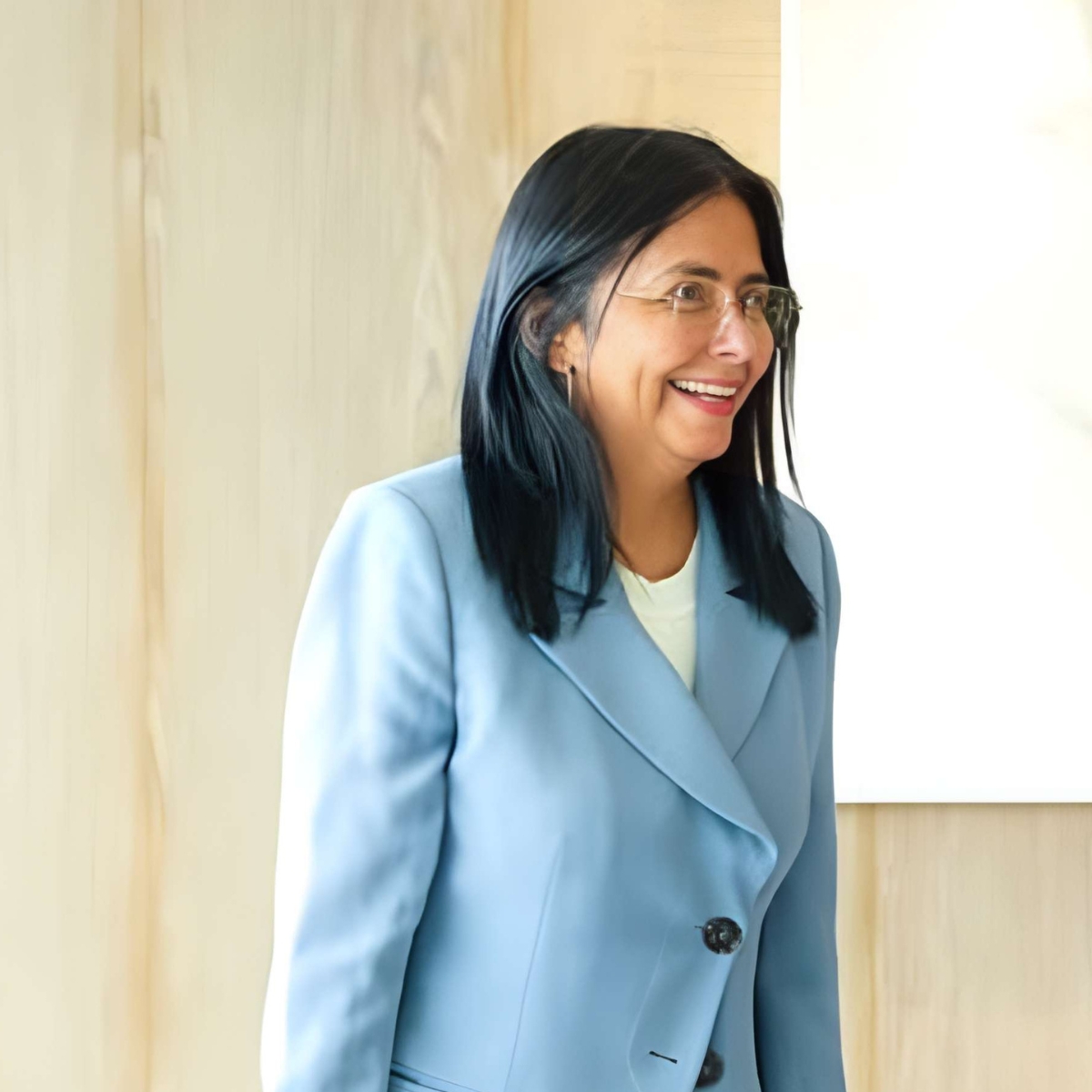
Delcy Eloína Rodríguez Gómez is a Venezuelan lawyer, diplomat, and politician who currently serves as the acting President of Venezuela following the January 3, 2026 apprehension of President Nicolás Maduro by US military forces. As Vice President since 2018, she holds one of the most influential positions in the Venezuelan government, overseeing critical ministries including finance and petroleum.
This biography examines her path from legal education through ministerial roles to her current unprecedented position as Venezuela’s de facto leader.
Who is Delcy Rodríguez?
Delcy Rodríguez is a Venezuelan political figure distinguished by her roles in multiple high-level government positions under President Nicolás Maduro. She has served as Minister of Communication, Minister of Foreign Affairs, President of the Constituent Assembly, and Vice President before ascending to her current position.
Her career represents a unique combination of technical legal expertise and hardline political commitment. Unlike many Venezuelan politicians, she brings formal legal training and international diplomatic experience to governance roles. Her administration of the petroleum ministry during the period of heavy international sanctions demonstrated her capacity to manage critical economic functions under extraordinary pressure.
In January 2026, following Maduro’s detention, Venezuela’s Supreme Court designated her as acting president, marking the first woman to hold this executive authority in Venezuela’s recent political history.
Delcy Rodríguez Age – How Old is She?
Delcy Rodríguez age is 56 years old as of January 2026. She was born on May 18, 1969, in Caracas, Venezuela.
Her relatively young age for someone holding such senior leadership positions reflects her rapid political ascension beginning in the early 2000s. She entered government service in 2003, making her rise to the vice presidency by 2018 a span of just 15 years.
Biography / Wiki Table
Early Life and Family Background
Delcy Rodríguez was born into a family deeply embedded in Venezuelan leftist politics. Her father, Jorge Antonio Rodríguez, was a prominent Marxist activist and co-founder of the Socialist League (Liga Socialista), Venezuela’s early revolutionary party. This paternal legacy profoundly shaped her political identity and career trajectory.
Her childhood carried the shadow of political violence. In 1976, when Delcy was just seven years old, her father was arrested and died while in custody of Venezuelan intelligence services (DISIP) during an interrogation related to his involvement in the kidnapping of American executive William Niehous. This formative tragedy—her father’s death in prison—became a defining moment that strengthened her commitment to socialist politics and influenced her decision to pursue law as a career.
Growing up in El Valle, a working-class neighborhood of Caracas, she developed early activist instincts. Her upbringing in this modest urban setting contrasted sharply with the elite circles she would later navigate as a government official. Her younger brother, Jorge Rodríguez Gómez, would follow a similar political path, eventually becoming Vice President under Hugo Chávez and later President of the National Assembly under Nicolás Maduro.
Education and Academic Development
Delcy pursued formal legal education at the Central University of Venezuela (UCV), one of the country’s most prestigious institutions. She earned her law degree in 1993, during the tail end of the Carlos Andrés Pérez administration. Even as a student, she distinguished herself as a student leader and activist, organizing fellow law students around labor rights and social justice issues.
Rather than limiting her education to Venezuela, she expanded her expertise internationally. She specialized in labor law in Paris, France, at Paris X University (Nanterre), where she studied collective negotiation systems and worker participation in labor contracts. This European legal education exposed her to comparative labor law frameworks and international human rights concepts that later informed her diplomatic positions.
Her academic training positioned her uniquely within the Venezuelan government—as one of few female officials with graduate-level international education combined with indigenous revolutionary credentials. After completing her studies, she returned to teach labor law at the Central University of Venezuela and served as president of the Venezuelan Association of Labor Lawyers, establishing herself as a recognized legal professional before her political rise.
Political Career Journey
Ministry of Presidential Affairs (2006)
Delcy’s government service began in earnest in 2003 when she joined the General Coordination of the Vice Presidency under Hugo Chávez. Her rapid advancement reflected both her competence and her family connections—her brother Jorge held the vice presidency at that time, facilitating her entry into high-level circles.
In February 2006, President Chávez appointed her as Minister for Presidential Affairs, a position she held until August 2006. This role provided her with intimate knowledge of executive decision-making and presidential operations.
Minister of Communication and Information (2013–2014)
When Nicolás Maduro became president in 2013, he appointed Rodríguez as Minister of Communication and Information (MINC). In this capacity, she managed state media messaging and government communications strategy. She served in this ministerial role until October 2014, a critical period when the Maduro government faced escalating economic crisis and international criticism.
Minister of Foreign Affairs – Historic First (2014–2017)
Rodríguez’s most internationally visible role came when President Maduro appointed her as Minister of Foreign Relations (Chancellor) on December 26, 2014. This appointment was historically significant: she became the first woman to serve as Foreign Minister in Venezuelan history.
For three years, she represented Venezuela at international forums including the United Nations, the Organization of American States (OAS), and MERCOSUR (the South American trade bloc). During this period, she became known for forcefully defending the Maduro government against international criticism.
- Denounced OAS Secretary General Luis Almagro as a “liar, dishonest, a criminal, and a mercenary” for his criticism of Venezuelan human rights violations.
- Rejected Argentine President Mauricio Macri’s calls for releasing political prisoners, asserting that Venezuela’s internal affairs should not be subject to external pressure.
- Defended Venezuela’s 2015 legislative elections and criticized international observation missions.
President of the Constituent Assembly (2017–2018)
In June 2017, she left her foreign minister position to stand as a candidate for the National Constituent Assembly (ANC), Venezuela’s proposed constituent body designed to rewrite the constitution. When the ANC was formally established on August 4, 2017, she was elected its president.
In this role, she oversaw the constituent process that expanded executive authority and marginalized the opposition-controlled National Assembly. The ANC produced a new constitution that critics argued consolidated Maduro’s power.
Vice President of Venezuela (2018–2026)
On June 14, 2018, President Maduro appointed Rodríguez as Vice President of Venezuela, succeeding Tareck El Aissami. This appointment also made her head of the Bolivarian Intelligence Service (SEBIN), Venezuela’s state security agency, a position that carried significant power over internal security operations
During her tenure as vice president, she:
- Welcomed international leaders including Turkish President Recep Tayyip Erdoğan in December 2018
- Visited religious and diplomatic sites including the Sheikh Zayed Grand Mosque in Abu Dhabi in November 2022
- Managed her portfolio with the gravity befitting Venezuela’s second-highest office
Minister of Petroleum (2024–2025)
In August 2024, President Maduro expanded her responsibilities by adding the Ministry of Petroleum to her portfolio, recognizing her as the government’s primary economic administrator. Oil revenues were crucial to Venezuela’s survival amid international sanctions, making this ministry vital to state finances
In this role, she navigated one of the world’s most challenging energy crises—Venezuela’s petroleum production had collapsed from 3 million barrels per day (in 2008) to under 500,000 barrels per day by 2024 due to mismanagement, sanctions, and infrastructure decay. Despite these constraints, she worked to maintain whatever production remained and sought alternative export markets, particularly in Asia.
Acting President (January 2026–Present)
Following the US apprehension of President Nicolás Maduro on January 3, 2026, Venezuela’s Constitutional Chamber of the Supreme Court ordered Rodríguez to assume the presidency to maintain “administrative continuity and the comprehensive defense of the Nation.”
In her first hours as acting leader, she:
- Convened the National Defense Council surrounded by ministers and military officials
- Demanded the United States provide “proof of life” for Maduro and his wife, Cilia Flores
- Declared the US military operation an “infringement of international law and violation of Venezuelan sovereignty”
- Called on Latin American governments to condemn the US action
- Stated that Maduro remained Venezuela’s “only president”
Delcy Rodríguez Family
Personal Life and Relationships
Current Relationship Status
It is worth noting that Delcy Rodríguez is not married, though she has maintained a long-term domestic partnership. According to official biographical records, she has been in a committed relationship with José Vicente Olmos Iguaro since 1996. This relationship, spanning nearly three decades, remains relatively private, with little public information about her partner’s professional background or family details.
Previous Romantic Connection
Prior to her current relationship, Rodríguez was romantically linked to Fernando Carrillo, a prominent Venezuelan telenovela (soap opera) actor and model popular in the 1990s. Their relationship lasted until 2007, ending as her political responsibilities intensified within the Maduro administration.
Also Read: Cilia Flores Biography: Age, Wiki, Family, Relationship and More