

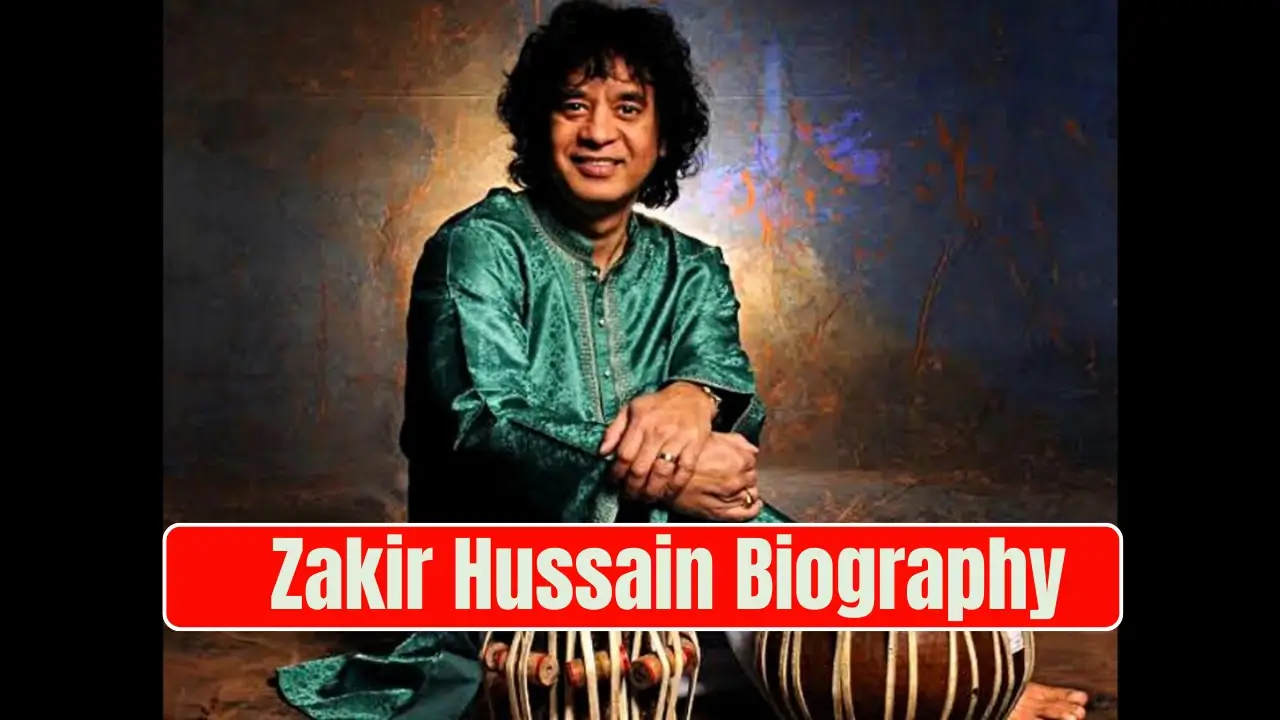
Read Zakir Hussain biography on farhanabhatt.com
| Category | Details |
|---|---|
| Full Name | Zakir Hussain Qureshi |
| Born | March 9, 1951 (Bombay, India) (Wikipedia) |
| Died | December 15, 2024 — San Francisco, USA (aged 73) (Wikipedia) |
| Profession | Tabla maestro, composer, percussionist, occasional film actor/score composer (Encyclopedia Britannica) |
| Parentage | Eldest son of legendary tabla player Alla Rakha (Encyclopedia Britannica) |
| Genres / Styles | Hindustani classical, jazz fusion, world music, cross-genre collaborations (Encyclopedia Britannica) |
| Renowned For | Exceptional tabla technique, globalizing Indian classical percussion, “dancing-fingers,” fusion collaborations (The Guardian) |
| Major Collaborations & Projects | Fusion group Shakti (with John McLaughlin & others), Planet Drum, collaborations with international artists like Yo‑Yo Ma, Mickey Hart, jazz & world-music projects. (Encyclopedia Britannica) |
| Awards & Honours | India’s top civilian/music honours (e.g., Padma Vibhushan in 2023, among others), multiple Grammy Awards (four-time winner, including wins in 2024) (Wikipedia) |
| Legacy | Widely regarded as one of the greatest tabla players ever, instrumental in bringing tabla & Indian classical percussion to global/world-music stage; left a lasting impact spanning multiple genres and generations. (ECM Records) |
Zakir Hussain transformed the tabla from an accompanying instrument into a solo voice. It could now stand alongside any instrument in world music. His legacy lives on through his recordings, his students, and the countless musicians he inspired across genres and borders. Ultimately, he proved that music could be a universal language. He brought together traditions from East and West to create something entirely new while honoring the ancient art forms that shaped him.
Early Life and Education
Born on March 9, 1951, in Bombay (now Mumbai), Maharashtra, Zakir Hussain Qureshi entered a family deeply rooted in musical tradition. His father, Alla Rakha Qureshi, was one of the most celebrated tabla players in Indian classical music history. Additionally, the story of Zakir’s birth holds special meaning in Indian music lore. According to tradition, his father whispered tabla rhythms into the baby’s ears instead of reciting a prayer. This moment marked the beginning of an extraordinary musical journey.
At age seven, his formal training in Hindustani classical music began. Each morning started with three hours of tuition. However, young Zakir’s education wasn’t limited to music alone. He studied at St. Michael’s High School in Mahim before graduating from St. Xavier’s College in Mumbai. Furthermore, his childhood was unique, shaped by both ancient traditions and modern influences. Before starting school classes, Zakir recited the Quran at a madrasa and sang hymns at a Roman Catholic church.
After college, he discovered the music of Jimi Hendrix and The Doors. Consequently, he considered becoming a rock drummer. This decision could have changed music history. Nevertheless, George Harrison, lead guitarist of The Beatles, soon dissuaded him. Harrison told him that, as a tabla player, he could combine Eastern and Western music to create his own unique sound.
Career
Early Performances and Rise to Fame
At age seven, Hussain started performing in concerts. By age twelve, he began touring. His first paid concert happened when he was 12. During his teenage years, he was already performing alongside India’s greatest musicians. These included sitar maestro Ravi Shankar, sarod player Ali Akbar Khan, and violinist L. Subramaniam.
In the late 1960s, Hussain moved to San Francisco. Then, in 1970, at age 19, he made his United States debut at the Fillmore East in New York. This happened when his father fell ill, and he performed with Ravi Shankar before continuing the tour. Soon after, he became immersed in the vibrant Bay Area music scene. In San Francisco, he joined jam sessions with the Grateful Dead. Moreover, he recorded with band members on the 1971 solo album by the Dead’s drummer Mickey Hart, “Rolling Thunder.”
Breaking Musical Boundaries
In 1973, Hussain founded the band Shakti (“Power”) with guitarist John McLaughlin. The group blended Hindustani classical music and jazz. This groundbreaking fusion captured worldwide attention. As a result, it helped introduce Indian classical music to Western audiences in an entirely new way. Over the decades, the band went through various formations. Eventually, it reunited in 2020 with new members.
Throughout his career spanning more than five decades, Hussain united musicians from diverse cultures. Simultaneously, he shaped modern world music. He worked with an astonishing range of artists across genres. Through the years, he performed and recorded with George Harrison, Van Morrison, Yo-Yo Ma, Pharoah Sanders, the Japanese drum group Kodo, Herbie Hancock and Charles Lloyd.
Teaching and Mentoring
Beyond performing, Hussain dedicated himself to teaching. At 19, he began teaching tabla at the University of Washington in Seattle. Later, he moved to Northern California to teach at the Ali Akbar College of Music in San Rafael. There, he led the Tal Vadya Rhythm Band, a cross-cultural, percussion-centered group. Subsequently, the Humanities Council at Princeton University named him an Old Dominion Fellow. During the 2005–2006 semester, he resided there as full professor in the music department.
His approach to teaching was revolutionary. Even his classical students received encouragement to extend the range of the tabla. He called it “a limitless instrument.” Notably, one of his students became the first tabla player to perform on Broadway. Another pioneered tabla in hip-hop rhythms and jazz.
Philosophy on Music
Regarding the purpose of music, Hussain held strong beliefs. In a conversation with author Nasreen Munni Kabir, he stated that he did not play at private gatherings, corporate events, or weddings. He believed that music should not be heard at events where people came to socialise, drink or eat. Instead, music should be the sole purpose of the event.
In 2015, Hussain told NPR that throughout his career, he had found similarities between rhythmists around the world. “We were all on the same wavelength, the same quest, looking for perfection, which we will never find. But that didn’t matter because it’s all about the journey — not the goal,” he said.
Zakir Hussain Book
Nasreen Munni Kabir compiled fifteen interview sessions from 2016 through 2017 into a book. Each session lasted about two hours. Published in 2018, “Zakir Hussain: A Life in Music” offers an intimate look at his life. The book describes his youth, years of intensive training, and development as a musician. Furthermore, it captures his philosophy, experiences, and insights into both Indian classical music and his groundbreaking collaborations across cultures.
Zakir Hussain Personal Life
At the Ali Akbar College of Music in San Francisco, Hussain met his future wife. He married Antonia Minnecola, a Kathak dancer and teacher who also became his manager. Together, they had two daughters, Anisa Qureshi and Isabella Qureshi. Anisa graduated from UCLA and is a film maker. Meanwhile, Isabella is studying dance in Manhattan.
Family was important to Hussain. He had two brothers: Taufiq Qureshi, a percussionist, and Fazal Qureshi, also a tabla player. However, the family experienced tragedies as well. Their brother Munawar died at a young age after being attacked by a rabid dog. His eldest sister Bilquis died before Hussain was born. Additionally, a sister, Razia, died from complications during cataract surgery, just hours before their father’s death in 2000.
Zakir Hussain Death
On December 15, 2024, Zakir Hussain died in San Francisco, California, at age 73. In a statement, his family revealed his cause of death was idiopathic pulmonary fibrosis, a chronic lung disease.
His family said, “His prolific work as a teacher, mentor and educator has left an indelible mark on countless musicians. He hoped to inspire the next generation to go further. He leaves behind an unparalleled legacy as a cultural ambassador and one of the greatest musicians of all time”.
A government minister declared him ‘irreplaceable’. As the son of legendary tabla master Ustad Allarakha, Zakir Hussain was widely regarded as the greatest tabla player of his generation. Many considered him a chief architect of the contemporary world music movement. Indeed, his contributions were uniquely transformative.
When Hussain died unexpectedly of a rare respiratory illness in December 2024, many saw him as the greatest and most consequential tabla player who ever lived. His influence extends far beyond his recordings and performances. Ultimately, he fundamentally changed how the world views Indian classical music and percussion.
Awards and Honours
Zakir Hussain’s extraordinary contributions earned him recognition across the globe. His awards represent some of the highest honors in both Indian and international music.
Indian National Awards
In 1988, the government awarded Hussain the title of Padma Shri. This was followed by the Padma Bhushan in 2002 and the Padma Vibhushan in 2023. The Padma awards are among India’s highest civilian honors. Notably, when the Padma Shri was announced for him in 1988, he was performing at St. Xavier’s College in Mumbai with Pandit Ravi Shankar. It was then that Pandit Ravi Shankar first addressed him as ‘Ustad’, the honorific title for master musicians.
In 1990, the President of India presented him with the Sangeet Natak Akademi Award. This made him one of the youngest musicians to receive this recognition from India’s National Academy of Music, Dance, and Drama. Later, in 2018, he received the Sangeet Natak Akademi Fellowship, a lifetime honor given to only 40 artists at a time.
Grammy Awards
Over his career, Hussain received nine Grammy Award nominations. He won four times, including three in 2024. His Grammy victories include:
- In 1992, Planet Drum, an album co-created and produced by Hussain and Mickey Hart, won the first-ever Grammy for Best World Music Album
- At the 51st Grammy Awards in 2009, the album Global Drum Project won the Grammy Award for Best Contemporary World Music Album
- At the 66th Annual Grammy Awards on February 4, 2024, Hussain became the first musician from India to receive three Grammys at one ceremony: Best Global Music Album for “This Moment,” Best Global Music Performance for “Pashto,” and Best Contemporary Instrumental Album for “As We Speak”
Additionally, he received two nominations for the 2026 Grammy Awards for his work with Shakti on “Mind Explosion (50th Anniversary Tour Live).”
International Recognition
In 1999, the National Endowment for the Arts gave him a National Heritage Fellowship. This is the highest award given to traditional artists in the United States. Then, in 2022, he received the Kyoto Prize, one of Japan’s most prestigious international awards. This acknowledged his contributions “to the cultural and spiritual betterment of mankind.”
Other honors included the Indo-American Award (1990), France’s Officier of the Order of Arts and Letters (2006), the Maharashtra Bhushan Award (2015), and the Aga Khan Music Award (2022). Furthermore, DownBeat Critics’ Poll voted him “Percussionist of the Year” multiple times.
Filmography and Soundtracks
While primarily known as a musician, Hussain also contributed to cinema. He played tabla on the soundtracks of Francis Coppola’s “Apocalypse Now,” Bernardo Bertolucci’s “Little Buddha,” and other films. For the Malayalam film “Vanaprastham,” a 1999 Cannes Film Festival entry, he composed, performed and acted as Indian music advisor. The film won multiple international awards.
He composed soundtracks for several movies. Most notably, these included “In Custody” and “The Mystic Masseur” by Ismail Merchant. He also starred in several films which showcased his musical performance. These included the 1998 documentary “Zakir and His Friends” and the documentary “The Speaking Hand: Zakir Hussain”.
Also Read: Ankit Sakhiya Biography: Meet Laalo: Krishna Sada Sahaayate Movie Director
Zakir Hussain Discography
Through the years, Hussain appeared on hundreds of albums. He was equally at home with Indian classical traditions and fresh multicultural hybrids. In 1991, he started a label, Moment Records, to release his classical and contemporary collaborations.
Notable projects include:
- Planet Drum (1992) with Mickey Hart
- Shakti albums spanning from 1976 to 2024
- Global Drum Project (2007)
- As We Speak (2023) with Béla Fleck, Edgar Meyer, and Rakesh Chaurasia
- This Moment (2023) with Shakti
- Tabla Beat Science projects merging tabla and electronics
He participated in many historic collaborations. These included Shakti, Remember Shakti, Making Music, The Diga Rhythm Band, Planet Drum and Global Drum Project with Mickey Hart, Tabla Beat Science, and Sangam with Charles Lloyd and Eric Harland.
Concerts and Performances
Throughout his career, he played more than 150 concerts a year until recently. To every performance, he brought an eagerly attentive presence. He beamed as his hands flew over his tabla drums to deliver fleet, microscopically precise beats and melodic tones.
In April 2009, Carnegie Hall honored his extraordinary contributions to the music world with four widely heralded, sold-out concerts at their Artist Perspective series. His performances became legendary for their technical brilliance, emotional depth, and ability to connect with audiences across cultural boundaries.
Musicians who performed with him consistently praised his unique gifts. Béla Fleck said Hussain made him a better player: “I call it the Magic Carpet Ride. His sense of time was so delicate and fine I could just relax. We could just sail”.
Also Read: Indian Actress Shraddha Dangar Biography